Monday, March 26, 2018

Hillside's Palliser Homes

The Hillside neighborhood has some of the most ornate homes in the city. Developed during the late 1800s and early 1900s, Hillside was home to Waterbury's wealthiest residents: factory owners and upper management, bankers and financiers, attorneys and judges, real estate developers, and business owners.

Although most of the houses were built for families, some were built for the unmarried daughters of industrialists. One such house, on Hillside Avenue, was built for Mary L. Mitchell, a widow whose brother, Charles Benedict, built a mansion for himself right next door.

The architect for both houses was Palliser, Palliser & Co., a Bridgeport-based firm that specialized in "cottages." During the late 1800s, the term cottage was used to describe the Queen Anne or stick style, no matter how large or grand the house might be.

House and floorplans from advertising brochure
for Palliser's New Cottage Homes, c. 1888.
This house was built in Peekskill, NY.


Sunday, March 25, 2018

Library Park History

Plans to renovate Library Park were announced this weekend (Rep-Am, 23 March 2018), so it seems fitting to spend some time delving into the park's history.

Library Park was created during the 1890s and expanded during the early 1900s. The expansion was part of a civic improvement project that eventually led to the redevelopment of all of Grand Street. Cass Gilbert, the architect for City Hall and four neighboring buildings constructed for the Chase family, worked with the Olmsted Brothers landscaping firm to beautify Library Park during the 1920s. The most recent improvement to Library Park was the installation of the Harrub Performing Arts Pavilion in 1985. Library Park's history begins, however, with a colonial-era burying ground.

Library Park in 1899, when the park was a rectangle extending straight back from Grand Street. There was a steep drop-off to a low retaining wall which isn't shown in this map. Hall, Livery, and Cedar Streets were removed during the early 1900s, making room for an enlargement of the park. (Detail of a map in the collection of the Library of Congress)


Monday, February 19, 2018

Gordon Webster Burnham

Gordon W. Burnham (1803-1885) was born and raised to be a farmer in eastern Connecticut, but instead wound up as one of Waterbury's most successful and wealthiest brass magnates, rubbing shoulders with Cornelius Vanderbilt and marketing Waterbury's brass products to the world.
Gordon W. Burnham
Published in The Town and City of Waterbury, Volume II


Sunday, February 04, 2018

Train Line History

One of the key assets that helps draw people to Waterbury is the train line connecting us to Bridgeport and New York City. Speaking as someone who relied on the train line to get me to my job in NYC for two years, I can't emphasize enough how essential the train service is, and how we very much need to see improvements to the train line. We need more daily trains, and we need express service trains during rush hour to make it easier for commuters to choose the train over their cars.

The Waterbury train station platform, 2018.


Unfortunately, due to the ongoing state fiscal fiasco, the Department of Transportation has suggested reducing, maybe even eliminating, the train line between Waterbury and Bridgeport, as well as the other branch service lines for New Canaan and Danbury. A little bit of history regarding the main line illustrates how potentially devastating this could be, and a longer bit of history regarding the branch lines illustrates what we've already lost.


Saturday, January 27, 2018

Waterbury's Trotting Parks

Trotting parks were a 19th century feature of New England life, offering the owners of standardbred horses a track for races. The racing circuit included Waterbury, Hartford, Putnam, and various other locations throughout New England.

The earliest documentation (found so far) of a trotting park in Waterbury is the 1879 Waterbury atlas, which shows the Jefferson Trotting Park on land owned by Matthew Lynch. The location is approximately where the Waterbury Screw Machine Products company is today on Thomaston Avenue. In 1879, there was no road, only the railroad. There was also a reservoir that has long since been drained.

G. M. Hopkins, Atlas of the City of Waterbury, Conn., 1879, Plate T
(Collection of Silas Bronson Library)

Thursday, January 04, 2018

Cyclone Bomb Day

Remember when winter storms were called things like nor'easter or blizzard? Things were so much simpler back then. At any rate, today we were hit with a small blizzard which dumped about a foot of snow on Waterbury. The Governor asked everyone to stay off the highways, and almost everything was closed.


A flock of about 50 sparrows spent the day in my yard, gobbling up bird seed.


Saturday, November 04, 2017

Election Guide 2017


Tuesday, November 7 is Election Day in Waterbury. Local elections are notorious for low voter turnout. The public is constantly bombarded with national politics, while it takes a bit of effort to keep up with local politics.

Election experts anticipate only about 10-12,000 people will vote in Waterbury next week, in a city of 110,000 people and roughly 60,000 registered voters. Barely one-sixth of the voters are expected to show up to vote.

I've prepared the following guide for anyone who's not sure what's going on with this election, who the candidates are, or where to go to vote.

If you care about where you live, please take the time to learn about the candidates and vote on Tuesday.


Sunday, October 22, 2017

Open Studio for On the Trail of Calder

Since October 2, a group of five artists from Italy have been working in an old factory on Freight Street, creating artwork inspired by Alexander Calder. The end result will be installation of five new sculptures in downtown Waterbury. Today was the Open Studio at the factory, giving the public a chance to preview the work and meet the artists.

Artist Eduardo Giannattasio greeting new arrivals to the studio. Giannattasio came up with the idea for the project, recruiting local resident Ann Marie Somma to help make it happen.

Tuesday, October 03, 2017

Militia History

The following article was originally published in The Waterbury Observer in 2013. I am posting it here in the wake of the Las Vegas massacre and in response to the many people who don't seem understand what our nation's founders meant by "well regulated militia." My article focuses on what was meant by "militia," but please note that the Second Amendment is all about being "well regulated" -- that means enacting laws to control access to weaponry. It does not mean allowing every random guy with issues to have unregulated access to weapons of mass murder.


Sunday, September 24, 2017

The Gathering in Library Park 2017

If the whole world got together for a party, it might look something like this. This was the fifth year of The Gathering, celebrating the many cultures that make Waterbury a wonderfully diverse city, with music, dance, food, and more.

It was hot in the sun, so the Italian ice vendors probably did very well.

The Gathering Parade 2017

Another year, another fabulous Gathering in downtown Waterbury! This annual festival celebrates the many different cultures that have found their way to the Brass City throughout its history. The event's slogan is "We all came from somewhere, now it's time to come together."

As in the past, I've divided up my photos into two blog posts: one of the parade, and one of the celebration in Library Park.

Lining up on East Main Street -- Dominican Republic

Sunday, September 10, 2017

#IBelieveInWaterbury and The Valley Girls

#IBelieveInWaterbury is the title of a new exhibit at the Mattatuck Museum, on view until December 3. The art is installed throughout the building, rather than being condensed into a single space. The result is that visitors find themselves on a sort of treasure hunt, looking for artwork inspired by Waterbury throughout all three floors (plus two mezzanine stairwell levels, a rooftop, and the front lobby).

The museum spent several months recruiting artists from near and far to participate, arranging special tours of Holyland, Rose Hill, and several churches to help inspire the artists. The final submissions were sifted through by a trio of jurors, who wound up selecting the work of 40 artists for the show. Below are some of my favorites.


Thursday, August 03, 2017

More on the Whipping Post

There has been a tremendous amount of public controversy about the post on the Green. Although many people seem to be picking and choosing facts that support their strongly held opinions, others have been more open-minded and are genuinely interested in learning more. Since this is such a widely-discussed topic, I've spent some time doing more research. Please be aware that the research is not completed: there are thousands of archival documents to sift through, photographs to compare, decades of newspaper articles to browse on microfilm, and scientific analysis of the post (just for starters). That level of research is not something I can undertake, since I'm doing this in my free time. It's the sort of research project for which a museum or historical society can get grant funding, or which a grad student might undertake for a dissertation.

The post on the Green in 2017, about a week before it was removed.


Monday, July 17, 2017

Whipping Post on the Green

There was a demonstration on the Green last week. I didn't see it myself, but photos have been showing up on Facebook. The issue in question is the controversial presence of the potentially centuries-old whipping post on the newly renovated Green. While many people have forgotten its original purpose and saw it as an innocent piece of history, in use as a bulletin board for centuries, others clearly recognized it as more than just a public notice board.

Photo from Jesus Papers' Facebook page, posted July 15, 2017.

The demonstration was performance art, as you can see from the photo, one of several circulating on Facebook right now.

Thursday, June 29, 2017

Early Female Physicians

Harriet Judd Sartain (1830-1923) is today remembered primarily for her work in homeopathic medicine in Philadelphia, but she was also the first woman with a medical degree to practice in Waterbury, returning here after finishing her education in 1854. She was one of two Connecticut women to earn medical degrees from the Female Medical College of Pennsylvania in 1853; the other was Ellen Boyle of Farmington. They were the first women from Connecticut to attend that college and may very well have been the first two women from Connecticut to earn medical degrees. Sixty years later, Judd Sartain was hailed as "the pioneer woman physician of America."


Forest City (SD) Press, 22 July 1914
Courtesy of Chronicling America

Sunday, June 25, 2017

Community Cleanup at Scovill Homes

There are people who sit around complaining about problems, and then there are people who dive right in and solve the problems. Today was a good day for the problem-solvers in the Scovill Row Homes.

Saturday, June 10, 2017

ACT For America Protest in Waterbury

A group called ACT for America organized "March Against Sharia" protests in two dozen cities around the country. The protest in Connecticut was held in front of Waterbury's City Hall. A counter-protest was held in front of the Silas Bronson Library.

The scene at City Hall just after 10 a.m.

Friday, June 02, 2017

Waterbury Democrat Newspaper

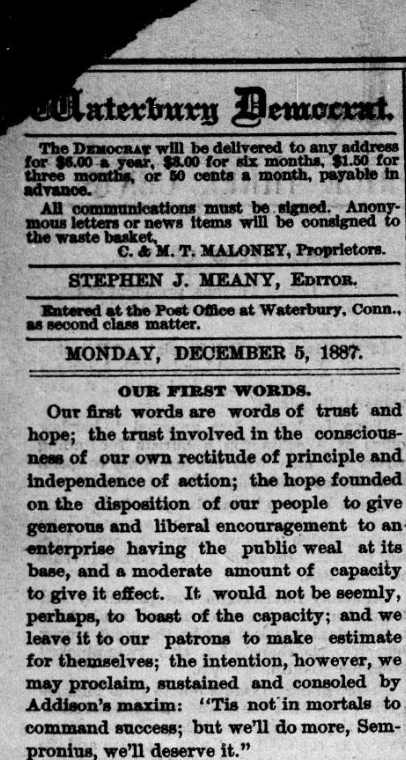
The Waterbury Democrat began in July 1881 as a weekly newspaper called the Valley Democrat in Waterbury, Connecticut. The newspaper became The Sunday Democrat on January 7, 1886, and The Waterbury Evening Democrat on December 5, 1887. Founded by an Irish Catholic Democrat, Cornelius Maloney, the Democrat was known for its promotion of the Democratic Party’s principles and for its coverage of Irish and Catholic topics. The paper focused its local reporting on Waterbury news and sports, along with a column for the neighboring towns of Naugatuck, Oakville, and Watertown.

Irish Catholics made up approximately half of Waterbury’s population at this time. The city’s first Irish immigrants arrived during the early 1830s. By the 1880s, they had largely overcome discrimination from the city’s Protestant community and were establishing themselves as a formidable force in local politics.

Cornelius Maloney was joined by his brother, Michael Thomas Maloney, in 1882, establishing the publishing firm name C. & M. T. Maloney. The Maloney brothers learned the printing and newspaper business in New Britain. Cornelius apprenticed with Oviatt & Guernsey, and later worked for the New Britain Record and the New Britain Observer before moving to Waterbury. He served as a Representative in the Connecticut General Assembly in 1887 and 1888, and he was the founder and first Grand Knight of the local Knights of Columbus, Sheridan Council, No. 24.

Editorial, Waterbury Democrat, 1887
Courtesy of Library of Congress Chronicling America


Sunday, January 29, 2017

Early Muslim Immigrants in Waterbury

Waterbury was one of the first places in the United States to become home to a community of Muslim immigrants, when Albanians began arriving a few years before World War I, fleeing war and massacres.

Although Muslims have lived in the United States throughout the entirety of the country's history, it was not until the twentieth century that sizable Muslim communities were able to establish themselves and thrive. The first recorded instance of communal prayers being held by American Muslims happened in 1900 in North Dakota.

Waterbury had one of the first mosques in the United States, established by the Albanian community in 1919. Earlier mosques included ones in North Dakota and Michigan in 1912 and Biddeford, Maine in 1915. Waterbury's mosque may well have been the fourth mosque to be established in this country. I have found very little information about it. By the 1930s, it was gone, but Waterbury's Albanian Muslim community would continue to grow as new wars and political oppression forced more people to flee their homeland.

Albanian American Muslim Center on Raymond Street, built in 1969.


Sunday, January 22, 2017

Waterbury at the Women's Marches

I'm doing something a little different with this post. I wasn't able to attend the Women's March yesterday, but I noticed many of my friends did. I reached out to some Waterbury people who went and asked them to share photos of the event and their reasons for attending. I want to make sure the Waterbury experience of this national historic event is preserved (because that's what historians do).

There's still time to participate in this blog post. If you're from Waterbury, send your photo(s) and reason for participating in the Women's March to waterburygirl@gmail.com and I will add them to the post. [Latest update: Tuesday, January 24, 2017]

Women's March in Hartford. Image courtesy of Robert Goodrich.