Showing posts with label Education. Show all posts

Tuesday, February 02, 2021

Public Schools, 1674-1868

There’s been some ongoing debate about forgiving students loans and making college free, which piqued my interest in the history of public education. We often assume that what we have now is what has always existed, but of course that’s not true. When Waterbury’s first public high school opened in 1851, it wasn’t free. In fact, legislation protecting the right of all children to attend any public school in Connecticut regardless of income or race didn’t exist until 1868. Earlier laws in Connecticut attempted to guarantee that children who had jobs would still get a basic education, but those laws weren’t always enforced.


Waterbury's first High School
From Richard Clark's Map of Waterbury, 1852


Nineteenth-century advocates for free education argued that it was in everyone's interest to ensure that all children could get the best education possible, that no one should be deprived of fulfilling their potential. Thanks to their advocacy, education is free through 12th grade.

Wednesday, August 26, 2015

Almost Home Wins CCF Trustee Award

Last week, on August 20, the Connecticut Community Foundation (CCF), based in Waterbury, held its first annual Trustee Award Ceremony at South Farms in Morris. They honored two organizations that embodied partnership and collaboration, core values of the Foundation. One of those two organizations was the Almost Home Summer Camp program, started this year in the WOW neighborhood.

Thursday, July 02, 2015

Summer Camp Launch

Sometimes it seems like there is more energy spent on complaining about problems than on solving problems, so I'm always delighted when I see the problem solvers shine.

Erika Cooper is one of Waterbury's great problem solvers. She's a Scovill Row Homes/WOW neighborhood resident, and my neighbor, so I'm extra pleased to see how much she's accomplished in the past year. Last fall, after a series of shootings rattled the neighborhood, and after discussing fears for their children with other parents at the school bus stop, Cooper formed the Uplift A Life Parents Committee. The group led a march and rally against the violence last September.

Preparing to march through the neighborhood on September 28, 2014.

Since September, Cooper has organized regular neighborhood cleanups for the neighborhood kids, building pride and teaching them the importance of contributing to their community, that they have the power to make things better. As she said today, we have to care--if we don't care, no one else will.

Saturday, September 08, 2012

Back to School Block Party

Here are a few photos from this afternoon's Back to School Block Party at the WOW Community Learning Center. Every so often it would rain, but that didn't dampen the mood!


Hot dogs and hamburgers on the grill


Bouncy House!


Info table for GEAR UP

 GEAR UP is a new federally-funded grant initiative announced by Governor Malloy earlier this year. The program is designed to help low-income students prepare for college.


5th District candidate Elizabeth Esty stopped by


Board of Education Commissioner Elizabeth Brown was in attendance.
And, of course, Alderman Greg Hadley, who runs the WOW Center.


Jon Clyde D'Angelo rapping with the students.

The performance was introduced by two of Waterbury's 3rd grade teachers, which was great. You know a teacher really cares about his students when he volunteers to spend his Saturday with them.

Sunday, April 22, 2012

Taking a Bite Out of Blight

Educating youth is a big part of Mayor O'Leary's anti-blight plan. Following the example set by PAL, in which children began taking pride in picking up litter instead of just walking past it, the Blight Task Force held an Anti-Blight and Litter Slogan Contest in February.

The winners of the contest were announced and the new slogan and logo were unveiled last week:

Mosies Vega, Rotella Magnet School, Grade 5 - Slogan Contest Winner

Fatime Kaliki, Wallace Middle School, Grade 6 - Slogan Contest Finalist

Katherine Abreu, Crosby High School, Grade 10 - Slogan Contest Finalist

Tye Proctor, Crosby High School, Grade 12 - Logo Design Winner


Photo from Mayor O'Leary's Facebook page.

The slogan and logo will be used in school literature, on posters, t-shirts, bumper stickers, billboards, and city buses.

This is an important step in creating a culture of cleanness. Our city's children are growing up surrounded by blight and litter. Picking up litter is not instinctive. By teaching our children that it's not okay to ignore litter, that keeping things clean is a good thing, they will be less likely to litter, and our city's future will be a little brighter.

Wednesday, December 21, 2011

Blight Update

I attended a meeting this morning at City Hall convened by Mayor O'Leary with representatives from key city departments, Board of Education, Board of Aldermen, WDC and community leaders. The topic: Blight.

When the Republican-American first reported that there was interest in relocating the Walsh School students to the new Jonathan Reed School, I was not happy. While I absolutely agreed that the Walsh students should have the best educational facilities, I was horrified at the concept of abandoning the school. If a neighborhood is blighted and the city decides to give up on it, the neighborhood will become a war zone/slum/ghetto/whatever you want to call it. Closing the school will make the neighborhood worse. Yes, the students would be attending school in a new building, but they would still be living in the old, blighted neighborhood, which would disintegrate rapidly. If the neighborhood blight is a problem for the school and the students, the only solution is to clean up the blight. If the school building needs repairs and upgrades, make that happen too.

I was very happy to read yesterday's article, in which the Mayor and the School Superintendent both supported improving the neighborhood and the school, rather than giving up on them.

The meeting this morning was the first of many. I wasn't sure what to expect. I've grown accustomed to city meetings in which everyone sits around debating what to do, complains about the problems, and then nothing ever gets done. This was not that sort of meeting. This is not that sort of Mayor.

Mayor O'Leary made it very clear that it is time for change, time to change the culture, time to change the tactics, time to change the attitude. He expects everyone, city employees and city residents, to roll up their sleeves and work their hardest to turn this city around. As he said, when you walk through neighborhoods like the one surrounding Walsh School, you can feel overwhelmed by the problems and not know where to start. I'd say, based on today's meeting, he's going to take on all the problems at once, building a strong team of people to make it happen.

He has encouraged everyone to be creative with their solutions and to be willing to try new things. He wants to end the culture of negativity, of people saying things can't be done, that problems can't be solved. He asked each department head present to come up with some specifics on improving the city's response to the blight problem, and he asked the community leaders present to make sure the residents do their part as well. He made it pretty clear that he expects everyone to work hard, find positive solutions, and give it all they've got. Leadership in action!

I don't want to sound like I'm back in campaign mode (I'm not), but this was a great meeting.  During the campaign, every so often someone would ask me if O'Leary really was going to follow through on his promises to clean up blight, etc. It's not going to happen overnight, but it's pretty obvious to me that this city is about to get a whole lot better.

Monday, July 18, 2011

Candidates Forum

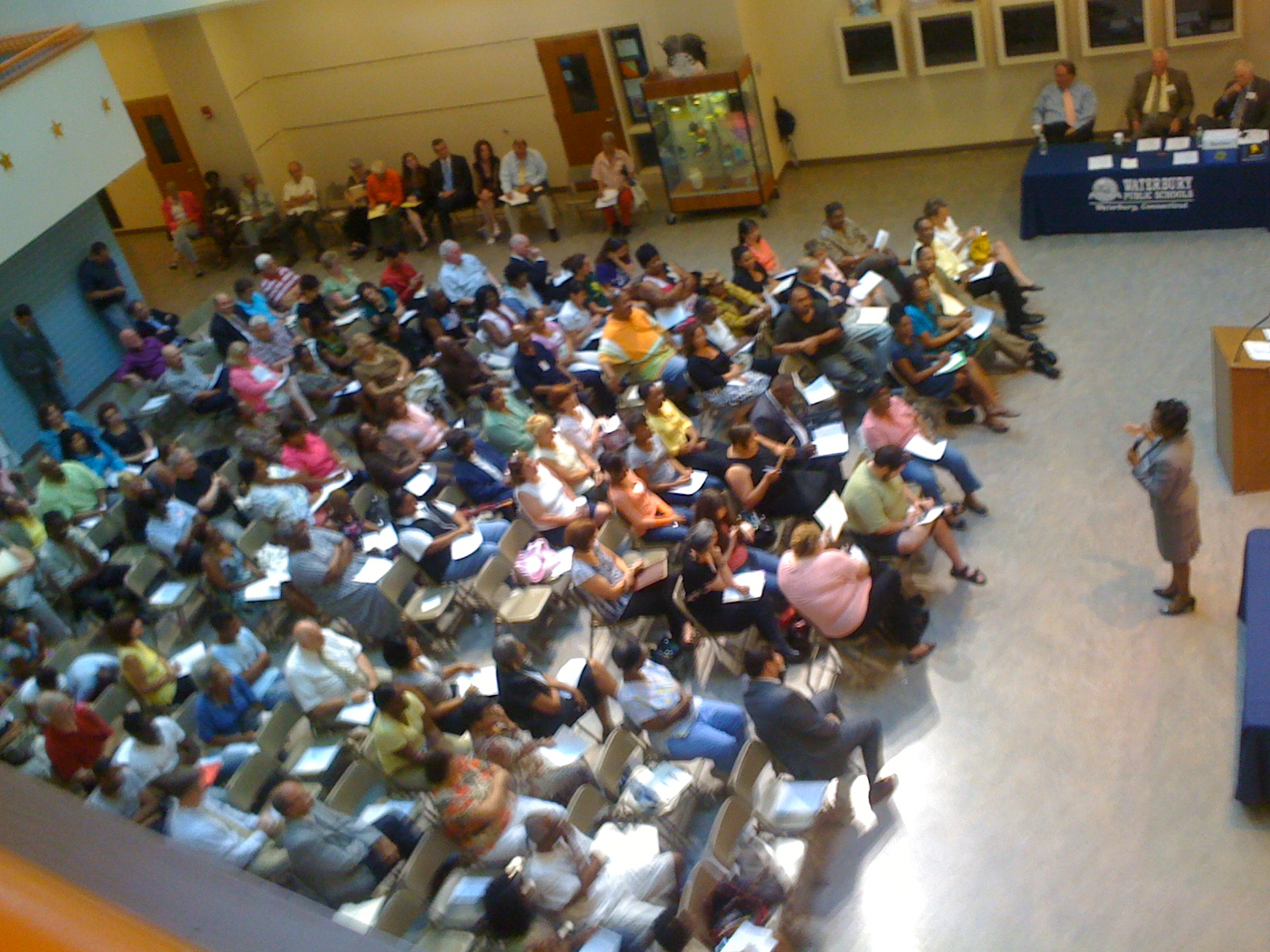
Tonight the Board of Education held the public forum for the three finalist candidates for the Superintendent position. After several revisions, the format was as follows: the candidates were presented one at a time, spending about ten minutes introducing themselves, then roughly 45 minutes answering written questions submitted by the audience before the program started. I thought the forum was very good. We were able to get to know the candidates much better, and we were given evaluation forms to fill out along the way and submit at the end.

The program was scheduled to start at 5:30, and anyone who wanted to write a question was asked to arrive at 5:15 (but they continued to collect questions until about 5:40).

The room at 5:15, seats filling up fast.


There were many supporters of Portia Bonner in the audience. By luck of the draw, she went first. You can see some of the audience in the photo below--there were many extra seats being set up just after 5:30, out of shot in the photo, and there were a dozen or so people watching from the balcony. Definitely a standing-room only event.


Anthony Mazzullo was the second candidate to "interview" with us...


...which meant Kathy Ouellette was the last. The entire program lasted until 8:30. Kudos to everyone who stayed through the whole thing (those chairs are not the most comfortable ones to sit in for three hours!).


Although everyone in the audience was pretty tired by the end, there were quite a few interesting conversations about the educational issues raised. One major issue to be discussed was the importance of standardized test scores. Mazzullo and Ouellette were polar opposites on the topic. Mazzullo feels that there is too much emphasis placed on test scores, whereas Ouellette seemed to be a firm believer in basing all action on test score data. I'm not a big fan of test score data, since I rarely tested well. Certainly tests can be an indicator of progress or lack thereof, but information needs to be acquired from other sources. For example, surveying college professors to find out what skills are consistently missing from students coming from the public schools could be very helpful.

I'm not going to try to cover the entire Q&A at the forum (in fact, I missed a chunk of it when I had to step out to a meeting of the Hall of Fame committee). But for more information, you can check out Bryan Baker's Twitter feed. There will also be a write-up in the Republican-American.

Tuesday, July 05, 2011

Poor Communication

[UPDATE 7/7/11: As announced in today's Republican-American, the format for the July 18 forum has been changed due to public demand. Anyone in attendance will be allowed to ask questions of the three candidates.]

The search for and hiring of the next Superintendent of the Waterbury schools has been an increasingly hot-button topic. On June 29, the Republican-American ran an article with the headline "School chief search: Don't ask." In the article, we were informed that the final hiring decision will be made public on August 8 and that there will be a public forum on July 18 at which only a select few will be allowed to ask questions of the three finalists. Nowhere in the article was information about how the members of the public who will be allowed to speak will be chosen, just a passing mention of having already chosen people who had previously expressed interest.

At tonight's Board of Education meeting, it was announced that anyone who wants to meet with the three candidates and ask them questions at the July 18 meeting should leave their name with the Board of Ed at the end of tonight's meeting, or call the Board of Ed office first thing tomorrow morning. Letters informing people that they have been selected to ask questions will be mailed out tomorrow (Wednesday).

This was the first I had heard of this process. I double-checked with some friends who have been following more closely than I have, and they knew nothing about this either. I checked the Board of Ed webpage and the public schools' website. Nothing.

Those of us in attendance tonight were somewhat tersely reprimanded for not showing up to earlier meetings to discuss the hiring of the Superintendent, and we were somewhat tersely reprimanded for complaining that the hiring process has not been public enough. There may not have been any intention to keep information from the public, but that definitely is what has happened.

We live in an age of amazing communication. Many of us spend a ridiculous amount of time online and expect to be able to get whatever information we need from the internet. I even stopped buying printed newspapers years ago and have online subscriptions instead. Between blogs, Facebook, Twitter and the city's website, there are many easy ways in which the public can be accurately informed and updated. They are also good ways to engage the public more.

If the public tells you that you haven't been keeping them informed, maybe it's time to update your communication methods.

If you would like to ask questions at the July 18 forum, call Carrie Swain at 203-574-8009 tomorrow, Wednesday, July 6. After that, it will apparently be too late.

Monday, June 27, 2011

UConn Dedication

Today I enjoyed the privilege of seeing a project I worked on come to its conclusion. Way back in 2006, I became part of the committee to select an artwork for the UConn-Waterbury campus. (At the time, I was teaching Art History and Art Appreciation there (I wish I still was!), which is how I wound up on the committee.) Today, the University dedicated the completed artwork and surrounding courtyard.

People mingling before the ceremony.

The sculpture incorporates metal and water, both symbolic of Waterbury. The artist, Barton Rubenstein, sees the different tall sculptural elements as being also symbolic of the UConn students.

Barton Rubenstein's Synergy, without the water feature turned on.

The weather was perfect--so glad the rainy weather finally went away!


It was nice to see many people I know at the event. There were quite a few people present. Many were headed across the street afterwards for the Osher fundraiser event at the Palace Theater. The Osher Life Long Institute program is a real asset for Waterbury, as is UConn itself.


When I taught at UConn-Waterbury, I started every semester by challenging my students to think about what is art. I took them to view the courtyard and asked them if they could identify the tromp l'oeil (fool the eye)"artwork" in front of them. Can you see it in the photo below?

Barton Rubenstein speaking in front of his sculpture, Synergy.

The retaining wall in the back of the courtyard, which looks like a natural rock wall, is actually a concrete wall shaped and colored to look like rock. It's not intended to be seen as an artwork--in fact, it is successful only if the viewer takes for granted that it's natural rather than entirely man-made. It's great for getting my students to start thinking about the definition of art.


Back to the ribbon-cutting ceremony.... speeches were given by Bill Pizzuto, Executive Director of the Waterbury campus, Joan Hartley, State Senator for the 15th District, and Susan Herbst, the new President of UConn.


After the ribbon-cutting, the waterfall portion of the sculpture was turned on. It's a great artwork, well-worth visiting, and a great addition to the courtyard.

Saturday, February 26, 2011

Bus Schedules

I've written on this topic far too many times. Public transportation is essential to a healthy, thriving city. It is also good for reducing pollution and traffic. It seems like a no-brainer to me, but here in Waterbury our public transportation system is woefully inadequate.

Naugatuck Valley Community College recently put out a press release explaining the need for better transportation for their students, including the following information from a recent survey:
  • 33% of students surveyed have been unable to take a class
    because of difficulty getting to NVCC
  • 48% of students surveyed would use evening bus service to take a
    night class at NVCC
  • 66% of students surveyed report knowing someone who would attend
    evening classes at NVCC if public transportation was available.
They also explain the massive conflict between the bus schedules and their class schedules: "
The college currently offers classes from 6:30 am – 10 pm. Buses stop at the College between 6:40 am and 5:40 pm."

When I was a college student up in Massachusetts, the Five College system (UMass, Amherst, Smith, Mt. Holyoke and Hampshire) actually subsidized the public buses during the school year, so that students could get to classes at any campus for free. 

The current proposed state budget will cut funding to our community colleges by 5.9%, so that involved a collaboration between the area colleges and the bus company is probably out of the question. But surely the bus company would benefit financially from providing better service to the college campuses (not just NVCC) throughout Waterbury. 

Thursday, January 13, 2011

The N-Word

The latest controversy in the Waterbury schools (I say "latest" because it seems like there's a new controversy almost every week) involves the use of the n-word in a play which will be performed at the Waterbury Arts Magnet School. The controversy has reached the notice of The New York Times, which wrote about it in the ArtsBeat blog.

The play in question is August Wilson's "Joe Turner's Come and Gone," the second installment in The Pittsburgh Cycle, which the Pulitzer Prize winning author wrote to chronicle the African-American experience decade by decade. When it opened at the Yale Repertory in 1987 and again on Broadway in 1988, the cast included Angela Bassett, L. Scott Caldwell and Delroy Lindo (who earned a Tony nomination).

Wilson's play uses the language of the early 20th century, because it is a historical drama. Unlike the pop culture stars of today's world, Wilson uses the n-word to remind us (and for kids, to teach them) why this word is so unpleasant and disturbing. Wilson grew up in Pittsburgh and, according to a short biography, he had full experience of being called a nigger by racists who used the word to intimidate and demean him. That racism led him to drop out of high school, choosing instead to study on his own. His use of the n-word in this play is necessary for both historic accuracy and to convey the racism that was rampant at the time.

The average teenager today hears the n-word constantly, in music and in everyday speech. I have overheard young children calling each other niggers, and referring to themselves as niggers. I have heard it used by adults wanting to sound "cool". This is the youth culture today.

I'd much rather have the kids at the Arts Magnet School learn about the history of the word through this play than to continue to use it blindly in everyday speech.

The controversy that has arisen will potentially have some benefit. The kids performing the play are now acutely aware of what a powerfully negative word it is. And they are probably learning a thing or two about censorship in a country that constitutionally protects freedom of speech.

Sunday, December 27, 2009

Schools and Prosperity

Over the years, I've been involved in numerous discussions about how to improve Waterbury, how to make the town more prosperous and a desirable place to live. At the moment, I am visiting family in Manhattan Beach, California (Los Angeles). When they bought their house here 20-some years ago, it was a very small, single-story home without basement, attic or garage. Every other house in town was the same, and they were all very affordable.

Since then, the town has grown considerably. The majority of those small houses have been rebuilt as large two-story houses with attics, basements and garages. The desirability of the town has soared and the housing prices have gone up accordingly, with only three dozen homes (including condos) currently listed on Yahoo's real estate site for less than one million dollars (and 162 properties listed between $1 million and $7 million). Granted, some of that inflation is due to the overall real estate bubble of recent years, but it is indicative of how much the town has changed.

I was thinking about the transformation I've witnessed over the decades and wondered what caused it (and, of course, how we might implement something similar in Waterbury). One important contributing factor was the quality of the schools. The real estate market became increasingly competitive because there were so many parents trying to get their kids into the schools. If you visit www.greatschools.org, you'll see that the highest-ranking Manhattan Beach public schools are rated 10 out of 10 points, whereas the Waterbury public schools range between 1 and 5 (very low scores), with Rotella getting the only 6 and Kaynor Tech the only 7. (On a side note, this answers some questions I've heard from people wondering why Kaynor Tech is so popular and why so many of its students are college-bound, rather than going straight into the work force).


The newly-rebuilt Kaynor Tech high school,
Waterbury's highest-rated school


This is by no means a comprehensive or even scientific analysis, but I think this is definitely something that does make a difference in a town's prosperity, not only because having the best schools will make Waterbury more desirable, but because better schools will give Waterbury's students better educations, and we will all benefit from that.

Alan Stein, a professor at UConn-Waterbury, wrote an excellent letter to the editor that appeared in yesterday's Rep-Am newspaper. The focus of his letter was an argument in favor of electing aldermen by district (which I strongly support), but he also wrote a very good observation about the Board of Education:

Some may question whether it's even appropriate for a Board of Education to be an elected body.

The political nature of that board is probably partly responsible for the recent attempt of some of its members to force school principals to ignore the Constitution.


I think that our Board of Education is fundamentally flawed, and I think that Prof. Stein is probably correct in assigning part of the blame to its political nature. Given the less than wonderful ratings of our schools (not just from the Great Schools website), the sole focus of the Board of Education should be searching for ways to make the schools better and implementing those improvements. Instead the Board seems to spend its time squabbling and grandstanding over Christmas parties vs. Winter Celebrations, the Duggan School construction project, and problems with the management of the school buses.

Our schools are some of the lowest-rated in the country. Let's make them the highest-rated.

Friday, December 11, 2009

Religion 101

I'm probably going to get some flak for this one, but I think it's time for me to dive into it.

There's been a lot of controversy and anger over the "news" that Walsh Elementary School principal Erik Brown has supposedly banned Christmas (he hasn't). According to the Republican-American, he has received hate mail from people all over the country. This raises my first point: if you are upset by the idea of Christmas being banned in a public school, the correct Christian response is not one of hatred. Sending threatening or hate-filled letters or calling to swear at Principal Brown is the exact opposite of the spirit of Christmas.

Second point: Principal Brown has not banned Christmas. He has instead assessed the demographics of his school and determined that overloading the kids with Santa Claus and other trappings of Christmas would be a problem for many of them. For example, many of the children at Walsh come from Jehovah's Witnesses families who are deeply offended by the commercialization of the Holy Day. Let's also not forget that not everyone in Waterbury is a Christian--we have, for example, many Jews and Muslims who might not appreciate having their children indoctrinated in another religion. Principal Brown's course of action, to have a winter celebration that is inclusive of more than one holiday tradition and to discourage the teachers from placing too much emphasis on a single interpretation of one religion's traditions, is a very good way to show respect towards the religious sensibilities of all the children in his school.

John Theriault has been up in arms over the issue, apparently thinking that Brown is somehow being unfair to the children at Walsh school because the other schools all have Christmas parties. I can only assume that he is forgetting about the children whose parents do not allow them to attend Christmas parties, and is oblivious to the fact that Brown is simply showing respect towards those children and their families.

I guess I am blogging about this topic because I am shocked at the level of public outcry over it. In every instance, it seems that people with no children at Walsh are reacting as if they personally have been prevented from enjoying their own Christmas celebrations and have forgotten just how much religious diversity there is in the world, in the United States, in Connecticut and in Waterbury. I guess I am also struck by how some of the people who are angry at Principal Brown are behaving far more like the Grinch than he is.

Come to think of it, let's take the metaphor of the Grinch one step further. The point to The Grinch was that the trappings of Christmas, the gifts, the trees, the roast beast, are completely unnecessary. Christmas exists in our hearts and is celebrated in the way we treat one another. Everything else is superfluous.

Sunday, November 08, 2009

Support the Schools

Stop & Shop, which has three stores in Waterbury and a fourth just over the line in Watertown, has a great program that makes it easy for you to help provide a little financial support to Waterbury schools. The A+ Bonus Bucks program donates money to the 3 schools of your choice (among those that are registered); the amount of the donation is connected to a point system based on how much money you spend at Stop & Shop.


In order to join the program, simply go to the website, register your Stop & Shop card (type in the numbers from the bar code), and select the schools. Simple as pi!

Wednesday, October 14, 2009

Grammar Problems

Two years ago, and again this year, I have been struck by and giggled at the gross grammatical error on the Jarjura campaign signs. The phrase is: Jarjura - Still the "right" choice.

Now, I understand why right is in quotation marks. It's intended as a reference to Jarjura having once been a write-in candidate. However, it looks ridiculous to anyone who knows grammar.

When a single word is placed inside quotation marks, the quotation marks imply irony or reservation. Specifically, when placed inside quotation marks, the implication is that the opposite is true, that Jarjura is not the right choice.

I was a little dismayed to see the grammar mistake reappear this year. It's a minor error, but in a city with struggling schools, it's very embarrassing to see our incumbent mayor make such an error.

The Jarjura ad which ran in today's Rep-Am got rid of the error by switching the slogan to Now the Best Choice, but instead put quotation marks around Proven Record, implying that he doesn't have a proven record, and added the grammatically foolish statement And Mayor Jarjura and his Democrat Team DID NOT RAISE YOUR TAXES IN 2010. Of course they didn't. 2010 hasn't happened yet, therefore that statement is impossible (and confusing for future historians!). Presumably the statement was intended to refer to the city's most recent budget, but that is not specified.

As with all grammatical issues, most people probably don't care, while those of us that do are driven crazy by it.

Thursday, October 01, 2009

Walsh Forum

I was kind of glad to see that the Rep-Am didn't report on Saturday's forum at Walsh School until today, but only because I was feeling bad about not having had time to blog about it yet!


I was surprised that there was almost no one in the audience. The only notice I had seen about the event was in the paper the day before, but the write-up made it sound like an important event for anyone who cares about the WOW neighborhood (where I live). However, as the school's principal, Erik Brown, pointed out, most people were probably planning on listening to it through WATR. After all, going to a 4-hour program that starts at 9 a.m. on a Saturday can't possibly be easy for most parents.

The forum was absolutely wonderful. I thought maybe there should have been an opportunity for public speaking from neighborhood residents, but, then again, there weren't that many of us and there was an opportunity to speak to most of the panelists after the program was over. (One panelist, Joan Hartley, never showed up or sent a substitute; a second panelist, Mayor Jarjura, joined the group more than an hour and a half late, spent a few moments shaking hands, spoke twice and left after an hour.)

The first hour might have been the best part, a discussion about the impact of poverty on Waterbury's students. It was a discussion that everyone should listen to, especially if they have never struggled with poverty.

Dr. Edward Joyner and Principal Brown spoke very well about specific students they have worked with whose poor behavior in school was directly connected to troubled home lives and very well about general difficulties.

Based on what I heard Saturday, and on a piece by Michael Puffer in today's paper, it seems that there is an unfortunate debate in the Waterbury schools about how to deal with student discipline issues. I suspect there are two competing philosophies of how a school should function. With the first philosophy, all students are treated exactly the same and are all expected to behave exactly the same. In this philosophy, the function of the school is largely limited to book learning and passing mastery tests.

The second philosophy recognizes that not all students are the same, that some students, when they are outside school, face challenges and difficulties that are overwhelming, that the only positive adult contact they might have is in the school, and that their school is the only place where they have a chance to learn how to rise above the difficulties of their lives.

If a student is homeless, do you suspend him when he acts out in school? If a teenage girl is stuck living in a house with heroin users, do you suspend her when she acts out in school? If the behavior merits suspension, then use an in-school suspension. Don't force them to stay home for a week. It will only make things worse.

While nearly all of the four hours was very inspirational, the last 20 or 30 minutes was frustrating, even infuriating. The discussion topic raised pertained to the terrible condition of the neighborhood and the impact that has on the ability of students to do well in school. If I'm remembering correctly, Larry Butler spoke early in the discussion about the responsibility of city and state officials to help solve the problems of blighted, abandoned buildings, crumbling sidewalks, litter, and so on. But the conversation quickly went downhill when some panelists insisted that the responsibility lies with the residents, that the burden of responsibility lies entirely with the people who live in the neighborhood and that if only we took pride in our neighborhood, everything would be fine. I almost stood up and demanded that they walk out onto the streets and say that to the many people who have spent the past 20 years struggling to make this neighborhood better, the people who are outside picking up litter every day, the people who were promised new sidewalks but have never seen them, the people who have complained about the problems and received no assistance, the people who call the police when there is a disturbance and don't see a response for 20 minutes (long after the culprits have disappeared), the children who have been hit by cars while crossing the road, the homeowners who have seen their taxes double and triple in the past eight years without seeing any increase or improvement in city services.

To every single panelist who placed the blame on the neighborhood residents, shame on you. What are we supposed to do about the crumbling sidewalks? What are we supposed to do about the abandoned, blighted buildings? What are we supposed to do about the speeding cars?

I have, in the past, notified the blight patrol about excessive litter at certain properties. The owners cleaned up the mess, passed their repeat inspection, and a week later all the litter was back. I didn't contact blight patrol again. I didn't see any point to it.

Last summer, I reprimanded a group of kids who were trying to demolish my neighbor's fence. Their response was to gesture toward all the abandoned buildings and say "who cares?" It was clear in their minds that this neighborhood is a disaster zone, that it will never get better, and that no one cares about it or them.

I've said this before and I will keep saying it until something happens: if the city could afford to borrow $2 million to buy Drubner's property, then it can afford to invest $2 million in the WOW neighborhood.

Saturday, May 24, 2008

Family Friendly

Waterbury has recently been ranked among the best places in the country to raise a family by BestLife magazine. We came in at number 43, after Stamford (#15). No other city or town from Connecticut made the list.

View more on MSN's website.

Saturday, June 02, 2007

Rotella Magnet School

Belated congratulations to Rotella Interdistrict Magnet School, recent recipient of the Ronald Simpson Deserved Merit Award, the highest honor given to magnet schools in the country.

Waterbury's magnet schools seem to be really great all around, and definitely seem to be better than regular schools. It's great that we have one of the best schools in the country. Maybe someday all of Waterbury's schoolchildren will be able to attend schools of that caliber.