Friday, July 06, 2018

Calder in Waterbury

Although the legendary sculptor Alexander Calder has been mentioned frequently in connection to the new artworks in downtown Waterbury, I haven't seen anyone delving into the history of Calder's Waterbury connections, so I figure I might as well do it here.

Alexander Calder at "Stegosaurus" dedication, Hartford, October 10, 1973
Collection of Hartford History Center, Hartford Public Library
and Connecticut History Illustrated

If you don't have a background in art or art history, you might be wondering, why Calder? Why is he so famous? Why would five artists come all the way from Italy (twice) for the opportunity to create art in the same city in which many of his sculptures were made?


Sunday, June 03, 2018

On the Trail of Calder in Downtown Waterbury

Five new public artworks, inspired by the work of Alexander Calder, were installed throughout downtown Waterbury on May 24. The dedication was held yesterday, beginning with a reception for the artists at John Bale Books. I wasn't able to attend, but since I work downtown, I get to enjoy the new art regularly.

We had our first look at the artwork last year during an open studio on Freight Street. Since then, the sculptures have been getting their finishing touches (and color) at White Welding.

They lend themselves to interesting photography, and they add a modern flair to downtown.

Rebirth by William Papaleo, Library Park

Tuesday, May 29, 2018

What Is Good History?

Everyone learned at least some history in school, whether it was the cute story about George Washington telling the truth about chopping down a cherry tree, or more advanced studies about politics, economics, and war.

Traditional history has focused on the story of society's elite, the top tier leaders who made history, but there's so much more to history than that.


So what is history, and how should it be told?


Sunday, May 13, 2018

Race Relations in 1914

An interesting debate played out in the editorial pages of The Republican newspaper in February, 1914. James E. Kefford, a prominent businessman and a founder of the local branch of the Negro Business League, took offense at the paper's demeaning description of African Americans and apparent embrace of Jim Crow laws in an editorial published on January 31, 1914. The letters and editorials that ensued reveal much about racial discrimination in Waterbury during that time.


Sunday, May 06, 2018

Waterbury's Frank Pepe

There's more to the Frank Pepe name than pizza. In 1910, Frank Pepe was the name of a successful grocery business in Waterbury.

Frank Pepe advertisement, Waterbury Republican, 10 May 1911
(Silas Bronson Library microfilm)


Sunday, April 29, 2018

Slavery in Waterbury

Years ago, during a program on slavery at the Mattatuck Museum, a white audience member stood up and said that he had been taught that slavery happened only in the South and, later, that the slavery which happened in the North wasn't so bad, that there weren't very many slaves here, so what did it matter? His comments reflected a fundamental misunderstanding of slavery and the whitewashing of history which, at the time, the Mattatuck was trying to correct.

In the past year or so, it's become clear to me that there are still too many people who are dismissive of the history of slavery in the North and in Waterbury, and too many people who are dismissive of what that history means to people whose ancestors were enslaved and to people who deal with systemic racism every day.

The Fortune's Story website does an excellent job of presenting the history of slavery in Waterbury. Since that site was launched, I've uncovered a few more pieces of information that help tell the story.


Sunday, April 15, 2018

Hamilton Park

You might think that Hamilton Park was named for Alexander Hamilton, but it was actually named for a local silver manufacturer whose wife donated the land to the city.

David Boughton Hamilton (1824-1898) was the president and treasurer of Rogers & Bro., best known today for their silver-plated flatware, which is still popular with collectors. Hamilton and the Rogers brothers came to Waterbury in 1858 to start the Rogers Brothers manufacturing business. After Hamilton's death, the company merged with others to become International Silver Co.

Silver Street takes its name from the Rogers and Hamilton silver-plating factories which were located next to the land that became Hamilton Park.

Detail of 1899 map of Waterbury showing factories on Silver Street.
Courtesy of Library of Congress


Monday, March 26, 2018

Hillside's Palliser Homes

The Hillside neighborhood has some of the most ornate homes in the city. Developed during the late 1800s and early 1900s, Hillside was home to Waterbury's wealthiest residents: factory owners and upper management, bankers and financiers, attorneys and judges, real estate developers, and business owners.

Although most of the houses were built for families, some were built for the unmarried daughters of industrialists. One such house, on Hillside Avenue, was built for Mary L. Mitchell, a widow whose brother, Charles Benedict, built a mansion for himself right next door.

The architect for both houses was Palliser, Palliser & Co., a Bridgeport-based firm that specialized in "cottages." During the late 1800s, the term cottage was used to describe the Queen Anne or stick style, no matter how large or grand the house might be.

House and floorplans from advertising brochure
for Palliser's New Cottage Homes, c. 1888.
This house was built in Peekskill, NY.


Sunday, March 25, 2018

Library Park History

Plans to renovate Library Park were announced this weekend (Rep-Am, 23 March 2018), so it seems fitting to spend some time delving into the park's history.

Library Park was created during the 1890s and expanded during the early 1900s. The expansion was part of a civic improvement project that eventually led to the redevelopment of all of Grand Street. Cass Gilbert, the architect for City Hall and four neighboring buildings constructed for the Chase family, worked with the Olmsted Brothers landscaping firm to beautify Library Park during the 1920s. The most recent improvement to Library Park was the installation of the Harrub Performing Arts Pavilion in 1985. Library Park's history begins, however, with a colonial-era burying ground.

Library Park in 1899, when the park was a rectangle extending straight back from Grand Street. There was a steep drop-off to a low retaining wall which isn't shown in this map. Hall, Livery, and Cedar Streets were removed during the early 1900s, making room for an enlargement of the park. (Detail of a map in the collection of the Library of Congress)


Monday, February 19, 2018

Gordon Webster Burnham

Gordon W. Burnham (1803-1885) was born and raised to be a farmer in eastern Connecticut, but instead wound up as one of Waterbury's most successful and wealthiest brass magnates, rubbing shoulders with Cornelius Vanderbilt and marketing Waterbury's brass products to the world.
Gordon W. Burnham
Published in The Town and City of Waterbury, Volume II


Sunday, February 04, 2018

Train Line History

One of the key assets that helps draw people to Waterbury is the train line connecting us to Bridgeport and New York City. Speaking as someone who relied on the train line to get me to my job in NYC for two years, I can't emphasize enough how essential the train service is, and how we very much need to see improvements to the train line. We need more daily trains, and we need express service trains during rush hour to make it easier for commuters to choose the train over their cars.

The Waterbury train station platform, 2018.


Unfortunately, due to the ongoing state fiscal fiasco, the Department of Transportation has suggested reducing, maybe even eliminating, the train line between Waterbury and Bridgeport, as well as the other branch service lines for New Canaan and Danbury. A little bit of history regarding the main line illustrates how potentially devastating this could be, and a longer bit of history regarding the branch lines illustrates what we've already lost.


Saturday, January 27, 2018

Waterbury's Trotting Parks

Trotting parks were a 19th century feature of New England life, offering the owners of standardbred horses a track for races. The racing circuit included Waterbury, Hartford, Putnam, and various other locations throughout New England.

The earliest documentation (found so far) of a trotting park in Waterbury is the 1879 Waterbury atlas, which shows the Jefferson Trotting Park on land owned by Matthew Lynch. The location is approximately where the Waterbury Screw Machine Products company is today on Thomaston Avenue. In 1879, there was no road, only the railroad. There was also a reservoir that has long since been drained.

G. M. Hopkins, Atlas of the City of Waterbury, Conn., 1879, Plate T
(Collection of Silas Bronson Library)

Thursday, January 04, 2018

Cyclone Bomb Day

Remember when winter storms were called things like nor'easter or blizzard? Things were so much simpler back then. At any rate, today we were hit with a small blizzard which dumped about a foot of snow on Waterbury. The Governor asked everyone to stay off the highways, and almost everything was closed.


A flock of about 50 sparrows spent the day in my yard, gobbling up bird seed.


Saturday, November 04, 2017

Election Guide 2017


Tuesday, November 7 is Election Day in Waterbury. Local elections are notorious for low voter turnout. The public is constantly bombarded with national politics, while it takes a bit of effort to keep up with local politics.

Election experts anticipate only about 10-12,000 people will vote in Waterbury next week, in a city of 110,000 people and roughly 60,000 registered voters. Barely one-sixth of the voters are expected to show up to vote.

I've prepared the following guide for anyone who's not sure what's going on with this election, who the candidates are, or where to go to vote.

If you care about where you live, please take the time to learn about the candidates and vote on Tuesday.


Sunday, October 22, 2017

Open Studio for On the Trail of Calder

Since October 2, a group of five artists from Italy have been working in an old factory on Freight Street, creating artwork inspired by Alexander Calder. The end result will be installation of five new sculptures in downtown Waterbury. Today was the Open Studio at the factory, giving the public a chance to preview the work and meet the artists.

Artist Eduardo Giannattasio greeting new arrivals to the studio. Giannattasio came up with the idea for the project, recruiting local resident Ann Marie Somma to help make it happen.

Tuesday, October 03, 2017

Militia History

The following article was originally published in The Waterbury Observer in 2013. I am posting it here in the wake of the Las Vegas massacre and in response to the many people who don't seem understand what our nation's founders meant by "well regulated militia." My article focuses on what was meant by "militia," but please note that the Second Amendment is all about being "well regulated" -- that means enacting laws to control access to weaponry. It does not mean allowing every random guy with issues to have unregulated access to weapons of mass murder.


Sunday, September 24, 2017

The Gathering in Library Park 2017

If the whole world got together for a party, it might look something like this. This was the fifth year of The Gathering, celebrating the many cultures that make Waterbury a wonderfully diverse city, with music, dance, food, and more.

It was hot in the sun, so the Italian ice vendors probably did very well.

The Gathering Parade 2017

Another year, another fabulous Gathering in downtown Waterbury! This annual festival celebrates the many different cultures that have found their way to the Brass City throughout its history. The event's slogan is "We all came from somewhere, now it's time to come together."

As in the past, I've divided up my photos into two blog posts: one of the parade, and one of the celebration in Library Park.

Lining up on East Main Street -- Dominican Republic

Sunday, September 10, 2017

#IBelieveInWaterbury and The Valley Girls

#IBelieveInWaterbury is the title of a new exhibit at the Mattatuck Museum, on view until December 3. The art is installed throughout the building, rather than being condensed into a single space. The result is that visitors find themselves on a sort of treasure hunt, looking for artwork inspired by Waterbury throughout all three floors (plus two mezzanine stairwell levels, a rooftop, and the front lobby).

The museum spent several months recruiting artists from near and far to participate, arranging special tours of Holyland, Rose Hill, and several churches to help inspire the artists. The final submissions were sifted through by a trio of jurors, who wound up selecting the work of 40 artists for the show. Below are some of my favorites.


Thursday, August 03, 2017

More on the Whipping Post

There has been a tremendous amount of public controversy about the post on the Green. Although many people seem to be picking and choosing facts that support their strongly held opinions, others have been more open-minded and are genuinely interested in learning more. Since this is such a widely-discussed topic, I've spent some time doing more research. Please be aware that the research is not completed: there are thousands of archival documents to sift through, photographs to compare, decades of newspaper articles to browse on microfilm, and scientific analysis of the post (just for starters). That level of research is not something I can undertake, since I'm doing this in my free time. It's the sort of research project for which a museum or historical society can get grant funding, or which a grad student might undertake for a dissertation.

The post on the Green in 2017, about a week before it was removed.


Monday, July 17, 2017

Whipping Post on the Green

There was a demonstration on the Green last week. I didn't see it myself, but photos have been showing up on Facebook. The issue in question is the controversial presence of the potentially centuries-old whipping post on the newly renovated Green. While many people have forgotten its original purpose and saw it as an innocent piece of history, in use as a bulletin board for centuries, others clearly recognized it as more than just a public notice board.

Photo from Jesus Papers' Facebook page, posted July 15, 2017.

The demonstration was performance art, as you can see from the photo, one of several circulating on Facebook right now.

Thursday, June 29, 2017

Early Female Physicians

Harriet Judd Sartain (1830-1923) is today remembered primarily for her work in homeopathic medicine in Philadelphia, but she was also the first woman with a medical degree to practice in Waterbury, returning here after finishing her education in 1854. She was one of two Connecticut women to earn medical degrees from the Female Medical College of Pennsylvania in 1853; the other was Ellen Boyle of Farmington. They were the first women from Connecticut to attend that college and may very well have been the first two women from Connecticut to earn medical degrees. Sixty years later, Judd Sartain was hailed as "the pioneer woman physician of America."


Forest City (SD) Press, 22 July 1914
Courtesy of Chronicling America

Sunday, June 25, 2017

Community Cleanup at Scovill Homes

There are people who sit around complaining about problems, and then there are people who dive right in and solve the problems. Today was a good day for the problem-solvers in the Scovill Row Homes.

Saturday, June 10, 2017

ACT For America Protest in Waterbury

A group called ACT for America organized "March Against Sharia" protests in two dozen cities around the country. The protest in Connecticut was held in front of Waterbury's City Hall. A counter-protest was held in front of the Silas Bronson Library.

The scene at City Hall just after 10 a.m.

Friday, June 02, 2017

Waterbury Democrat Newspaper

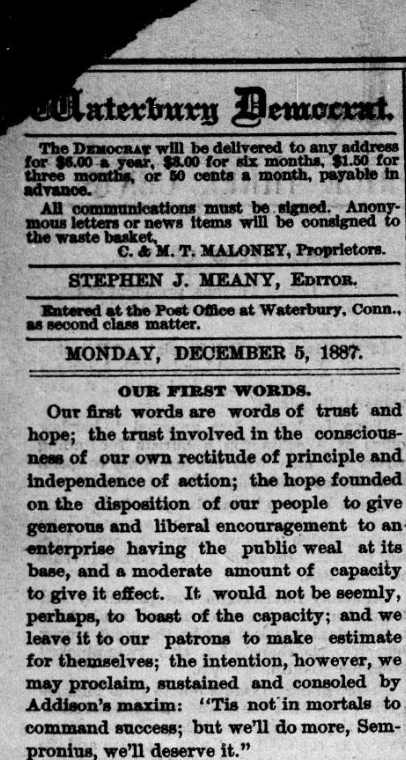
The Waterbury Democrat began in July 1881 as a weekly newspaper called the Valley Democrat in Waterbury, Connecticut. The newspaper became The Sunday Democrat on January 7, 1886, and The Waterbury Evening Democrat on December 5, 1887. Founded by an Irish Catholic Democrat, Cornelius Maloney, the Democrat was known for its promotion of the Democratic Party’s principles and for its coverage of Irish and Catholic topics. The paper focused its local reporting on Waterbury news and sports, along with a column for the neighboring towns of Naugatuck, Oakville, and Watertown.

Irish Catholics made up approximately half of Waterbury’s population at this time. The city’s first Irish immigrants arrived during the early 1830s. By the 1880s, they had largely overcome discrimination from the city’s Protestant community and were establishing themselves as a formidable force in local politics.

Cornelius Maloney was joined by his brother, Michael Thomas Maloney, in 1882, establishing the publishing firm name C. & M. T. Maloney. The Maloney brothers learned the printing and newspaper business in New Britain. Cornelius apprenticed with Oviatt & Guernsey, and later worked for the New Britain Record and the New Britain Observer before moving to Waterbury. He served as a Representative in the Connecticut General Assembly in 1887 and 1888, and he was the founder and first Grand Knight of the local Knights of Columbus, Sheridan Council, No. 24.

Editorial, Waterbury Democrat, 1887
Courtesy of Library of Congress Chronicling America


Sunday, January 29, 2017

Early Muslim Immigrants in Waterbury

Waterbury was one of the first places in the United States to become home to a community of Muslim immigrants, when Albanians began arriving a few years before World War I, fleeing war and massacres.

Although Muslims have lived in the United States throughout the entirety of the country's history, it was not until the twentieth century that sizable Muslim communities were able to establish themselves and thrive. The first recorded instance of communal prayers being held by American Muslims happened in 1900 in North Dakota.

Waterbury had one of the first mosques in the United States, established by the Albanian community in 1919. Earlier mosques included ones in North Dakota and Michigan in 1912 and Biddeford, Maine in 1915. Waterbury's mosque may well have been the fourth mosque to be established in this country. I have found very little information about it. By the 1930s, it was gone, but Waterbury's Albanian Muslim community would continue to grow as new wars and political oppression forced more people to flee their homeland.

Albanian American Muslim Center on Raymond Street, built in 1969.


Sunday, January 22, 2017

Waterbury at the Women's Marches

I'm doing something a little different with this post. I wasn't able to attend the Women's March yesterday, but I noticed many of my friends did. I reached out to some Waterbury people who went and asked them to share photos of the event and their reasons for attending. I want to make sure the Waterbury experience of this national historic event is preserved (because that's what historians do).

There's still time to participate in this blog post. If you're from Waterbury, send your photo(s) and reason for participating in the Women's March to waterburygirl@gmail.com and I will add them to the post. [Latest update: Tuesday, January 24, 2017]

Women's March in Hartford. Image courtesy of Robert Goodrich.


Peace and Unity Community Gathering

The Naugatuck Valley Project partnered with Waterbury's United Muslim Masjid and St. John's Episcopal Church to host a community gathering on Wednesday, January 18, 2017. As soon as I heard about it, I was determined to attend and show my support for my Muslim friends and neighbors who face an uncertain future with a president who gladly stoked people's irrational fear of Muslims during his campaign.

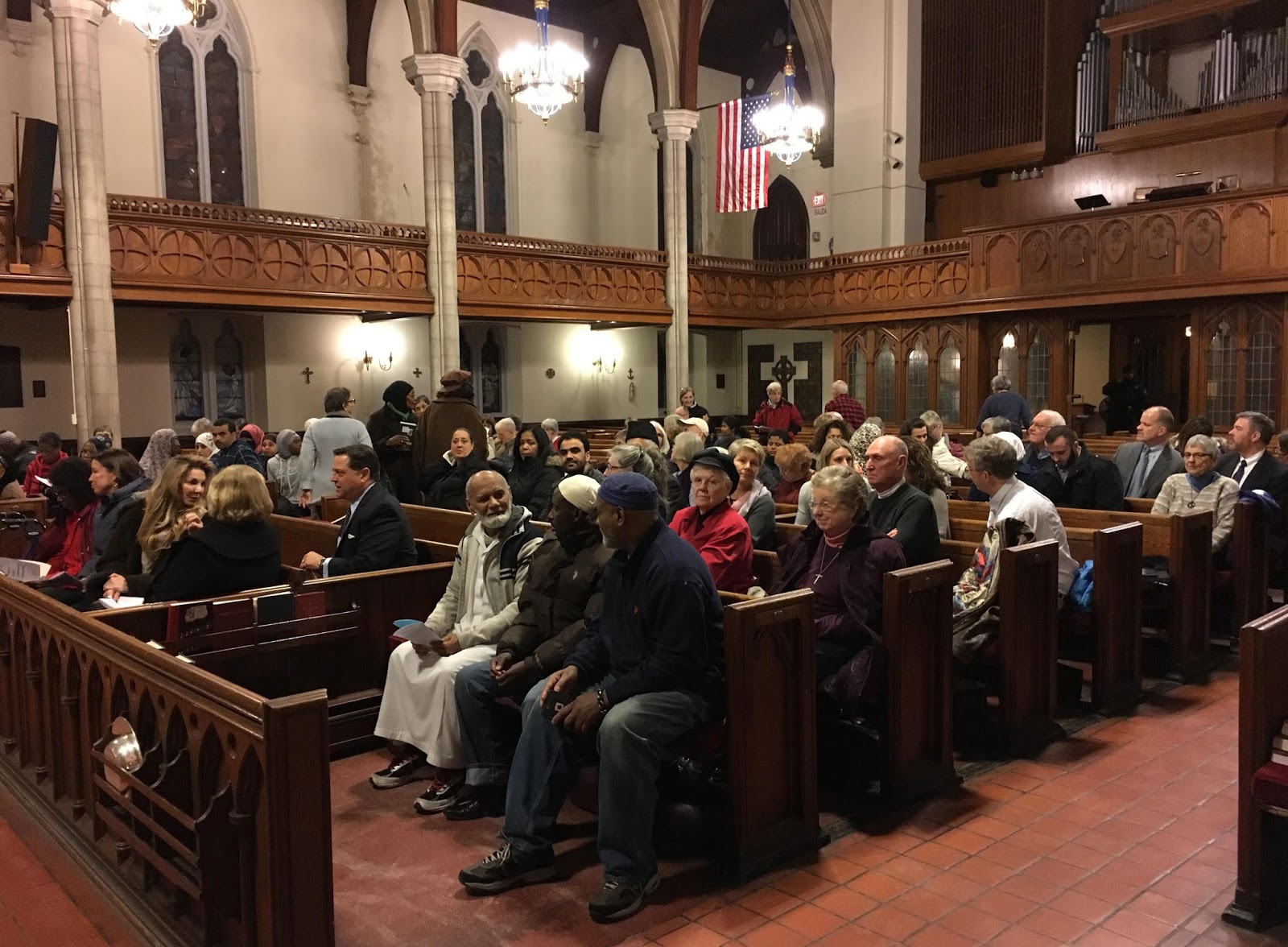
I was so pleased to see a large audience at the community gathering. When I arrived, the church was nearly half full and many more people arrived after me. The Rep-Am estimated some 200 people were in attendance. Christians, Jews, Muslims, atheists, agnostics, Democrats, Republicans, Independents, unaffiliated voters, and more came together to take a stand against bigotry, racism, xenophobia, and intolerance.

The scene when I arrived, before the church filled up.

Saturday, January 14, 2017

Grassroots Organizing and Funding

I am a member of the Grassroots Grants Committee at the Connecticut Community Foundation. In the year or so that we've been active, we have been privileged to see some of the amazing individuals and groups that are changing people's lives in Waterbury and to make funds available for their programs. It has been a profoundly heartwarming experience to see how many people truly care about others, to see how many people who have experienced difficulties and suffering in their own lives turn that into a determination to help others facing the same challenges they once faced, and to see how many people are working to lift up those around them out of the goodness of their hearts.

The Grassroots Grants program is open to any Waterbury resident who wants to make positive changes in their neighborhood or community. This can include things like starting a community garden, offering a program for homeless youth, or building relationships between community members.

Melissa Green, co-chair of the Grassroots Grants Committee, speaking at the Silas Bronson Library


Saturday, November 26, 2016

Welton Horse Fountain


The publication of Charles Monagan's novel about Carrie Welton has inspired renewed interest in the statue of a horse on the Green downtown. The novel is very good--I highly recommend reading it, especially if you have any interest at all in Waterbury's history. It blends fiction seamlessly with historical fact, making the past come alive. The Silas Bronson Library has copies of the book available to borrow. You can also buy a copy at John Bale Books on Grand Street, the Mattatuck Museum on the Green, or online at Amazon.com.

For whatever reason, I have always been very passionate about defending the horse that was the inspiration for the statue. If you're not familiar with the story, here's the gist of it: the horse was modeled after Knight, Carrie Welton's favorite horse; Knight, however, was responsible for the death of Carrie's father, Joseph Welton. The condensed version of the story, as it is often told, is "that's Carrie Welton's horse Knight, who killed her father." Very dramatic and memorable, but the full story is more nuanced.

Monday, October 31, 2016

Vampires, Ghosts, and Witches

It's Halloween, so what better time to look for stories of ghosts, goblins, and haunted houses in Waterbury? Here's what I've been able to find so far.


Baby Vampire?

The New-York Gazette reported a bizarre story on September 10, 1770: "We hear from Waterbury, that a Woman of that Town, who in the fourth or fifth Month of her Pregnancy, was taken with a most violent Longing to eat the Flesh from her husband's Arms---he indulged her in making several Attempts, but her Teeth were not sufficient for her Purpose;---and her accountable Longing continued until her Deliver, which was about three Weeks ago. The infant refusing the Breast, or any other Sustenance usually given to Infants, it was offered the raw Flesh of a Fowl, cut fine and dipt in the Fowl's Blood; on which it has fed heartily every Day since its Birth, and is the only Food the Child has taken, till a few Days since, when it eat a little Milk mixt with Blood."

Tuesday, September 20, 2016

Construction on the Green

The big public works project right now is the reconstruction of the Green downtown. The Green has been fenced off, and so far they've removed most of the sidewalks, lamp posts, benches, wood stanchions, and a few trees.

Friday, September 16, 2016

Library Matters

I've always taken it for granted that, of course, everyone has a library card. Why wouldn't you? As it turns out, however, only about a third of the residents of Waterbury have a library card, and more than half of those cards are expired.

In the past year, people have told me they don't use the library because their kids are all grown up, or because they think there's nothing for them at the library. In fact, there is something for everyone at the Silas Bronson Library. Take a look at this list, and I think you'll see something that appeals to you:

Friday, June 17, 2016

Aliens and Refugees During World War II

The war in Europe began with Germany's invasion of Poland and the subsequent declarations of war against Germany by Great Britain and France in September, 1939. On the other side of the Atlantic Ocean, the United States remained neutral until December, 1941, when Japan bombed our military base at Pearl Harbor.

Refugees

In 1940, as the war raged on, the United States began taking in refugees. Children from Great Britain were the first to be welcomed, sent away by their parents in the hopes that they would escape the bombings and the possible impending invasion. (If you're a fan of the Narnia Chronicles, this might sound familiar--the Pevensie children were sent away to the English countryside to escape the Nazi bombings of London.) The U.S. government found itself balancing citizen enthusiasm for taking in refugee children with the slow bureaucratic requirements of the immigration laws ("Mayor Spellacy Gets Assurance," Waterbury Democrat, 13 July 1940).

Waterbury Republican, 7 Aug 1940
Collection of Silas Bronson Library

Sunday, April 10, 2016

A Century of Melting Pot Frictions, Part Five

Part of a series exploring the prejudice each new immigrant group encountered when they arrived in this country.
--------------------------
 
Chinese and Japanese

Immigrants from Asia fared somewhat better in Waterbury during the late 1800s and early 1900s than did immigrants from Europe, most likely because they came here in small numbers, drawing less attention to themselves. In 1901, the Hartford Courant mentioned in passing that the only Chinese woman in Connecticut lived in Waterbury, running a store with her husband. The paper did not bother to print their names.

Hartford Courant, 2 Aug 1901


A Century of Melting Pot Frictions: Part Four

Part of a series exploring the prejudice each new immigrant group encountered when they arrived in this country.
--------------------------
 
Russians

Russian and Italian immigrants were often grouped together as anarchists, perhaps because many of them were socialists advocating for improved labor rights. Russian socialists were referred to as Bolsheviks, the Russian political party led by Lenin which seized control of the Russian government in October 1917. Within a year's time, newspapers across the United States were instilling a fear of the "red terror," Bolshevism, in the hearts of their readers.

A Century of Melting Pot Frictions, Part Three

Part of a series exploring the prejudice each new immigrant group encountered when they arrived in this country.
--------------------------
 
Italians

After a surge in immigration from Italy during the 1880s, Italians became closely associated with anarchy, socialism, and general crime from the 1890s to the 1930s. "Italian anarchists" is a phrase that was frequently repeated in the newspapers, as was "Italian radical."

A Century of Melting Pot Frictions, Part Two

Part of a series exploring the prejudice each new immigrant group encountered when they arrived in this country.
--------------------------
 
New Immigrants

Just as the Irish were reviled during the 1850s, new groups from Europe were reviled during the early 1900s. In 1904, Rev. Joel S. Ives of Hartford preached against immigration ("Connecticut's Immigrant Problem," Boston Evening Transcript, 23 March 1904), declaring that the problem wasn't the large number of immigrants arriving from Europe, but the poor character of the immigrants. He claimed "I have seen no foreign country with worse appearing settlements of foreigners" than what he saw in New Haven. Ives targeted Catholics Italians and Poles, and Russian Jews.

A Century of Melting Pot Frictions, Part One

Xenophobia is a word that has been used frequently in the past year. The definition, an intense or irrational dislike or fear of people from other countries, clearly describes some of the rhetoric we've been hearing from certain political figures. Whether it's an intense fear of Syrian refugees, an irrational dislike of Mexican immigrants, or an irrational fear of all Muslims, xenophobia has been surging.

As someone who was a child during the 1970s, I have long embraced the melting pot metaphor of this country, thanks in part to a School House Rock video and Disneyland's It's A Small World ride. One of the things that makes America great is our diversity, our ability to integrate people of different faiths and customs into our country. While other nations are torn apart by warfare and genocide stemming from their inability to get along with people of different religions and ethnicities, we have dozens of religions and ethnicities living together in relative harmony. Yes, we still have room for improvement, but overall, we're doing pretty well.

As someone who has immersed herself in historical studies for decades, I have an instinct to compare current events to historical events. Despite the rosy image of the melting pot, our country's history is one in which new groups of immigrants often face a long uphill struggle toward acceptance and integration. Political rhetoric can easily turn to oppressive action. Studying what happened in the past can help us today. We can learn from the mistakes of the past and make better choices in the future.

It's fairly well known that Irish Catholics faced severe discrimination for decades after they began to arrive here in large numbers. Italians weren't considered "white" when they first arrived. Germans were vilified during World War I, to the point that some of them even claimed to be Swiss rather than German. Distrust of Russian immigrants began after World War I and continued through most of the century, thanks to the Cold War. During World War II, Japanese Americans were so distrusted, our government (their government) took away everything they had and locked them up in internment camps.

To a degree, Waterbury has historically been more welcoming of foreigners than many other communities in the United States, largely because the factories eagerly welcomed immigrant laborers to their workforce. The city's success was dependent upon the continual influx of new workers to the factories. But each new immigrant group was met with suspicion, fear, and prejudice as they made their presence known in Waterbury.

Sunday, April 03, 2016

The Crafter's Classroom

There's a great new co-op storefront in downtown Waterbury: The Crafter's Classroom, 106 Grand Street. They opened with a ribbon cutting on Friday, and they already have some fun classes being booked.


Sunday, February 21, 2016

Burning Desire at Seven Angels Theatre

A couple of months ago, I happened to be checking out the Seven Angels Theatre website and was pleasantly surprised to see that Lou Diamond Phillips would be starring in the world premiere of his new play, Burning Desire, right here in Waterbury. Now, I'm not by any means a fangirl of actors. I don't get starstruck. But when I saw that Lou Diamond Phillips (who was so wonderful in La Bamba, Stand and Deliver, Young Guns, a guest appearance on Psych, and now on Longmire) was going to be performing here in Waterbury, at Seven Angels, I immediately bought tickets.

Image from Seven Angels Theatre Facebook page.

Sunday, February 14, 2016

Harrub Memorial at Chase Park

During the early 1900s, Americans were fascinated with a romanticized view of the colonial period. Their enthusiasm for the colonial past started in 1876 with the centennial celebration of the start of the Revolutionary War. In 1920, when the country celebrated the 300th anniversary of the Pilgrim's arrival at Plymouth Rock, the Colonial Revival era was in full swing.

Waterbury inventor and engineer Charles Harrub was enamored with an idealized image of the Pilgrims. Following the death of his wife, Rhoby, in 1921, Harrub began planning a memorial to honor both his wife and the Pilgrims. He died before the monument could be completed, but he left his entire estate to the City of Waterbury, which oversaw the completion of Harrub's vision.

Harrub Pilgrim Memorial, Chase Park, April 2011

Instagram Album

I've started a Waterbury Instagram account, where I will be posting photos of all that is beautiful or interesting in the Brass City. I'll be posting at least one photo a day.


You can find the photos at https://www.instagram.com/waterburygirl/ (no Instagram account required for viewing the images).

Saturday, January 23, 2016

Snowy Waterbury

I love walking in the snow, and today was a perfect day for doing just that.

Welton Carriage Shed.

Civic Responsibility Online

I went back to high school yesterday to participate in a "Who Is My Neighbor?" workshop at Westover School's Rasin Center for Global Justice, sharing my experiences with blogging.

It's always interesting to get someone else's perspective on your work. One of the school's teachers commented afterward that I demonstrated to the students that the internet makes it easier to fulfill a civic responsibility to speak out and to have your voice heard, and that we must abide by an ethical standard of moral judgment and informed opinion (perhaps even more so, since what we post online is there for years). She made a very good point that we must combine moral judgment, informed opinion, and courage in order to be heard. You can write or say whatever you want, but if you aren't trustworthy, you won't be respected, and your voice won't be heard.

Monday, December 21, 2015

St. John's Church

The Rep-Am newspaper recently reported that St. John's Episcopal Church, on the Green, is giving serious thought to selling their building ("St. John's Considers Move," 9 December 2015). According to the article, the church is no longer able to afford the upkeep of the building. More telling, their endowment has dwindled down from millions to only $800,000.

Side note: an endowment is the investment fund that helps pay the bills for churches and other nonprofits. Standard recommended practice is to spend no more than 4% of your annual interest, rolling the rest back into the principle, helping it keep up with inflation. It's a lot like a retirement fund, except that it has to last for centuries. Dipping into the endowment principle should be done only under special circumstances--like a much-needed building expansion or emergency repairs--and the money should be replaced through fundraising as quickly as possible.

If St. John's does decide to sell their building, it will be a significant milestone in Waterbury's history. The Episcopal Church was the second church in Waterbury, dating back to 1740. They've been on the Green since 1795.

When Waterbury was founded, everyone belonged to the Congregational Church (which was the official church of Connecticut until 1818). The Great Awakening, a widespread religious revival of the 1720s and 1730s, led to many people leaving the Congregational Church and joining the Anglican Church (Church of England). After the Revolutionary War, Anglicans in the U.S. ditched their allegiance to the King and reformed as Episcopalians.

Wednesday, November 04, 2015

Happy Blogiversary!

Today is the 10 year anniversary of this blog. So much has changed since then. During the first year or two of my blogging, a "hot" post had a dozen views--which isn't too surprising, since many of those early posts were pretty dull! But as they say, the best way to improve as a writer is to keep writing.

As some of you know, I started a new job last month. I am now Director of the Silas Bronson Library in Waterbury--absolutely a dream job. A couple of people have asked if I'll still be writing about Waterbury history, and the answer is a solid YES. Researching and writing about Waterbury history is what I do for fun in my free time. The same is true for my artwork--painting brings me peace and fulfillment.

Thank you to everyone who reads this blog. Rest assured there will be many more posts about history and cool current happenings in the coming months and years. Oh, and if you want to know what's happening at the Bronson Library, you can follow along on Facebook and Twitter. Loads of good stuff there, too! ;)

Saturday, October 31, 2015

"Mary Della"

While doing some research into Waterbury history, I stumbled onto a serialized novel from 1929, firmly set in Waterbury. Serialized novels were tremendously popular during the 1800s--most of the famous novels from that era first appeared in serial format in newspapers. The format continued into the 1900s, but eventually lost popularity. Serialized storytelling moved into radio and, eventually, television, where it continues to thrive today.

This particular serialized novel was titled "Mary Della" and was written by someone named Julie Anne Moore. There's no sign of Julie Anne Moore other than being listed as the author of this and other stories. I'm assuming Julie Anne Moore was a pen name. (I'll do some additional research later this week to see if I can find out more about her.)

"Mary Della" was serialized by The Independent Syndicate, a company based in Washington, D.C. It ran in newspapers all over the country, but not simultaneously. Some papers started running it in 1929, others in 1930. Some included photographic illustrations, others ran the installments without any illustrations.

Wednesday, August 26, 2015

Almost Home Wins CCF Trustee Award

Last week, on August 20, the Connecticut Community Foundation (CCF), based in Waterbury, held its first annual Trustee Award Ceremony at South Farms in Morris. They honored two organizations that embodied partnership and collaboration, core values of the Foundation. One of those two organizations was the Almost Home Summer Camp program, started this year in the WOW neighborhood.

Sunday, August 16, 2015

Charlton Comics: The Tenuous Waterbury Connection

Most people are aware of Waterbury's claim to fame as home of Eastern Color Printing, the first printing company to make comic books. Lesser known is Waterbury's connection to Charlton Comics, a Derby-based company that helped launch the careers of some of the biggest names in comic books. According to anecdotes, Charlton Comics used a Waterbury printer for their first however many years, and they were co-founded by one of the defendants in Waterbury's Hayes-Leary scandal. I had assumed that Charlton was printing in Waterbury because the company's co-founder was from Waterbury (but you know what they say about assumptions...).

Yesterday, I attended a panel discussion about Charlton Comics at the Connecticut ComiCONN. While I was already aware of much of what is generally known about the company's history, the discussion got me thinking about it in new ways, and inspired me to write what I thought would be a quick blog post highlighting the Waterbury side of the Charlton story. As it turns out, I've stumbled onto a piece of history that hasn't been fully documented and is mostly misunderstood.

Charlton Comics panel at CT ComiCONN, 15 Aug 2015
Left to right: Mort Todd, Roy Thomas, Paul Kupperberg, TC Ford


In my effort to trace Waterbury's ties to Charlton Comics, I have found more questions than answers. There is a documentary about Charlton currently being made, so perhaps the film makers will uncover some of the answers. Or, perhaps, someone reading this post will share a few clues in the comments section. In the meantime, however, here's what I know.

Sunday, August 09, 2015

Dating Your Family Photos

Being able to easily identify the approximate date of an old photograph is a skill I take for granted, since I do it all the time. Yesterday, after a friend posted something on Facebook, I realized that it is not a common skill. I looked for a good guide to identifying photograph dates for my friend, but I couldn't find one I liked. So, with that said, here is a guide to figuring out when a photograph was taken (using all Waterbury and Waterbury-connected photos, of course!).


1. No photographs before the 1840s.

The photographic process was invented in France by Louis Daguerre in 1839. That first type of photograph is called a daguerreotype, after its inventor. Only one image was made, developed directly on a glass plate, which was then placed in a protective case.

Daguerreotypes had a long exposure time, meaning that people had to hold still for several minutes to avoid looking blurry. Daguerreotypes of street scenes don't show any people or animals, unless they happened to be standing still during the exposure time. People walking by were effectively invisible.

Waterbury's Scovill Manufacturing Company was the first in the U.S. to make daguerreotype plates, starting in 1842.

Daguerreotype of St. John's Church on the Green, Waterbury, circa 1847
(Collection of Mattatuck Museum)

Wednesday, July 29, 2015

Brass City Comic Con 6

Naugatuck Valley Community College once again hosted Waterbury's own comic book convention, the sixth annual Brass City Comic Con, on Sunday July 26. As always, it was a great event for families and anyone wanting to meet real live comics professionals. No lines, and plenty of accomplished artists and authors happy to discuss their work.

A few of the great cosplayers at the Brass City Comic Con.

Thursday, July 02, 2015

Summer Camp Launch

Sometimes it seems like there is more energy spent on complaining about problems than on solving problems, so I'm always delighted when I see the problem solvers shine.

Erika Cooper is one of Waterbury's great problem solvers. She's a Scovill Row Homes/WOW neighborhood resident, and my neighbor, so I'm extra pleased to see how much she's accomplished in the past year. Last fall, after a series of shootings rattled the neighborhood, and after discussing fears for their children with other parents at the school bus stop, Cooper formed the Uplift A Life Parents Committee. The group led a march and rally against the violence last September.

Preparing to march through the neighborhood on September 28, 2014.

Since September, Cooper has organized regular neighborhood cleanups for the neighborhood kids, building pride and teaching them the importance of contributing to their community, that they have the power to make things better. As she said today, we have to care--if we don't care, no one else will.

Sunday, June 28, 2015

First Annual Jerk Festival at Library Park

Two of the things I love best about Waterbury are its summertime ethnic festivals and its diversity of culture and food, so I was delighted to learn that the West Indian Social Club of Greater Waterbury was launching an annual Jerk Festival. I had a busy day, but I made time to swing by the festival for lunch and take a few photos.


For those who are unfamiliar with the term, "jerk" is a spicy Caribbean dry-rub barbeque (in simplest terms).

Connecticut has the sixth largest non-Hispanic West Indian population in the U.S., with 87,149 immigrants reported in the 2010 Census.

A 2013 Census report estimates that Waterbury has 3,304 non-Hispanic immigrants from the West Indies, with 2,185 of those people coming from Jamaica.

Friday, June 19, 2015

Historic Bridges

The latest issue of Connecticut Explored magazine features an article about some of Connecticut's historic bridges, and it reminded me that Waterbury has two of the state's 45+ bridges listed on the National Register of Historic Places.


Washington Avenue Bridge

Washington Avenue bridge, as seen from South Main Street.

Thursday, May 21, 2015

Hancock Brook Trail

After all the years that I've been in Waterbury, there are still so many wonderful things to be discovered. Today, when I was making a quick trip to view a historic bridge, I wound up hiking a trail that I never really knew existed. It took a lot longer than expected, but it was definitely worth doing.

Saturday, May 16, 2015

The Gathering 2015

The third great year of a great event. Thousands of people, speaking dozens of different languages, with different cultures and different life experiences, all gathering together for a festival celebrating each others music, dance, clothing, food, culture.

As before, The Gathering started with a parade down East Main Street, around the Green, up Bank Street to Grand Street, and then to Library Park. The park was set up with stages for music and dance performances, and tents for vendors selling food and other goods from all over the world.

New Zealand (Rod Dixon)

Wednesday, May 13, 2015

Laura Pearsall and Lakewood Park

Laura Elizabeth Russell (1844-1913) grew up in the Bucks Hill neighborhood. She was raised by her grandparents, Joseph and Elizabeth Fairclough, immigrants from Birmingham, England. Her grandfather worked as a blacksmith, while his sons helped support the family by farming.

At some point during the 1860s, Laura Russell met Zophar Pearsall, a prominent New York City butcher with a shop at Fulton Market and a home on Second Avenue. His customers included major hotels, steamship lines, and wealthy private homes. Zophar was nearly 30 years older than Laura and divorced. He was also very wealthy. Laura and Zophar married and had two children together.

Although Zophar continued his NYC business at Fulton Market, the family maintained a home in Waterbury, next door to Laura’s grandmother. Their house was large, with room for the family, three servants, and guests.

Zophar died in 1883 after a long illness. Laura and her son, also named Zophar, continued the Fulton Market business. All went well until 1890, when Laura was named as co-respondent in a divorce suit between Sarah and Edwin Camp. Sarah Camp claimed damages against Laura for the “alienation of Mr. Camp’s affections” and additionally claimed that Edwin gave Laura over $40,000 worth of property during their affair.

Saturday, April 18, 2015

Wednesday, April 15, 2015

Municipal Stadium Origins

During the 1890s, the Waterbury Driving Park opened on Watertown Avenue. Leased from the City by the Waterbury Driving Company, it hosted races for horses, cyclists, and runners; football games for high schools; and baseball games for city teams.

Bridgeport Sunday Herald, 6 September 1896

Friday, April 10, 2015

Socialites of 1890

While browsing copies of the Waterbury Sunday Herald through the Connecticut State Library's Digital Collections, I came across an illustrated writeup about a ball held in January or February 1890 by the Second Regiment Connecticut National Guard, which was headquartered here in Waterbury. The ball was held at Waterbury's City Hall (not the current building; the former City Hall building which was located on the Green).

The "news" article is fascinating both for the evocative images of the event, and for the tiny glimpse it gives of Waterbury's high society women during the Gilded Age. Although the article gave little detail about the women it featured, my research has uncovered a wide range of fascinating life stories, including a glamorous actress, a diplomat's wife rescuing a man from a grizzly bear in Canada, the wife of a famous playwright, women who were active in local organizations, and women who preferred the "quiet" life of raising a family and managing a household.

Artist's depiction of the ball, Sunday Herald (9 Feb 1890)

Sunday, March 01, 2015

Warner Gardens History

One of the most unique places in Waterbury is Warner Gardens. Located at the top of Long Hill, the decaying complex of buildings seems more like something you’d find in the deep South than in Connecticut. Its history begins with a wartime housing shortage, includes a period of pride and achievement during the Civil Rights era, and is now approaching a transformative ending.

Warner Gardens. Photo by Gretchen Van Tassel, June 1945.
Collection of UC Berkeley, Bancroft Library
[Note: updated on March 8, 2015 to include Sanborn map showing all the original buildings.]

Saturday, February 21, 2015

Jacques', Annie Louise Ames, and Jean Dixon

Jacques' Theater was a legendary downtown landmark during the first half of the 20th century. Jacques' (pronounced "Jake's") opened in 1886 on the corner of Abbott and Phoenix Avenues as Jacques' Opera House. It began as a premiere theater; by the 1940s it had become a burlesque theater. The building was demolished in the 1950s.

The theater was established and managed by Eugene "Jean" Jacques (1855-1905), who was born in Plymouth but grew up in Waterbury. His father, John J. Jacques, was a physician and pharmacist who operated a drug store downstairs in their apartment building on the Green, near Exchange Place. Jean worked in his father's drug store for years before launching himself into the theater business.


Postcard view of Jacques', circa 1905


Thursday, February 05, 2015

Snow Fun

With a couple of feet of snow still on the ground, and another foot expected on Sunday and Monday, many people are feeling overwhelmed and discouraged. What if, instead of despairing, we embraced the large quantity of snow to have a snow sculpting competition? It would be a fun use of the excess snow, and could be held in one of the city parks.

Maybe that's a little ambitious for a spur of the moment idea. As they say, start small.

Friday, January 30, 2015

Winter Views Along the Naugatuck River

I returned to Waterbury from work early today, and I happened to have my camera with me, so I decided to take advantage of the last hour of daylight to take a peak at the Naugatuck River from the northern, center, and southern parts of the city.

Saturday, January 17, 2015

Waterbury's Connections to Selma

Sometimes related events converge by coincidence. As Waterbury wrestles with the creation of new voting districts, guided by an outside demographer whose primary focus is adherence to the Voting Rights Act of 1965, a new movie, Selma, brings to life the conflict that forced the Voting Rights Act into being.

Brief Background

On January 2, 1965, Martin Luther King, Jr., the Student Nonviolent Coordinating Committee (SNCC), and the Southern Christian Leadership Conference (SCLC), along with other groups, began a voting rights campaign in Selma, Alabama. Their goal was to focus national attention on the local government, which was illegally preventing African Americans from voting.

One of the protesters, an African American church deacon named Jimmie Lee Jackson, while protecting his mother and grandfather, was shot and killed by an Alabama state trooper in February. On March 7, activists began a march from Selma to Montgomery, but they didn't get far. State troopers set up a blockade on the Edmund Pettus Bridge in Selma, attacking the marchers with tear gas and clubs. The event received wide television coverage, sparking national outrage.

Sunday, January 11, 2015

Public Response to the First Map

The public gave its response to the first draft map for Aldermen by District on Thursday, January 8. Overviews of the meeting have been reported on by the Waterbury Observer and the Rep-Am, so I'll try to stay focused on some of what they didn't cover.

Wednesday, January 07, 2015

The First Map

The latest chapter in the saga of Aldermen by District is unfolding this week. In a surprise move Monday, the city posted on their website a preliminary map showing possible boundaries for the new Aldermanic districts. Outrage and accusations of gerrymandering promptly ensued.

Tuesday, December 16, 2014

Drawing Up the New Districts

Things are chugging along with the establishment of Aldermen by District. Check out the Waterbury Observer for a good report of what's going on with the District Commission.

If this is a topic that is of interest to you (and if you live in Waterbury, it should be), I recommend that you plan on attending the public meeting at City Hall on January 8 at 6:30 p.m. The District Commission will present three district maps for us to give feedback on. ("Us" means anyone and everyone who lives and votes in Waterbury.)

Wednesday, November 26, 2014

Aldermanic and Mayoral History

Whenever there's a political or social controversy, it can be helpful (or at least interesting) to take a look back through history to see how we got to this point. I've spent some time over the past week or so sifting through newspapers on microfilm and in online databases, and rooting out old charter revision reports tucked away in the basement of the Bronson Library. As a result, I've found some interesting information about the origins of Waterbury's Aldermen at Large system, which will be coming to an end next year.

Sunday, November 16, 2014

Museum Graffiti

I finally got a chance to take a close look at this new artwork commissioned by the Mattatuck Museum. I had seen photos posted by the museum on Facebook, but seeing art in person is always better. This impressive graffiti was created by New Jersey artist Joe Iurato.

Sunday, November 09, 2014

Fun with Maps!

The big question on everyone's mind is the drawing of Aldermanic district boundaries. We're unlikely to see the official boundaries until later this winter or in the spring, but I'm an impatient kind of woman, so here's a first effort at what the map might look like.

Aldermen by District Charter Language

After a flurry of campaigning led by John Murray, publisher of The Waterbury Observer, the Charter Revision establishing Aldermen by District was passed by Waterbury's voters. So what happens next?

Monday, October 27, 2014

Underhanded Opposition to Aldermen by District

It was very disappointing to read today's coverage of the Aldermen by District issue in the Rep-Am. At first I was confused by their one-sided, inaccurate, and unappealing reporting. Then I went back and read today's Editorial, in which they clearly state that they think Aldermen by District is a bad idea. Then their appalling coverage made sense--forget journalistic integrity, the Rep-Am is trying to torpedo the Charter Revision.

Sunday, October 26, 2014

Delinquent Property Tax Rules

After reading coverage in print and online of Andre Michaud's difficulties with the Tax Collector's Office, and knowing how overwhelmingly frustrating it is to be railroaded by bureaucracy, I decided to figure out what was going on. The "he said, she said" coverage of the story in the Rep-Am did nothing to help readers decide who was right. The official report issued by the city's Corporation Council did little to clarify the matter, as it avoided answering any questions about how the delinquent tax system works.

It's taken me hours to unravel what really happens, even though this is information that should be readily available to the general public. What I discovered is that the system by which real estate property is auctioned off for delinquent taxes is shrouded in mystery and confusing legal jargon.

Sunday, October 12, 2014

Election 2014 Voter Registration and Ballot Questions

Are you ready to vote on November 4?

Check your voter registration status online to make sure you're registered where you currently live.

If you need to register, or if you need to change your address, or if your name has changed, you can register online; OR,

         Download the registration form, print it out, and mail it to Registrar of Voters, Chase Municipal Building, 236 Grand Street, Floor 1, Waterbury, CT 06702 postmarked no later than October 21, 2014; OR,

         Download the registration form, print it out, and deliver it in person to Registrar of Voters, Chase Municipal Building, 236 Grand Street, Floor 1, Waterbury, CT 06702 no later than October 28, 2014.

Friday, October 10, 2014

Election 2014 General Candidates

Secretary of State

We've all heard about the U.S. Secretary of State, an appointed position currently held by John Kerry, previously held by Hillary Clinton.

In Connecticut, the Secretary of State oversees elections, business filings, notaries, and other duties related to public records and documents. It's sort of the paperwork department for the State of Connecticut.

This year's candidates are:

Election 2014 State House of Representatives Candidates

Waterbury is divided into five legislative districts: 71, 72, 73, 74, 75.

You can find out which district you vote in by first checking your voter registration information, and then going to the Waterbury Registrar of Voters webpage to see where your polling place is located. (For example, my polling place is Reed School, which is in the 72nd District.)

Tuesday, October 07, 2014

Election 2014 State Senate Candidates

So many races, so many candidates! Waterbury falls within two State Senate districts, the 15th and 16th.

15th State Senate District

This district includes most of Waterbury, as well as parts of Middlebury and Naugatuck.

Election 2014 Congressional Candidates

Waterbury is divided between two U.S. Congressional Districts: the 3rd and 5th.

Third District Congressional Race

The 3rd District includes some of Waterbury (most of what's to the south of I-84), Naugatuck, New Haven, Wallingford, and so on. Rosa DeLauro (D) has served as the Congresswoman for the 3rd District since 1991. I've never met her, and it seems like she barely notices that Waterbury is in her district. Govtrack.us seems to have some good data on her performance in the U.S. Congress.

Saturday, October 04, 2014

Election 2014 Gubernatorial Candidates

There's a lot on the ballot for Waterbury this year, so I'm dividing it into multiple posts. This post will address the candidates for Governor; upcoming posts will look at legislative candidates and the charter revision questions.