 |
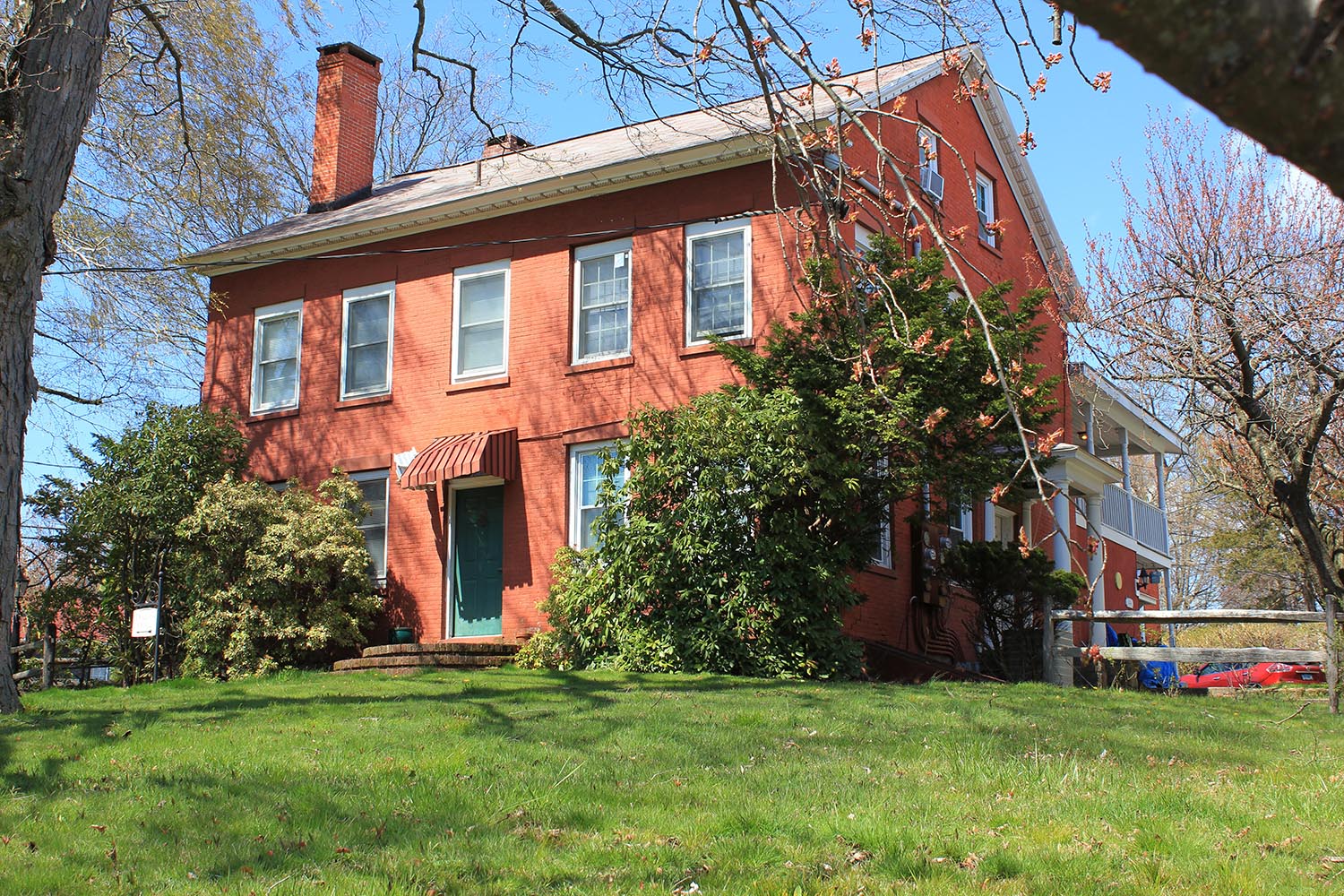
| The Porter House, April 2020 |

Thursday, April 30, 2020
The Porter House
One of Waterbury's most underappreciated buildings is the Porter house on East Main Street, across from Hamilton Park. The history of the house, from its construction to its role as a station on the Underground Railroad, make it worthy of recognition and preservation as an important historic property.

Tuesday, March 24, 2020
Influenza Pandemic of 1918
As we slog our way through the COVID-19 pandemic, I have found some reassurance from studying the 1918 influenza pandemic, the worst pandemic of the 20th century. While the parallels between the two pandemics are frightening, the 1918 pandemic didn't last forever, and this pandemic won't either. We also have some huge advantages that didn't exist in 1918, from ventilators to a drastically better understanding of how to respond to a virus. There's a lot we can learn from what happened in 1918, both from the mistakes made and from the community spirit and volunteerism that emerged to defeat the epidemic.
General Overview
The 1918 influenza pandemic was caused by an H1N1 virus with genes of avian origin. Approximately one-third of the world's population was infected by the virus, leading to the death of 50 million people worldwide. Approximately 675,000 in the United States were killed by the pandemic, of which approximately 9,000 were in Connecticut and more than 1,000 were in Waterbury. Most of Waterbury's deaths happened in a single month.
 |
| U.S. Public Health Service Broadside, 1918 Library of Congress |
General Overview
The 1918 influenza pandemic was caused by an H1N1 virus with genes of avian origin. Approximately one-third of the world's population was infected by the virus, leading to the death of 50 million people worldwide. Approximately 675,000 in the United States were killed by the pandemic, of which approximately 9,000 were in Connecticut and more than 1,000 were in Waterbury. Most of Waterbury's deaths happened in a single month.
Saturday, February 22, 2020
Unidentified Civil War Veteran
Every so often, I visit the Library of Congress website to see what new Waterbury material has been digitized. My latest search pulled up a photograph of an African American Civil War veteran whose photograph was taken in Waterbury. His name is not on the photograph, so his identity is currently unknown.
The photograph is a carte-de-visite, a print mounted onto a card, with the name of the photographer below the photograph.The medal on the man's chest is the medal of the Grand Army of the Republic (G.A.R.) veterans organization.
 |
| Collection of Library of Congress Prints and Photographs Division |
The photograph is a carte-de-visite, a print mounted onto a card, with the name of the photographer below the photograph.The medal on the man's chest is the medal of the Grand Army of the Republic (G.A.R.) veterans organization.
Friday, February 14, 2020
Old Houses at Bucks Hill, Part One
Bucks Hill (also spelled Buck's Hill) was far enough removed from the center of Waterbury to be considered a satellite settlement during the early 1700s. The origin of the name is unknown.
 |
| Bucks Hill District, 1874 |
Tuesday, December 24, 2019
Christmases Past: 1870s - 1900s
During the 1870s, Christmas in Waterbury began to look more like it does today than it had in earlier decades (see previous post). Christmas trees were becoming a standard feature, as were wreaths and poinsettias. Merchants offered countless options for gifts, grocers sold produce from warmer climates, and holiday entertainments ranged from the spiritual to the bawdy.
Waterbury's population boomed during the late 1800s, with thousands of people moving here to work in the factories. From 1870 to 1900, Waterbury's population grew from 13,148 to 51,139. It reached 73,141 in 1910.
Waterbury's growth was directly connected to the growth of industry and transportation throughout the country. This was an era of expansion, innovation, and colonization.
The first Christmas cards in the United States were introduced in 1874 by Louis Prang & Co. The advent of chromolithographic printing made the production of colorful cards affordable for the masses.
Thomas Nast's iconic illustration of Merry Old Santa Claus, carrying an armload of toys, appeared in Harper's Weekly magazine on January 1, 1881.
Waterbury's population boomed during the late 1800s, with thousands of people moving here to work in the factories. From 1870 to 1900, Waterbury's population grew from 13,148 to 51,139. It reached 73,141 in 1910.
Waterbury's growth was directly connected to the growth of industry and transportation throughout the country. This was an era of expansion, innovation, and colonization.
The first Christmas cards in the United States were introduced in 1874 by Louis Prang & Co. The advent of chromolithographic printing made the production of colorful cards affordable for the masses.
Thomas Nast's iconic illustration of Merry Old Santa Claus, carrying an armload of toys, appeared in Harper's Weekly magazine on January 1, 1881.
 |
| Thomas Nast, Merry Old Santa Claus, 1881 |
Sunday, December 22, 2019
Christmases Past: 1840s - 1860s
Christmas is a time of nostalgia, with people reflecting on their happy memories from childhood, but the older history is just as interesting. Many of the traditions we associate with Christmas were adopted during the 1800s.
Washington Irving published a satirical story about St. Nicholas in 1809, writing "lo! the good St. Nicholas came riding over the tops of the trees, in that self-same wagon wherein he brings his yearly presents to children. ... And he lit his pipe by the fire, and sat himself down and smoked; and as he smoked the smoke from his pipe ascended into the air, and spread like a cloud overhead." (Washington Irving’s Works: Knickerbocker’s history of New York, 1895 edition, p. 181-182)
An illustrated poem about "Old Santeclaus" was published in New York in 1821, the first known publication to depict Santa's sleigh and reindeer.
Washington Irving published a satirical story about St. Nicholas in 1809, writing "lo! the good St. Nicholas came riding over the tops of the trees, in that self-same wagon wherein he brings his yearly presents to children. ... And he lit his pipe by the fire, and sat himself down and smoked; and as he smoked the smoke from his pipe ascended into the air, and spread like a cloud overhead." (Washington Irving’s Works: Knickerbocker’s history of New York, 1895 edition, p. 181-182)
An illustrated poem about "Old Santeclaus" was published in New York in 1821, the first known publication to depict Santa's sleigh and reindeer.
 |
| The Children's friend. Number III. A New-Year's present, to the little ones from five to twelve, 1821 Beinecke Rare Book and Manuscript Library, Yale University / Wikimedia Commons |
Saturday, October 12, 2019
Taverns, Beer, and Civil Rights
I recently purchased a Waterbury token on a whim while looking for information about a Pete’s Tavern featured in a series of articles in 1949 (more on that below). I had no way of knowing whether the Pete’s Tavern on the token was the same Pete’s Tavern in the newspaper articles, but I impulsively placed a bid on eBay and wound up being the only bidder.
Now saddled with a Pete’s Tavern token, I set about researching tokens in an effort to learn when it was made, trying to see whether or not the token was connected to the Pete's Tavern I had read about in the newspaper articles from 1949.
The available material about merchant tokens was entirely unhelpful, as it was all too generalized. From what I read, my token could have been produced anytime between the 1880s and the 1940s.
Next, I tried skimming the Waterbury City Directories for Pete’s Tavern. Here’s where things started to get interesting.
 |
| Pete's Tavern Token, front and back |
Now saddled with a Pete’s Tavern token, I set about researching tokens in an effort to learn when it was made, trying to see whether or not the token was connected to the Pete's Tavern I had read about in the newspaper articles from 1949.
The available material about merchant tokens was entirely unhelpful, as it was all too generalized. From what I read, my token could have been produced anytime between the 1880s and the 1940s.
Next, I tried skimming the Waterbury City Directories for Pete’s Tavern. Here’s where things started to get interesting.
Sunday, July 07, 2019
Rowhome Rehab
We've been trying to remodel our Scovill Row Home for over a year now, hitting endless obstacles from contractors who want nothing to do with us. The worst was Giordano Cabinets. The rep who came to our house took one look at the neighborhood (which is predominantly African American and Hispanic) and asked if his crew would be safe here, then gave us an estimate of $62,000 for cabinets and countertops for a 19 square foot kitchen. I can only assume that the estimate was excessively high because they don't want the job.
Sunday, May 05, 2019
The Spires of St. Anne's
As reported in the Republican-American on May 2, the iconic spires of St. Anne's Church will be removed by All Saints Parish this summer. The job will cost the parish an estimated $881,255. The plan is to remove the Vermont blue marble blocks carefully, so that they can be used to someday restore the spires if enough money can be raised. The dome of the church is also in need of repairs; parishioners have told me there is water coming in through the dome windows.
This is not the first time that stonework has fallen from the building. Major repairs were done in the 1980s and the 2000s, but the problems have continued.
I have, frankly, had trouble tracing all of the repairs done to the towers, as very little information is available, and what I can find seems contradictory in places. A newspaper article in 2004 stated that $329,000 had just been spent to repair the towers and dome, but in 2006 there was a chunk of stonework missing from the west tower. Another newspaper article, from 2006, stated that the parish had raised nearly $2 million for repairs to the building. When I curated an exhibit about Waterbury architecture in 2009, repairs to the spires and dome had just wrapped up the previous year, but in 2011, the parish was once again talking about raising money to repair the spires.
 |
| The twin spires of St. Anne in 2006 |
This is not the first time that stonework has fallen from the building. Major repairs were done in the 1980s and the 2000s, but the problems have continued.
I have, frankly, had trouble tracing all of the repairs done to the towers, as very little information is available, and what I can find seems contradictory in places. A newspaper article in 2004 stated that $329,000 had just been spent to repair the towers and dome, but in 2006 there was a chunk of stonework missing from the west tower. Another newspaper article, from 2006, stated that the parish had raised nearly $2 million for repairs to the building. When I curated an exhibit about Waterbury architecture in 2009, repairs to the spires and dome had just wrapped up the previous year, but in 2011, the parish was once again talking about raising money to repair the spires.
Tuesday, March 05, 2019
Waterbury and the Green Book
Thanks to the Oscar awards, the movie Green Book has been getting a lot of attention. There are plenty of good resources for learning more about the historical Green Book -- the New York Public Library has a good online resource, and there have been several short articles and videos looking into some of the Green Book locations. There is also a documentary on the Smithsonian Channel.
Much of the focus has been on the southern states covered by the Green Book, but travel through the northern states was also potentially dangerous during the mid-20th century. Having a guide to hotels and tourist homes for African Americans in Connecticut made travel much easier and safer.
Between 1938 and 1950, the only Waterbury locations in the Green Book were in the North Square neighborhood (with the exception of an address on Bridge Street near the heavily Irish Abrigador neighborhood). Beginning in 1950, the Elton Hotel was listed in the Green Book. In 1961, the Putt Meadow Motor Court on Meriden Road was added.
 |
| The Negro Motorist Green Book, 1939 Collection of The New York Public Library |
Much of the focus has been on the southern states covered by the Green Book, but travel through the northern states was also potentially dangerous during the mid-20th century. Having a guide to hotels and tourist homes for African Americans in Connecticut made travel much easier and safer.
Between 1938 and 1950, the only Waterbury locations in the Green Book were in the North Square neighborhood (with the exception of an address on Bridge Street near the heavily Irish Abrigador neighborhood). Beginning in 1950, the Elton Hotel was listed in the Green Book. In 1961, the Putt Meadow Motor Court on Meriden Road was added.
Saturday, February 23, 2019
Winter is the Pits
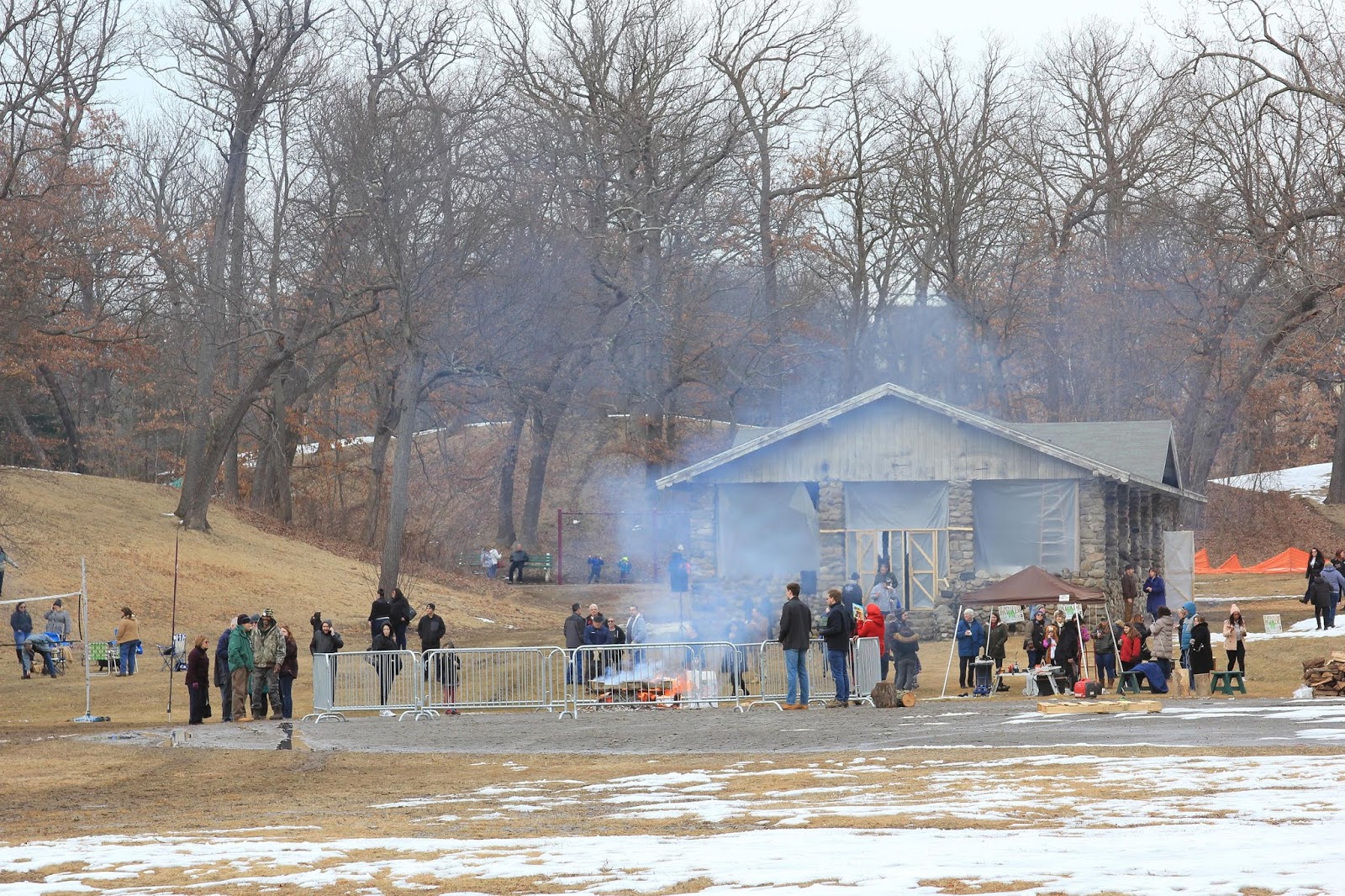
One of Waterbury's great grassroots groups, Spirit of Waterbury, put together a winter festival at Hamilton Park this afternoon, the second in their series of Hidden Spaces, Secret Places events. The weather was more mud season than snow season, but everyone still had a good time. An estimated 1,000 people attended the event, which included a small bonfire, several pit fires, s'mores, chili, soups, hot chocolate, food trucks, and a mobile pub.

Sunday, February 03, 2019
A Brief History of Waterbury's Black Barber Shops
Black barber shops have been an important center of African American communities since the 1800s. Black barbers were among the first African American entrepreneurs to build their businesses in Waterbury. The city's first black-owned barber shop opened in 1846, catering to a primarily white clientele. During the early 1900s, Waterbury’s African American community grew large enough to support a black barber shop dedicated to that community, located in the North Square neighborhood.
Monday, January 21, 2019
Lost Cats
Over the weekend, we took in a stray female cat and we are now trying to find its owners.

If your cat or dog is missing, be sure to contact rescue shelters and look through the postings of animals for adoption, and keep looking for a few months. Don't just look at listings of "found cats," because not everyone who finds a cat and adopts it out will post there.

If your cat or dog is missing, be sure to contact rescue shelters and look through the postings of animals for adoption, and keep looking for a few months. Don't just look at listings of "found cats," because not everyone who finds a cat and adopts it out will post there.
Tuesday, December 18, 2018
Connecticut's Black Governors
Starting sometime around 1750, Connecticut’s enslaved Africans began a tradition of electing their own Governor. In later years, the newly elected black Governor would ride through the street leading a celebratory parade.
The title of Governor is specific to the New England colonies. Some accounts indicate that they were referred to as Kings “in remembrance of their Kings of Guinea,” while other accounts indicate that both a Governor and a King were elected. In African American Connecticut Explored, Katherine J. Harris wrote that Kings were elected in areas of the colony that had stronger ties to the British Crown.
The annual elections continued to be held long after slavery ended in Connecticut, continuing in the Naugatuck Valley until about 1856. I have found one reference indicating that at least one election was held in Waterbury during the 1800s. It also appears that the African American community in Waterbury was closely connected to those throughout the Naugatuck Valley south to Derby.
Nelson Weston, originally from Humphreysville in Seymour, was the second person to run a barbershop in Waterbury and the first black barber here, from 1846 until sometime in the 1850s. While he was living and working in Waterbury, he was elected as Connecticut’s black Governor, in 1850. He was one of three Weston men to serve as Connecticut's black Governor.
The title of Governor is specific to the New England colonies. Some accounts indicate that they were referred to as Kings “in remembrance of their Kings of Guinea,” while other accounts indicate that both a Governor and a King were elected. In African American Connecticut Explored, Katherine J. Harris wrote that Kings were elected in areas of the colony that had stronger ties to the British Crown.
The annual elections continued to be held long after slavery ended in Connecticut, continuing in the Naugatuck Valley until about 1856. I have found one reference indicating that at least one election was held in Waterbury during the 1800s. It also appears that the African American community in Waterbury was closely connected to those throughout the Naugatuck Valley south to Derby.
Nelson Weston, originally from Humphreysville in Seymour, was the second person to run a barbershop in Waterbury and the first black barber here, from 1846 until sometime in the 1850s. While he was living and working in Waterbury, he was elected as Connecticut’s black Governor, in 1850. He was one of three Weston men to serve as Connecticut's black Governor.
Saturday, November 24, 2018
Farewell to Trinity
The Trinity Episcopal Parish was formed in 1877 as an off-shoot of St. John's Episcopal Parish, in part because St. John's had grown very large. Additionally, the new Trinity parish adhered to precepts of a Catholic movement within the Episcopal/Anglican faith.
For the first six years, Trinity's parishioners worshiped in a former Universalist chapel on Grand Street. Construction of the beautiful granite Trinity Episcopal Church was completed in 1884, with the first service held there on May 18, 1884.
In a centennial history of Trinity Episcopal Church, it was noted that Trinity "can boast of having some of the most influential people in Waterbury's history as her parishioners. She can also claim the allegiance of three Connecticut governors, Templeton, Stearns and Lilley."
The book's preface was written by John J. McMahon, who wrote the following about the interior of Trinity:
For the first six years, Trinity's parishioners worshiped in a former Universalist chapel on Grand Street. Construction of the beautiful granite Trinity Episcopal Church was completed in 1884, with the first service held there on May 18, 1884.
 |
| Trinity Episcopal Church in 1884; photo by Adt & Brothers, published in Waterbury and Her Industries |
In a centennial history of Trinity Episcopal Church, it was noted that Trinity "can boast of having some of the most influential people in Waterbury's history as her parishioners. She can also claim the allegiance of three Connecticut governors, Templeton, Stearns and Lilley."
The book's preface was written by John J. McMahon, who wrote the following about the interior of Trinity:
As an outsider to the church I was deeply impressed by the interior. It is a building that, regardless of one's religious beliefs, should be seen. The architectural lines and handcrafted fixtures have a charm and majesty of their own not often seen in more modern ecclesiastical buildings. In Trinity one can feast his eyes upon a composition of unusual beauty and strength. Here, one can forget all about the hurried noises of downtown Waterbury. There is only the hushed air of a church that can match any other around in terms of elegance and character.
Sunday, September 23, 2018
The Gathering at Library Park 2018
I'm sorry to say I did not get in as much of The Gathering this year as I wanted. By the end of watching the parade, my back was killing me. The delicious Lithuanian beer helped mask the pain, but by about 3 p.m., I was ready to collapse and headed home early.
At any rate, here are the photos from what I was able to enjoy. There's always so much going on, and so many awesome things to try to experience. The photos barely skim the surface of all that happened at The Gathering.
At any rate, here are the photos from what I was able to enjoy. There's always so much going on, and so many awesome things to try to experience. The photos barely skim the surface of all that happened at The Gathering.
 |
| Welcome from Ghana |
The Gathering Parade 2018
Another year, another great day at The Gathering! I wasn't feeling my best, but there was no way I was going to miss out on this event.
As before, I'm posting photos of the parade first, then I'll do a second post of the events in the park.
As before, I'm posting photos of the parade first, then I'll do a second post of the events in the park.
 |
| Police Pipes & Drums |
Saturday, September 22, 2018
Trinity Episcopal Church
Last weekend, a friend drew my attention to a distressing post on the Facebook group, You Know You're From Waterbury When.... The post has since been taken down, but it showed photos of the former Trinity Episcopal Church on Prospect Street and stated that the Immaculate Conception parish was about to demolish the building. The post was followed by a flurry of responses from people who were horrified by the news. Several of the Immaculate's parishioners responded with some conflicting information. The church is owned by Immaculate Conception, which ran it as the Father McGivney Center for many years.
 |
| The former Trinity Episcopal Church, 2018 |
Since there were so many rumors and conflicting details, I reached out to Immaculate Conception asking for the correct information. No one has responded. Father Ford, who is in charge of the plans, has been out of the country in Portugal. Perhaps when he returns, I'll find out more details. In the meantime, here's what I know.
Saturday, August 04, 2018
The Life and Death of a Factory
Waterbury has lost another historic factory building to catastrophic fire. The building most recently known as Ansonia Copper and Brass caught fire on July 30, 2018. The dramatic fire was covered by all of the area news media.
Amazingly, the fire was contained to just one building. Sadly, it was the oldest and most beautiful building in a sprawling complex of historic factory buildings, with a rich history that made it worth preserving.
 |
| WTNH Channel 8 coverage of the factory fire, July 31, 2018 |
Amazingly, the fire was contained to just one building. Sadly, it was the oldest and most beautiful building in a sprawling complex of historic factory buildings, with a rich history that made it worth preserving.
Friday, July 06, 2018
Calder in Waterbury
Although the legendary sculptor Alexander Calder has been mentioned frequently in connection to the new artworks in downtown Waterbury, I haven't seen anyone delving into the history of Calder's Waterbury connections, so I figure I might as well do it here.
If you don't have a background in art or art history, you might be wondering, why Calder? Why is he so famous? Why would five artists come all the way from Italy (twice) for the opportunity to create art in the same city in which many of his sculptures were made?
 |
| Alexander Calder at "Stegosaurus" dedication, Hartford, October 10, 1973 Collection of Hartford History Center, Hartford Public Library and Connecticut History Illustrated |
If you don't have a background in art or art history, you might be wondering, why Calder? Why is he so famous? Why would five artists come all the way from Italy (twice) for the opportunity to create art in the same city in which many of his sculptures were made?
Sunday, June 03, 2018
On the Trail of Calder in Downtown Waterbury
Five new public artworks, inspired by the work of Alexander Calder, were installed throughout downtown Waterbury on May 24. The dedication was held yesterday, beginning with a reception for the artists at John Bale Books. I wasn't able to attend, but since I work downtown, I get to enjoy the new art regularly.
We had our first look at the artwork last year during an open studio on Freight Street. Since then, the sculptures have been getting their finishing touches (and color) at White Welding.
They lend themselves to interesting photography, and they add a modern flair to downtown.
We had our first look at the artwork last year during an open studio on Freight Street. Since then, the sculptures have been getting their finishing touches (and color) at White Welding.
They lend themselves to interesting photography, and they add a modern flair to downtown.
 |
| Rebirth by William Papaleo, Library Park |
Tuesday, May 29, 2018
What Is Good History?
Everyone learned at least some history in school, whether it was the cute story about George Washington telling the truth about chopping down a cherry tree, or more advanced studies about politics, economics, and war.
Traditional history has focused on the story of society's elite, the top tier leaders who made history, but there's so much more to history than that.
So what is history, and how should it be told?
Traditional history has focused on the story of society's elite, the top tier leaders who made history, but there's so much more to history than that.
So what is history, and how should it be told?
Sunday, May 13, 2018
Race Relations in 1914
An interesting debate played out in the editorial pages of The Republican newspaper in February, 1914. James E. Kefford, a prominent businessman and a founder of the local branch of the Negro Business League, took offense at the paper's demeaning description of African Americans and apparent embrace of Jim Crow laws in an editorial published on January 31, 1914. The letters and editorials that ensued reveal much about racial discrimination in Waterbury during that time.
Sunday, May 06, 2018
Waterbury's Frank Pepe
 |
| Frank Pepe advertisement, Waterbury Republican, 10 May 1911 (Silas Bronson Library microfilm) |
Sunday, April 29, 2018
Slavery in Waterbury
Years ago, during a program on slavery at the Mattatuck Museum, a white audience member stood up and said that he had been taught that slavery happened only in the South and, later, that the slavery which happened in the North wasn't so bad, that there weren't very many slaves here, so what did it matter? His comments reflected a fundamental misunderstanding of slavery and the whitewashing of history which, at the time, the Mattatuck was trying to correct.
In the past year or so, it's become clear to me that there are still too many people who are dismissive of the history of slavery in the North and in Waterbury, and too many people who are dismissive of what that history means to people whose ancestors were enslaved and to people who deal with systemic racism every day.
The Fortune's Story website does an excellent job of presenting the history of slavery in Waterbury. Since that site was launched, I've uncovered a few more pieces of information that help tell the story.
In the past year or so, it's become clear to me that there are still too many people who are dismissive of the history of slavery in the North and in Waterbury, and too many people who are dismissive of what that history means to people whose ancestors were enslaved and to people who deal with systemic racism every day.
The Fortune's Story website does an excellent job of presenting the history of slavery in Waterbury. Since that site was launched, I've uncovered a few more pieces of information that help tell the story.
Sunday, April 15, 2018
Hamilton Park
You might think that Hamilton Park was named for Alexander Hamilton, but it was actually named for a local silver manufacturer whose wife donated the land to the city.
David Boughton Hamilton (1824-1898) was the president and treasurer of Rogers & Bro., best known today for their silver-plated flatware, which is still popular with collectors. Hamilton and the Rogers brothers came to Waterbury in 1858 to start the Rogers Brothers manufacturing business. After Hamilton's death, the company merged with others to become International Silver Co.
Silver Street takes its name from the Rogers and Hamilton silver-plating factories which were located next to the land that became Hamilton Park.
David Boughton Hamilton (1824-1898) was the president and treasurer of Rogers & Bro., best known today for their silver-plated flatware, which is still popular with collectors. Hamilton and the Rogers brothers came to Waterbury in 1858 to start the Rogers Brothers manufacturing business. After Hamilton's death, the company merged with others to become International Silver Co.
Silver Street takes its name from the Rogers and Hamilton silver-plating factories which were located next to the land that became Hamilton Park.
 |
| Detail of 1899 map of Waterbury showing factories on Silver Street. Courtesy of Library of Congress |
Monday, March 26, 2018
Hillside's Palliser Homes
The Hillside neighborhood has some of the most ornate homes in the city. Developed during the late 1800s and early 1900s, Hillside was home to Waterbury's wealthiest residents: factory owners and upper management, bankers and financiers, attorneys and judges, real estate developers, and business owners.
Although most of the houses were built for families, some were built for the unmarried daughters of industrialists. One such house, on Hillside Avenue, was built for Mary L. Mitchell, a widow whose brother, Charles Benedict, built a mansion for himself right next door.
The architect for both houses was Palliser, Palliser & Co., a Bridgeport-based firm that specialized in "cottages." During the late 1800s, the term cottage was used to describe the Queen Anne or stick style, no matter how large or grand the house might be.
Although most of the houses were built for families, some were built for the unmarried daughters of industrialists. One such house, on Hillside Avenue, was built for Mary L. Mitchell, a widow whose brother, Charles Benedict, built a mansion for himself right next door.
The architect for both houses was Palliser, Palliser & Co., a Bridgeport-based firm that specialized in "cottages." During the late 1800s, the term cottage was used to describe the Queen Anne or stick style, no matter how large or grand the house might be.
 |
| House and floorplans from advertising brochure for Palliser's New Cottage Homes, c. 1888. This house was built in Peekskill, NY. |
Sunday, March 25, 2018
Library Park History
Plans to renovate Library Park were announced this weekend (Rep-Am, 23 March 2018), so it seems fitting to spend some time delving into the park's history.
Library Park was created during the 1890s and expanded during the early 1900s. The expansion was part of a civic improvement project that eventually led to the redevelopment of all of Grand Street. Cass Gilbert, the architect for City Hall and four neighboring buildings constructed for the Chase family, worked with the Olmsted Brothers landscaping firm to beautify Library Park during the 1920s. The most recent improvement to Library Park was the installation of the Harrub Performing Arts Pavilion in 1985. Library Park's history begins, however, with a colonial-era burying ground.
Library Park was created during the 1890s and expanded during the early 1900s. The expansion was part of a civic improvement project that eventually led to the redevelopment of all of Grand Street. Cass Gilbert, the architect for City Hall and four neighboring buildings constructed for the Chase family, worked with the Olmsted Brothers landscaping firm to beautify Library Park during the 1920s. The most recent improvement to Library Park was the installation of the Harrub Performing Arts Pavilion in 1985. Library Park's history begins, however, with a colonial-era burying ground.
 |
| Library Park in 1899, when the park was a rectangle extending straight back from Grand Street. There was a steep drop-off to a low retaining wall which isn't shown in this map. Hall, Livery, and Cedar Streets were removed during the early 1900s, making room for an enlargement of the park. (Detail of a map in the collection of the Library of Congress) |
Monday, February 19, 2018
Gordon Webster Burnham
Gordon W. Burnham (1803-1885) was born and raised to be a farmer in eastern Connecticut, but instead wound up as one of Waterbury's most successful and wealthiest brass magnates, rubbing shoulders with Cornelius Vanderbilt and marketing Waterbury's brass products to the world.
 |
| Gordon W. Burnham Published in The Town and City of Waterbury, Volume II |
Sunday, February 04, 2018
Train Line History
One of the key assets that helps draw people to Waterbury is the train line connecting us to Bridgeport and New York City. Speaking as someone who relied on the train line to get me to my job in NYC for two years, I can't emphasize enough how essential the train service is, and how we very much need to see improvements to the train line. We need more daily trains, and we need express service trains during rush hour to make it easier for commuters to choose the train over their cars.
Unfortunately, due to the ongoing state fiscal fiasco, the Department of Transportation has suggested reducing, maybe even eliminating, the train line between Waterbury and Bridgeport, as well as the other branch service lines for New Canaan and Danbury. A little bit of history regarding the main line illustrates how potentially devastating this could be, and a longer bit of history regarding the branch lines illustrates what we've already lost.
 |
| The Waterbury train station platform, 2018. |
Unfortunately, due to the ongoing state fiscal fiasco, the Department of Transportation has suggested reducing, maybe even eliminating, the train line between Waterbury and Bridgeport, as well as the other branch service lines for New Canaan and Danbury. A little bit of history regarding the main line illustrates how potentially devastating this could be, and a longer bit of history regarding the branch lines illustrates what we've already lost.
Saturday, January 27, 2018
Waterbury's Trotting Parks
Trotting parks were a 19th century feature of New England life, offering the owners of standardbred horses a track for races. The racing circuit included Waterbury, Hartford, Putnam, and various other locations throughout New England.
The earliest documentation (found so far) of a trotting park in Waterbury is the 1879 Waterbury atlas, which shows the Jefferson Trotting Park on land owned by Matthew Lynch. The location is approximately where the Waterbury Screw Machine Products company is today on Thomaston Avenue. In 1879, there was no road, only the railroad. There was also a reservoir that has long since been drained.
The earliest documentation (found so far) of a trotting park in Waterbury is the 1879 Waterbury atlas, which shows the Jefferson Trotting Park on land owned by Matthew Lynch. The location is approximately where the Waterbury Screw Machine Products company is today on Thomaston Avenue. In 1879, there was no road, only the railroad. There was also a reservoir that has long since been drained.
 |
| G. M. Hopkins, Atlas of the City of Waterbury, Conn., 1879, Plate T (Collection of Silas Bronson Library) |
Thursday, January 04, 2018
Cyclone Bomb Day
Remember when winter storms were called things like nor'easter or blizzard? Things were so much simpler back then. At any rate, today we were hit with a small blizzard which dumped about a foot of snow on Waterbury. The Governor asked everyone to stay off the highways, and almost everything was closed.

A flock of about 50 sparrows spent the day in my yard, gobbling up bird seed.

A flock of about 50 sparrows spent the day in my yard, gobbling up bird seed.
Saturday, November 04, 2017
Election Guide 2017

Tuesday, November 7 is Election Day in Waterbury. Local elections are notorious for low voter turnout. The public is constantly bombarded with national politics, while it takes a bit of effort to keep up with local politics.
Election experts anticipate only about 10-12,000 people will vote in Waterbury next week, in a city of 110,000 people and roughly 60,000 registered voters. Barely one-sixth of the voters are expected to show up to vote.
I've prepared the following guide for anyone who's not sure what's going on with this election, who the candidates are, or where to go to vote.
If you care about where you live, please take the time to learn about the candidates and vote on Tuesday.
Sunday, October 22, 2017
Open Studio for On the Trail of Calder
Since October 2, a group of five artists from Italy have been working in an old factory on Freight Street, creating artwork inspired by Alexander Calder. The end result will be installation of five new sculptures in downtown Waterbury. Today was the Open Studio at the factory, giving the public a chance to preview the work and meet the artists.
 |
| Artist Eduardo Giannattasio greeting new arrivals to the studio. Giannattasio came up with the idea for the project, recruiting local resident Ann Marie Somma to help make it happen. |
Tuesday, October 03, 2017
Militia History
The following article was originally published in The Waterbury Observer in 2013. I am posting it here in the wake of the Las Vegas massacre and in response to the many people who don't seem understand what our nation's founders meant by "well regulated militia." My article focuses on what was meant by "militia," but please note that the Second Amendment is all about being "well regulated" -- that means enacting laws to control access to weaponry. It does not mean allowing every random guy with issues to have unregulated access to weapons of mass murder.
Sunday, September 24, 2017
The Gathering in Library Park 2017
If the whole world got together for a party, it might look something like this. This was the fifth year of The Gathering, celebrating the many cultures that make Waterbury a wonderfully diverse city, with music, dance, food, and more.
 |
| It was hot in the sun, so the Italian ice vendors probably did very well. |
The Gathering Parade 2017
Another year, another fabulous Gathering in downtown Waterbury! This annual festival celebrates the many different cultures that have found their way to the Brass City throughout its history. The event's slogan is "We all came from somewhere, now it's time to come together."
As in the past, I've divided up my photos into two blog posts: one of the parade, and one of the celebration in Library Park.
As in the past, I've divided up my photos into two blog posts: one of the parade, and one of the celebration in Library Park.
 |
| Lining up on East Main Street -- Dominican Republic |
Sunday, September 10, 2017
#IBelieveInWaterbury and The Valley Girls
#IBelieveInWaterbury is the title of a new exhibit at the Mattatuck Museum, on view until December 3. The art is installed throughout the building, rather than being condensed into a single space. The result is that visitors find themselves on a sort of treasure hunt, looking for artwork inspired by Waterbury throughout all three floors (plus two mezzanine stairwell levels, a rooftop, and the front lobby).
The museum spent several months recruiting artists from near and far to participate, arranging special tours of Holyland, Rose Hill, and several churches to help inspire the artists. The final submissions were sifted through by a trio of jurors, who wound up selecting the work of 40 artists for the show. Below are some of my favorites.

The museum spent several months recruiting artists from near and far to participate, arranging special tours of Holyland, Rose Hill, and several churches to help inspire the artists. The final submissions were sifted through by a trio of jurors, who wound up selecting the work of 40 artists for the show. Below are some of my favorites.

Thursday, August 03, 2017
More on the Whipping Post
There has been a tremendous amount of public controversy about the post on the Green. Although many people seem to be picking and choosing facts that support their strongly held opinions, others have been more open-minded and are genuinely interested in learning more. Since this is such a widely-discussed topic, I've spent some time doing more research. Please be aware that the research is not completed: there are thousands of archival documents to sift through, photographs to compare, decades of newspaper articles to browse on microfilm, and scientific analysis of the post (just for starters). That level of research is not something I can undertake, since I'm doing this in my free time. It's the sort of research project for which a museum or historical society can get grant funding, or which a grad student might undertake for a dissertation.
 |
| The post on the Green in 2017, about a week before it was removed. |
Monday, July 17, 2017
Whipping Post on the Green
There was a demonstration on the Green last week. I didn't see it myself, but photos have been showing up on Facebook. The issue in question is the controversial presence of the potentially centuries-old whipping post on the newly renovated Green. While many people have forgotten its original purpose and saw it as an innocent piece of history, in use as a bulletin board for centuries, others clearly recognized it as more than just a public notice board.
The demonstration was performance art, as you can see from the photo, one of several circulating on Facebook right now.
 |
| Photo from Jesus Papers' Facebook page, posted July 15, 2017. |
The demonstration was performance art, as you can see from the photo, one of several circulating on Facebook right now.
Thursday, June 29, 2017
Early Female Physicians
Harriet Judd Sartain (1830-1923) is today remembered primarily for her work in homeopathic medicine in Philadelphia, but she was also the first woman with a medical degree to practice in Waterbury, returning here after finishing her education in 1854. She was one of two Connecticut women to earn medical degrees from the Female Medical College of Pennsylvania in 1853; the other was Ellen Boyle of Farmington. They were the first women from Connecticut to attend that college and may very well have been the first two women from Connecticut to earn medical degrees. Sixty years later, Judd Sartain was hailed as "the pioneer woman physician of America."
 |
| Forest City (SD) Press, 22 July 1914 Courtesy of Chronicling America |
Sunday, June 25, 2017
Community Cleanup at Scovill Homes
There are people who sit around complaining about problems, and then there are people who dive right in and solve the problems. Today was a good day for the problem-solvers in the Scovill Row Homes.
Saturday, June 10, 2017
ACT For America Protest in Waterbury
A group called ACT for America organized "March Against Sharia" protests in two dozen cities around the country. The protest in Connecticut was held in front of Waterbury's City Hall. A counter-protest was held in front of the Silas Bronson Library.
 |
| The scene at City Hall just after 10 a.m. |
Friday, June 02, 2017
Waterbury Democrat Newspaper
The Waterbury Democrat began in July 1881 as a weekly newspaper called the Valley Democrat in Waterbury, Connecticut. The newspaper became The Sunday Democrat on January 7, 1886, and The Waterbury Evening Democrat on December 5, 1887. Founded by an Irish Catholic Democrat, Cornelius Maloney, the Democrat was known for its promotion of the Democratic Party’s principles and for its coverage of Irish and Catholic topics. The paper focused its local reporting on Waterbury news and sports, along with a column for the neighboring towns of Naugatuck, Oakville, and Watertown.
Irish Catholics made up approximately half of Waterbury’s population at this time. The city’s first Irish immigrants arrived during the early 1830s. By the 1880s, they had largely overcome discrimination from the city’s Protestant community and were establishing themselves as a formidable force in local politics.
Cornelius Maloney was joined by his brother, Michael Thomas Maloney, in 1882, establishing the publishing firm name C. & M. T. Maloney. The Maloney brothers learned the printing and newspaper business in New Britain. Cornelius apprenticed with Oviatt & Guernsey, and later worked for the New Britain Record and the New Britain Observer before moving to Waterbury. He served as a Representative in the Connecticut General Assembly in 1887 and 1888, and he was the founder and first Grand Knight of the local Knights of Columbus, Sheridan Council, No. 24.
Irish Catholics made up approximately half of Waterbury’s population at this time. The city’s first Irish immigrants arrived during the early 1830s. By the 1880s, they had largely overcome discrimination from the city’s Protestant community and were establishing themselves as a formidable force in local politics.
Cornelius Maloney was joined by his brother, Michael Thomas Maloney, in 1882, establishing the publishing firm name C. & M. T. Maloney. The Maloney brothers learned the printing and newspaper business in New Britain. Cornelius apprenticed with Oviatt & Guernsey, and later worked for the New Britain Record and the New Britain Observer before moving to Waterbury. He served as a Representative in the Connecticut General Assembly in 1887 and 1888, and he was the founder and first Grand Knight of the local Knights of Columbus, Sheridan Council, No. 24.
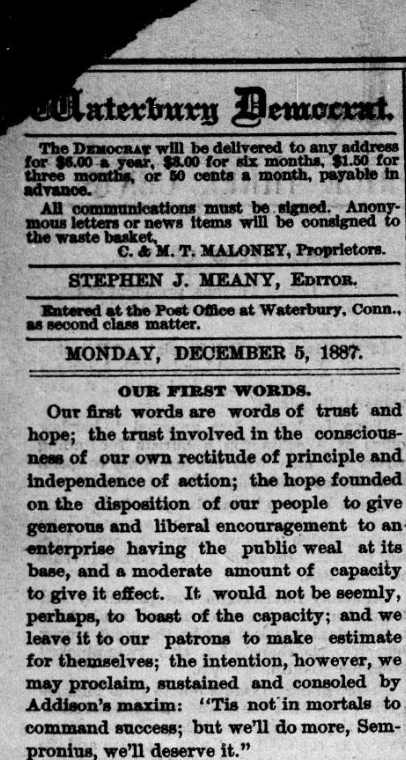 |
| Editorial, Waterbury Democrat, 1887 Courtesy of Library of Congress Chronicling America |
Sunday, January 29, 2017
Early Muslim Immigrants in Waterbury
Waterbury was one of the first places in the United States to become home to a community of Muslim immigrants, when Albanians began arriving a few years before World War I, fleeing war and massacres.
Although Muslims have lived in the United States throughout the entirety of the country's history, it was not until the twentieth century that sizable Muslim communities were able to establish themselves and thrive. The first recorded instance of communal prayers being held by American Muslims happened in 1900 in North Dakota.
Waterbury had one of the first mosques in the United States, established by the Albanian community in 1919. Earlier mosques included ones in North Dakota and Michigan in 1912 and Biddeford, Maine in 1915. Waterbury's mosque may well have been the fourth mosque to be established in this country. I have found very little information about it. By the 1930s, it was gone, but Waterbury's Albanian Muslim community would continue to grow as new wars and political oppression forced more people to flee their homeland.
Although Muslims have lived in the United States throughout the entirety of the country's history, it was not until the twentieth century that sizable Muslim communities were able to establish themselves and thrive. The first recorded instance of communal prayers being held by American Muslims happened in 1900 in North Dakota.
Waterbury had one of the first mosques in the United States, established by the Albanian community in 1919. Earlier mosques included ones in North Dakota and Michigan in 1912 and Biddeford, Maine in 1915. Waterbury's mosque may well have been the fourth mosque to be established in this country. I have found very little information about it. By the 1930s, it was gone, but Waterbury's Albanian Muslim community would continue to grow as new wars and political oppression forced more people to flee their homeland.
 |
| Albanian American Muslim Center on Raymond Street, built in 1969. |
Sunday, January 22, 2017
Waterbury at the Women's Marches
I'm doing something a little different with this post. I wasn't able to attend the Women's March yesterday, but I noticed many of my friends did. I reached out to some Waterbury people who went and asked them to share photos of the event and their reasons for attending. I want to make sure the Waterbury experience of this national historic event is preserved (because that's what historians do).
There's still time to participate in this blog post. If you're from Waterbury, send your photo(s) and reason for participating in the Women's March to waterburygirl@gmail.com and I will add them to the post. [Latest update: Tuesday, January 24, 2017]
There's still time to participate in this blog post. If you're from Waterbury, send your photo(s) and reason for participating in the Women's March to waterburygirl@gmail.com and I will add them to the post. [Latest update: Tuesday, January 24, 2017]
 |
| Women's March in Hartford. Image courtesy of Robert Goodrich. |
Peace and Unity Community Gathering
The Naugatuck Valley Project partnered with Waterbury's United Muslim Masjid and St. John's Episcopal Church to host a community gathering on Wednesday, January 18, 2017. As soon as I heard about it, I was determined to attend and show my support for my Muslim friends and neighbors who face an uncertain future with a president who gladly stoked people's irrational fear of Muslims during his campaign.
I was so pleased to see a large audience at the community gathering. When I arrived, the church was nearly half full and many more people arrived after me. The Rep-Am estimated some 200 people were in attendance. Christians, Jews, Muslims, atheists, agnostics, Democrats, Republicans, Independents, unaffiliated voters, and more came together to take a stand against bigotry, racism, xenophobia, and intolerance.
I was so pleased to see a large audience at the community gathering. When I arrived, the church was nearly half full and many more people arrived after me. The Rep-Am estimated some 200 people were in attendance. Christians, Jews, Muslims, atheists, agnostics, Democrats, Republicans, Independents, unaffiliated voters, and more came together to take a stand against bigotry, racism, xenophobia, and intolerance.
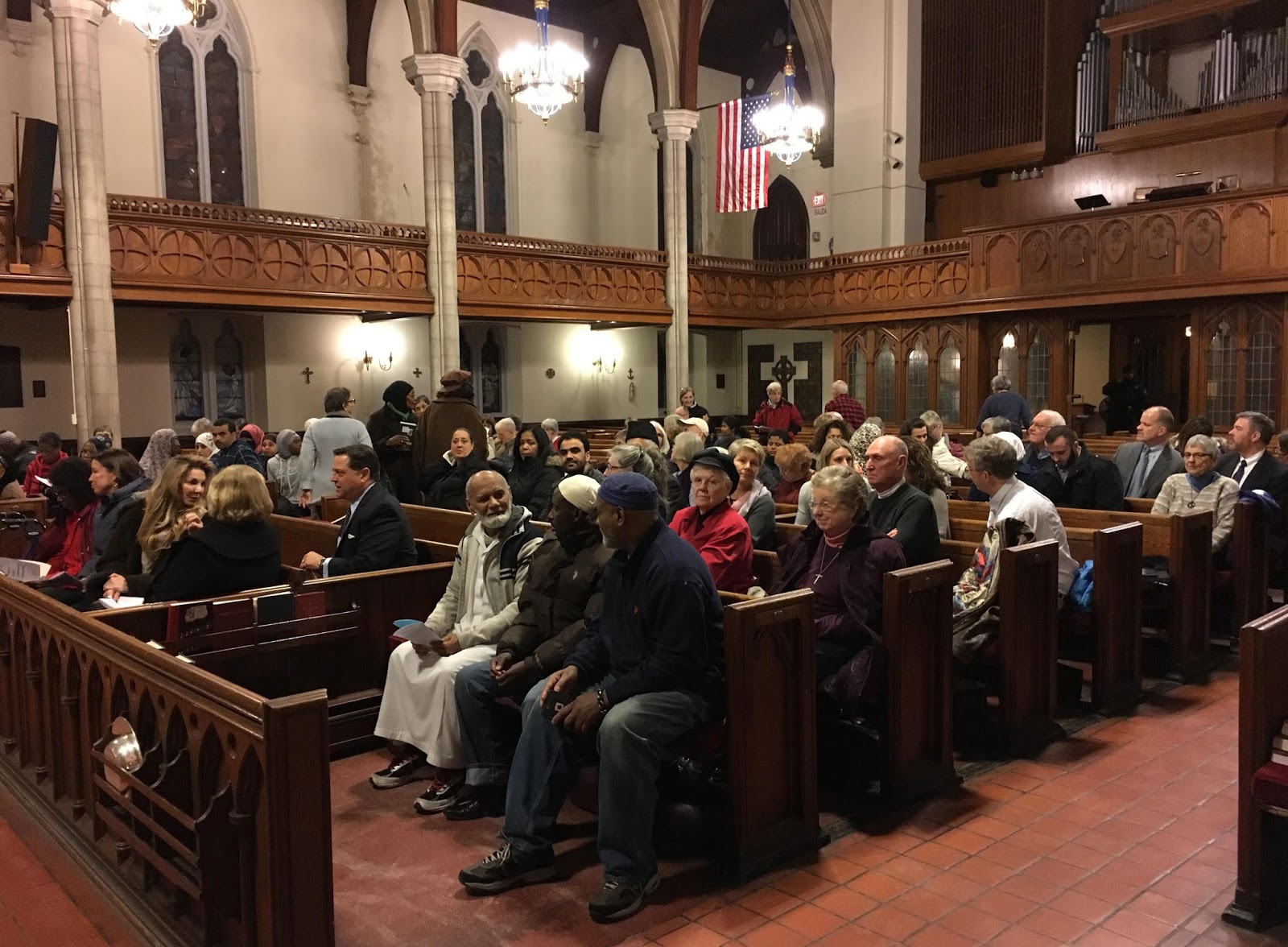 |
| The scene when I arrived, before the church filled up. |
Saturday, January 14, 2017
Grassroots Organizing and Funding
I am a member of the Grassroots Grants Committee at the Connecticut Community Foundation. In the year or so that we've been active, we have been privileged to see some of the amazing individuals and groups that are changing people's lives in Waterbury and to make funds available for their programs. It has been a profoundly heartwarming experience to see how many people truly care about others, to see how many people who have experienced difficulties and suffering in their own lives turn that into a determination to help others facing the same challenges they once faced, and to see how many people are working to lift up those around them out of the goodness of their hearts.
The Grassroots Grants program is open to any Waterbury resident who wants to make positive changes in their neighborhood or community. This can include things like starting a community garden, offering a program for homeless youth, or building relationships between community members.
The Grassroots Grants program is open to any Waterbury resident who wants to make positive changes in their neighborhood or community. This can include things like starting a community garden, offering a program for homeless youth, or building relationships between community members.
 |
| Melissa Green, co-chair of the Grassroots Grants Committee, speaking at the Silas Bronson Library |
Saturday, November 26, 2016
Welton Horse Fountain

The publication of Charles Monagan's novel about Carrie Welton has inspired renewed interest in the statue of a horse on the Green downtown. The novel is very good--I highly recommend reading it, especially if you have any interest at all in Waterbury's history. It blends fiction seamlessly with historical fact, making the past come alive. The Silas Bronson Library has copies of the book available to borrow. You can also buy a copy at John Bale Books on Grand Street, the Mattatuck Museum on the Green, or online at Amazon.com.
For whatever reason, I have always been very passionate about defending the horse that was the inspiration for the statue. If you're not familiar with the story, here's the gist of it: the horse was modeled after Knight, Carrie Welton's favorite horse; Knight, however, was responsible for the death of Carrie's father, Joseph Welton. The condensed version of the story, as it is often told, is "that's Carrie Welton's horse Knight, who killed her father." Very dramatic and memorable, but the full story is more nuanced.
Monday, October 31, 2016
Vampires, Ghosts, and Witches
It's Halloween, so what better time to look for stories of ghosts, goblins, and haunted houses in Waterbury? Here's what I've been able to find so far.
Baby Vampire?
The New-York Gazette reported a bizarre story on September 10, 1770: "We hear from Waterbury, that a Woman of that Town, who in the fourth or fifth Month of her Pregnancy, was taken with a most violent Longing to eat the Flesh from her husband's Arms---he indulged her in making several Attempts, but her Teeth were not sufficient for her Purpose;---and her accountable Longing continued until her Deliver, which was about three Weeks ago. The infant refusing the Breast, or any other Sustenance usually given to Infants, it was offered the raw Flesh of a Fowl, cut fine and dipt in the Fowl's Blood; on which it has fed heartily every Day since its Birth, and is the only Food the Child has taken, till a few Days since, when it eat a little Milk mixt with Blood."
Baby Vampire?
The New-York Gazette reported a bizarre story on September 10, 1770: "We hear from Waterbury, that a Woman of that Town, who in the fourth or fifth Month of her Pregnancy, was taken with a most violent Longing to eat the Flesh from her husband's Arms---he indulged her in making several Attempts, but her Teeth were not sufficient for her Purpose;---and her accountable Longing continued until her Deliver, which was about three Weeks ago. The infant refusing the Breast, or any other Sustenance usually given to Infants, it was offered the raw Flesh of a Fowl, cut fine and dipt in the Fowl's Blood; on which it has fed heartily every Day since its Birth, and is the only Food the Child has taken, till a few Days since, when it eat a little Milk mixt with Blood."
Tuesday, September 20, 2016
Construction on the Green
The big public works project right now is the reconstruction of the Green downtown. The Green has been fenced off, and so far they've removed most of the sidewalks, lamp posts, benches, wood stanchions, and a few trees.
Friday, September 16, 2016
Library Matters
I've always taken it for granted that, of course, everyone has a library card. Why wouldn't you? As it turns out, however, only about a third of the residents of Waterbury have a library card, and more than half of those cards are expired.
In the past year, people have told me they don't use the library because their kids are all grown up, or because they think there's nothing for them at the library. In fact, there is something for everyone at the Silas Bronson Library. Take a look at this list, and I think you'll see something that appeals to you:
In the past year, people have told me they don't use the library because their kids are all grown up, or because they think there's nothing for them at the library. In fact, there is something for everyone at the Silas Bronson Library. Take a look at this list, and I think you'll see something that appeals to you:
Friday, June 17, 2016
Aliens and Refugees During World War II
The war in Europe began with Germany's invasion of Poland and the subsequent declarations of war against Germany by Great Britain and France in September, 1939. On the other side of the Atlantic Ocean, the United States remained neutral until December, 1941, when Japan bombed our military base at Pearl Harbor.
Refugees
In 1940, as the war raged on, the United States began taking in refugees. Children from Great Britain were the first to be welcomed, sent away by their parents in the hopes that they would escape the bombings and the possible impending invasion. (If you're a fan of the Narnia Chronicles, this might sound familiar--the Pevensie children were sent away to the English countryside to escape the Nazi bombings of London.) The U.S. government found itself balancing citizen enthusiasm for taking in refugee children with the slow bureaucratic requirements of the immigration laws ("Mayor Spellacy Gets Assurance," Waterbury Democrat, 13 July 1940).
Refugees
In 1940, as the war raged on, the United States began taking in refugees. Children from Great Britain were the first to be welcomed, sent away by their parents in the hopes that they would escape the bombings and the possible impending invasion. (If you're a fan of the Narnia Chronicles, this might sound familiar--the Pevensie children were sent away to the English countryside to escape the Nazi bombings of London.) The U.S. government found itself balancing citizen enthusiasm for taking in refugee children with the slow bureaucratic requirements of the immigration laws ("Mayor Spellacy Gets Assurance," Waterbury Democrat, 13 July 1940).
 |
| Waterbury Republican, 7 Aug 1940 Collection of Silas Bronson Library |
Sunday, April 10, 2016
A Century of Melting Pot Frictions, Part Five
Part of a series exploring the prejudice each new immigrant group encountered when they arrived in this country.
--------------------------
Chinese and Japanese
Immigrants from Asia fared somewhat better in Waterbury during the late 1800s and early 1900s than did immigrants from Europe, most likely because they came here in small numbers, drawing less attention to themselves. In 1901, the Hartford Courant mentioned in passing that the only Chinese woman in Connecticut lived in Waterbury, running a store with her husband. The paper did not bother to print their names.
--------------------------
Chinese and Japanese
Immigrants from Asia fared somewhat better in Waterbury during the late 1800s and early 1900s than did immigrants from Europe, most likely because they came here in small numbers, drawing less attention to themselves. In 1901, the Hartford Courant mentioned in passing that the only Chinese woman in Connecticut lived in Waterbury, running a store with her husband. The paper did not bother to print their names.
 |
| Hartford Courant, 2 Aug 1901 |
A Century of Melting Pot Frictions: Part Four
Part of a series exploring the prejudice each new immigrant group encountered when they arrived in this country.
--------------------------
Russians
Russian and Italian immigrants were often grouped together as anarchists, perhaps because many of them were socialists advocating for improved labor rights. Russian socialists were referred to as Bolsheviks, the Russian political party led by Lenin which seized control of the Russian government in October 1917. Within a year's time, newspapers across the United States were instilling a fear of the "red terror," Bolshevism, in the hearts of their readers.
--------------------------
Russians
Russian and Italian immigrants were often grouped together as anarchists, perhaps because many of them were socialists advocating for improved labor rights. Russian socialists were referred to as Bolsheviks, the Russian political party led by Lenin which seized control of the Russian government in October 1917. Within a year's time, newspapers across the United States were instilling a fear of the "red terror," Bolshevism, in the hearts of their readers.
A Century of Melting Pot Frictions, Part Three
Part of a series exploring the prejudice each new immigrant group encountered when they arrived in this country.
--------------------------
Italians
After a surge in immigration from Italy during the 1880s, Italians became closely associated with anarchy, socialism, and general crime from the 1890s to the 1930s. "Italian anarchists" is a phrase that was frequently repeated in the newspapers, as was "Italian radical."
--------------------------
Italians
After a surge in immigration from Italy during the 1880s, Italians became closely associated with anarchy, socialism, and general crime from the 1890s to the 1930s. "Italian anarchists" is a phrase that was frequently repeated in the newspapers, as was "Italian radical."
A Century of Melting Pot Frictions, Part Two
Part of a series exploring the prejudice each new immigrant group encountered when they arrived in this country.
--------------------------
New Immigrants
Just as the Irish were reviled during the 1850s, new groups from Europe were reviled during the early 1900s. In 1904, Rev. Joel S. Ives of Hartford preached against immigration ("Connecticut's Immigrant Problem," Boston Evening Transcript, 23 March 1904), declaring that the problem wasn't the large number of immigrants arriving from Europe, but the poor character of the immigrants. He claimed "I have seen no foreign country with worse appearing settlements of foreigners" than what he saw in New Haven. Ives targeted Catholics Italians and Poles, and Russian Jews.
--------------------------
New Immigrants
Just as the Irish were reviled during the 1850s, new groups from Europe were reviled during the early 1900s. In 1904, Rev. Joel S. Ives of Hartford preached against immigration ("Connecticut's Immigrant Problem," Boston Evening Transcript, 23 March 1904), declaring that the problem wasn't the large number of immigrants arriving from Europe, but the poor character of the immigrants. He claimed "I have seen no foreign country with worse appearing settlements of foreigners" than what he saw in New Haven. Ives targeted Catholics Italians and Poles, and Russian Jews.
A Century of Melting Pot Frictions, Part One
Xenophobia is a word that has been used frequently in the past year. The definition, an intense or irrational dislike or fear of people from other countries, clearly describes some of the rhetoric we've been hearing from certain political figures. Whether it's an intense fear of Syrian refugees, an irrational dislike of Mexican immigrants, or an irrational fear of all Muslims, xenophobia has been surging.
As someone who was a child during the 1970s, I have long embraced the melting pot metaphor of this country, thanks in part to a School House Rock video and Disneyland's It's A Small World ride. One of the things that makes America great is our diversity, our ability to integrate people of different faiths and customs into our country. While other nations are torn apart by warfare and genocide stemming from their inability to get along with people of different religions and ethnicities, we have dozens of religions and ethnicities living together in relative harmony. Yes, we still have room for improvement, but overall, we're doing pretty well.
As someone who has immersed herself in historical studies for decades, I have an instinct to compare current events to historical events. Despite the rosy image of the melting pot, our country's history is one in which new groups of immigrants often face a long uphill struggle toward acceptance and integration. Political rhetoric can easily turn to oppressive action. Studying what happened in the past can help us today. We can learn from the mistakes of the past and make better choices in the future.
It's fairly well known that Irish Catholics faced severe discrimination for decades after they began to arrive here in large numbers. Italians weren't considered "white" when they first arrived. Germans were vilified during World War I, to the point that some of them even claimed to be Swiss rather than German. Distrust of Russian immigrants began after World War I and continued through most of the century, thanks to the Cold War. During World War II, Japanese Americans were so distrusted, our government (their government) took away everything they had and locked them up in internment camps.
To a degree, Waterbury has historically been more welcoming of foreigners than many other communities in the United States, largely because the factories eagerly welcomed immigrant laborers to their workforce. The city's success was dependent upon the continual influx of new workers to the factories. But each new immigrant group was met with suspicion, fear, and prejudice as they made their presence known in Waterbury.
As someone who was a child during the 1970s, I have long embraced the melting pot metaphor of this country, thanks in part to a School House Rock video and Disneyland's It's A Small World ride. One of the things that makes America great is our diversity, our ability to integrate people of different faiths and customs into our country. While other nations are torn apart by warfare and genocide stemming from their inability to get along with people of different religions and ethnicities, we have dozens of religions and ethnicities living together in relative harmony. Yes, we still have room for improvement, but overall, we're doing pretty well.
As someone who has immersed herself in historical studies for decades, I have an instinct to compare current events to historical events. Despite the rosy image of the melting pot, our country's history is one in which new groups of immigrants often face a long uphill struggle toward acceptance and integration. Political rhetoric can easily turn to oppressive action. Studying what happened in the past can help us today. We can learn from the mistakes of the past and make better choices in the future.
It's fairly well known that Irish Catholics faced severe discrimination for decades after they began to arrive here in large numbers. Italians weren't considered "white" when they first arrived. Germans were vilified during World War I, to the point that some of them even claimed to be Swiss rather than German. Distrust of Russian immigrants began after World War I and continued through most of the century, thanks to the Cold War. During World War II, Japanese Americans were so distrusted, our government (their government) took away everything they had and locked them up in internment camps.
To a degree, Waterbury has historically been more welcoming of foreigners than many other communities in the United States, largely because the factories eagerly welcomed immigrant laborers to their workforce. The city's success was dependent upon the continual influx of new workers to the factories. But each new immigrant group was met with suspicion, fear, and prejudice as they made their presence known in Waterbury.
Sunday, April 03, 2016
The Crafter's Classroom
There's a great new co-op storefront in downtown Waterbury: The Crafter's Classroom, 106 Grand Street. They opened with a ribbon cutting on Friday, and they already have some fun classes being booked.


Sunday, February 21, 2016
Burning Desire at Seven Angels Theatre
A couple of months ago, I happened to be checking out the Seven Angels Theatre website and was pleasantly surprised to see that Lou Diamond Phillips would be starring in the world premiere of his new play, Burning Desire, right here in Waterbury. Now, I'm not by any means a fangirl of actors. I don't get starstruck. But when I saw that Lou Diamond Phillips (who was so wonderful in La Bamba, Stand and Deliver, Young Guns, a guest appearance on Psych, and now on Longmire) was going to be performing here in Waterbury, at Seven Angels, I immediately bought tickets.
 |
| Image from Seven Angels Theatre Facebook page. |
Sunday, February 14, 2016
Harrub Memorial at Chase Park
During the early 1900s, Americans were fascinated with a romanticized view of the colonial period. Their enthusiasm for the colonial past started in 1876 with the centennial celebration of the start of the Revolutionary War. In 1920, when the country celebrated the 300th anniversary of the Pilgrim's arrival at Plymouth Rock, the Colonial Revival era was in full swing.
Waterbury inventor and engineer Charles Harrub was enamored with an idealized image of the Pilgrims. Following the death of his wife, Rhoby, in 1921, Harrub began planning a memorial to honor both his wife and the Pilgrims. He died before the monument could be completed, but he left his entire estate to the City of Waterbury, which oversaw the completion of Harrub's vision.
Waterbury inventor and engineer Charles Harrub was enamored with an idealized image of the Pilgrims. Following the death of his wife, Rhoby, in 1921, Harrub began planning a memorial to honor both his wife and the Pilgrims. He died before the monument could be completed, but he left his entire estate to the City of Waterbury, which oversaw the completion of Harrub's vision.
 |
| Harrub Pilgrim Memorial, Chase Park, April 2011 |
Instagram Album
I've started a Waterbury Instagram account, where I will be posting photos of all that is beautiful or interesting in the Brass City. I'll be posting at least one photo a day.

You can find the photos at https://www.instagram.com/waterburygirl/ (no Instagram account required for viewing the images).

You can find the photos at https://www.instagram.com/waterburygirl/ (no Instagram account required for viewing the images).
Saturday, January 23, 2016
Snowy Waterbury
I love walking in the snow, and today was a perfect day for doing just that.
 |
| Welton Carriage Shed. |
Civic Responsibility Online
I went back to high school yesterday to participate in a "Who Is My Neighbor?" workshop at Westover School's Rasin Center for Global Justice, sharing my experiences with blogging.
It's always interesting to get someone else's perspective on your work. One of the school's teachers commented afterward that I demonstrated to the students that the internet makes it easier to fulfill a civic responsibility to speak out and to have your voice heard, and that we must abide by an ethical standard of moral judgment and informed opinion (perhaps even more so, since what we post online is there for years). She made a very good point that we must combine moral judgment, informed opinion, and courage in order to be heard. You can write or say whatever you want, but if you aren't trustworthy, you won't be respected, and your voice won't be heard.
Monday, December 21, 2015
St. John's Church
The Rep-Am newspaper recently reported that St. John's Episcopal Church, on the Green, is giving serious thought to selling their building ("St. John's Considers Move," 9 December 2015). According to the article, the church is no longer able to afford the upkeep of the building. More telling, their endowment has dwindled down from millions to only $800,000.
Side note: an endowment is the investment fund that helps pay the bills for churches and other nonprofits. Standard recommended practice is to spend no more than 4% of your annual interest, rolling the rest back into the principle, helping it keep up with inflation. It's a lot like a retirement fund, except that it has to last for centuries. Dipping into the endowment principle should be done only under special circumstances--like a much-needed building expansion or emergency repairs--and the money should be replaced through fundraising as quickly as possible.
If St. John's does decide to sell their building, it will be a significant milestone in Waterbury's history. The Episcopal Church was the second church in Waterbury, dating back to 1740. They've been on the Green since 1795.
When Waterbury was founded, everyone belonged to the Congregational Church (which was the official church of Connecticut until 1818). The Great Awakening, a widespread religious revival of the 1720s and 1730s, led to many people leaving the Congregational Church and joining the Anglican Church (Church of England). After the Revolutionary War, Anglicans in the U.S. ditched their allegiance to the King and reformed as Episcopalians.
Side note: an endowment is the investment fund that helps pay the bills for churches and other nonprofits. Standard recommended practice is to spend no more than 4% of your annual interest, rolling the rest back into the principle, helping it keep up with inflation. It's a lot like a retirement fund, except that it has to last for centuries. Dipping into the endowment principle should be done only under special circumstances--like a much-needed building expansion or emergency repairs--and the money should be replaced through fundraising as quickly as possible.
If St. John's does decide to sell their building, it will be a significant milestone in Waterbury's history. The Episcopal Church was the second church in Waterbury, dating back to 1740. They've been on the Green since 1795.
When Waterbury was founded, everyone belonged to the Congregational Church (which was the official church of Connecticut until 1818). The Great Awakening, a widespread religious revival of the 1720s and 1730s, led to many people leaving the Congregational Church and joining the Anglican Church (Church of England). After the Revolutionary War, Anglicans in the U.S. ditched their allegiance to the King and reformed as Episcopalians.
Wednesday, November 04, 2015
Happy Blogiversary!
Today is the 10 year anniversary of this blog. So much has changed since then. During the first year or two of my blogging, a "hot" post had a dozen views--which isn't too surprising, since many of those early posts were pretty dull! But as they say, the best way to improve as a writer is to keep writing.
As some of you know, I started a new job last month. I am now Director of the Silas Bronson Library in Waterbury--absolutely a dream job. A couple of people have asked if I'll still be writing about Waterbury history, and the answer is a solid YES. Researching and writing about Waterbury history is what I do for fun in my free time. The same is true for my artwork--painting brings me peace and fulfillment.
Thank you to everyone who reads this blog. Rest assured there will be many more posts about history and cool current happenings in the coming months and years. Oh, and if you want to know what's happening at the Bronson Library, you can follow along on Facebook and Twitter. Loads of good stuff there, too! ;)
As some of you know, I started a new job last month. I am now Director of the Silas Bronson Library in Waterbury--absolutely a dream job. A couple of people have asked if I'll still be writing about Waterbury history, and the answer is a solid YES. Researching and writing about Waterbury history is what I do for fun in my free time. The same is true for my artwork--painting brings me peace and fulfillment.
Thank you to everyone who reads this blog. Rest assured there will be many more posts about history and cool current happenings in the coming months and years. Oh, and if you want to know what's happening at the Bronson Library, you can follow along on Facebook and Twitter. Loads of good stuff there, too! ;)
Saturday, October 31, 2015
"Mary Della"
While doing some research into Waterbury history, I stumbled onto a serialized novel from 1929, firmly set in Waterbury. Serialized novels were tremendously popular during the 1800s--most of the famous novels from that era first appeared in serial format in newspapers. The format continued into the 1900s, but eventually lost popularity. Serialized storytelling moved into radio and, eventually, television, where it continues to thrive today.
This particular serialized novel was titled "Mary Della" and was written by someone named Julie Anne Moore. There's no sign of Julie Anne Moore other than being listed as the author of this and other stories. I'm assuming Julie Anne Moore was a pen name. (I'll do some additional research later this week to see if I can find out more about her.)
"Mary Della" was serialized by The Independent Syndicate, a company based in Washington, D.C. It ran in newspapers all over the country, but not simultaneously. Some papers started running it in 1929, others in 1930. Some included photographic illustrations, others ran the installments without any illustrations.
This particular serialized novel was titled "Mary Della" and was written by someone named Julie Anne Moore. There's no sign of Julie Anne Moore other than being listed as the author of this and other stories. I'm assuming Julie Anne Moore was a pen name. (I'll do some additional research later this week to see if I can find out more about her.)
"Mary Della" was serialized by The Independent Syndicate, a company based in Washington, D.C. It ran in newspapers all over the country, but not simultaneously. Some papers started running it in 1929, others in 1930. Some included photographic illustrations, others ran the installments without any illustrations.
Subscribe to:
Posts (Atom)