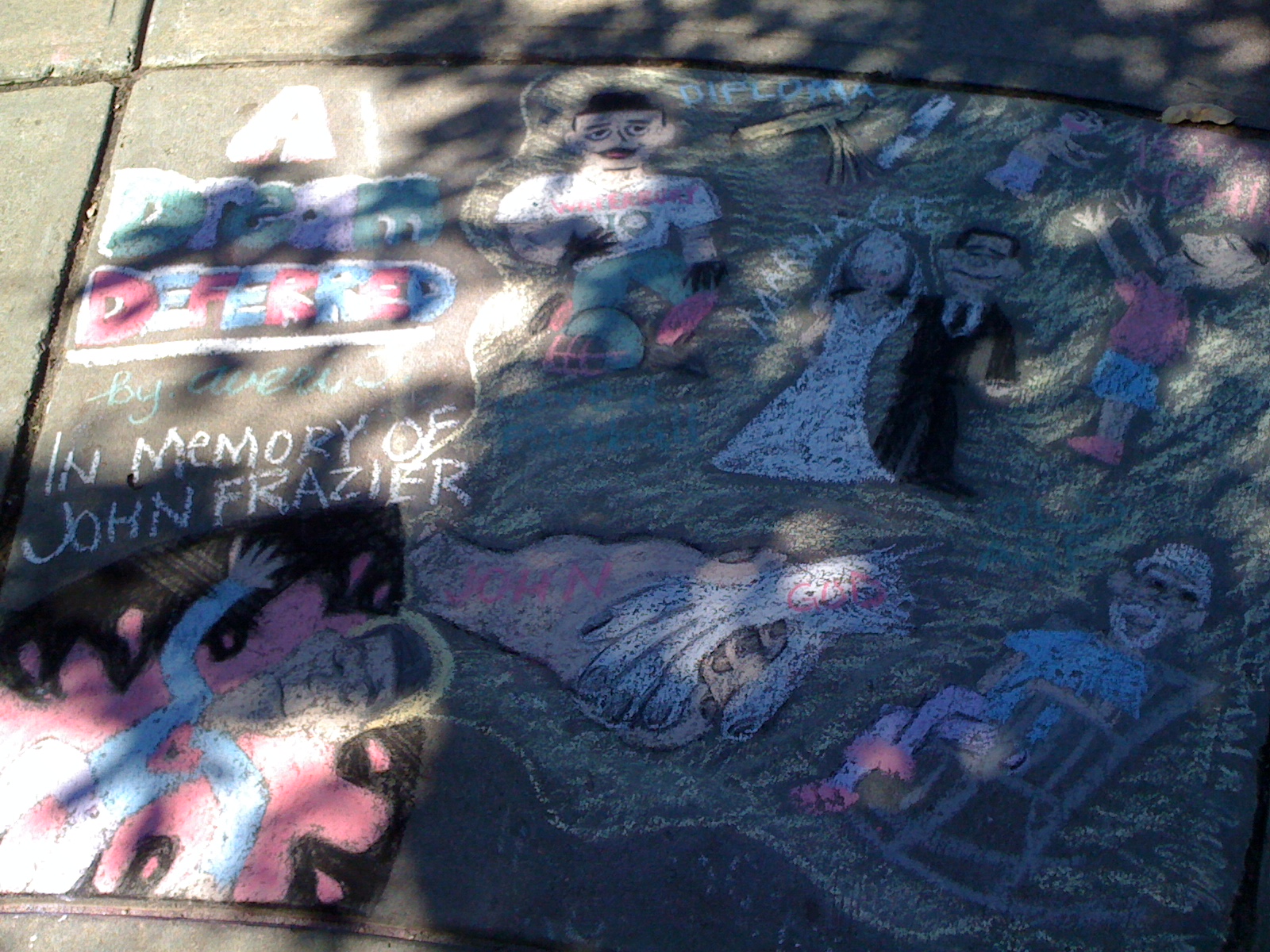
There were a couple of fun events downtown on Saturday, and fortunately the torrential downpours of the previous days were replaced with gorgeous sunny weather. The annual Downtown Draw chalk art competition was held in the morning, followed by an Out for Art event on Bank Street in the afternoon.
The students participating in the chalk drawing competition were given a theme and then went to work creating their art. Here are some of the highlights.
A block of Bank Street was closed to traffic for the afternoon's Out for Art. The shops and restaurant all had outdoor and indoor offerings.
Shakesperience set up a table for anyone wanting to help build papier mâché sets for the Jungle Book.
There was live music outside Howland Hughes.
At 3 p.m., the outdoor music stopped and the number of people at Out for Art suddenly dropped. I was down the street at Goldsmith's, wondering what happened. Eventually I found the music and the people, inside Howland Hughes:
Monday, October 04, 2010
Thursday, September 23, 2010
Art Downtown: Synergy
UConn Waterbury recently unveiled a new sculpture by nationally-known artist Barton Rubenstein called Synergy. The sculpture was created as part of the Connecticut Art in Public Spaces program.
Barton was selected with the help of the Connecticut Commission on Culture and Tourism, which has slide banks of thousands of artworks by artists in the state and beyond.
In addition to adding a sculpture to the UConn campus, the courtyard was upgraded with a basketball court and a paved area for outdoor activities.
One of the interesting things about this sculpture is that it was created through a collaborative process. Sometimes an artist works alone (so many times an artist works alone!), sometimes an artist creates something to meet specific guidelines. For this artwork, the sculptor worked with a committee from UConn which included administrative staff, art faculty, facilities staff, and student representatives. The committee presented the artist with a wide range of concepts, desires and needs, and the artist came back with a proposal that met the committee's input and still stayed within budget.
One of the requested features was a water aspect (symbolic of Waterbury), which is why the sculpture has a constant waterfall flowing from the tops of the steel structures. Steel was chosen as more practical than brass, but the artwork also incorporates a lighting element which creates an illusion of a brassy color where the light strikes the steel.
The twisting columns vary in height, adding visual complexity, avoiding monotony.
The perceived color of the forms changes with the light, both artificial and natural.
Barton was selected with the help of the Connecticut Commission on Culture and Tourism, which has slide banks of thousands of artworks by artists in the state and beyond.
In addition to adding a sculpture to the UConn campus, the courtyard was upgraded with a basketball court and a paved area for outdoor activities.
One of the interesting things about this sculpture is that it was created through a collaborative process. Sometimes an artist works alone (so many times an artist works alone!), sometimes an artist creates something to meet specific guidelines. For this artwork, the sculptor worked with a committee from UConn which included administrative staff, art faculty, facilities staff, and student representatives. The committee presented the artist with a wide range of concepts, desires and needs, and the artist came back with a proposal that met the committee's input and still stayed within budget.
One of the requested features was a water aspect (symbolic of Waterbury), which is why the sculpture has a constant waterfall flowing from the tops of the steel structures. Steel was chosen as more practical than brass, but the artwork also incorporates a lighting element which creates an illusion of a brassy color where the light strikes the steel.
The twisting columns vary in height, adding visual complexity, avoiding monotony.
The perceived color of the forms changes with the light, both artificial and natural.
Tuesday, September 21, 2010
Main Street News
| FOR IMMEDIATE RELEASE | ||||||
| CT Main Street Center |
| |||||
Investment, Jobs Increase in CT Main Street Communities (Hartford, CT) - CT Main Street Center has reported that investment in Connecticut Main Street communities has increased by 17% in the period from June 30, 2009 to June 30, 2010. Since the start of the recession in 2007, the number of net new jobs in Main Street districts has increased by 18%. "Even in this challenging economic climate our Main Street programs are continuing to experience significant investment in their respective districts. It is encouraging to see major institutions invest in facilities and private developers creating more housing in these Main Street districts," said John Simone, President & CEO of CT Main Street Center. Impressive Numbers from New London, Waterbury & Hartford's Upper Albany Neighborhood Particularly impressive numbers have emerged out of downtowns in New London and Waterbury, as well as the Upper Albany Main Street neighborhood in Hartford. In downtown New London over $16.6 million was invested in public and private funds in the past year, most of which were directly attributable to the new Harbour Towers high-rise condominiums. Additionally, building improvements by 19 property owners accounted for $327,000 in private funding for their projects in the Historic Waterfront District. In that same period, downtown Waterbury experienced more than $4.4 million in private investment, in large part to the rehabilitation of 70 Bank Street into 18 fully leased market rate apartments, and the construction of the new Meadow Street Commons, a 28,000 square foot, Class-A retail/storefront/office building at 228 Meadow Street. Hartford's Upper Albany neighborhood welcomed two major projects: the rehabilitation and adaptive reuse of the Chrysalis Center's facilities at the site of the former Sealtest Building on Homestead Avenue, and the construction of the new Wilson-Gray YMCA Youth & Family Center on Albany Avenue. Together, the two projects represent $44 million in investment in the district - and follow the opening of the $20 million University of Hartford Performing Arts Center in 2008. CT Main Street Center collects statistical information on economic activity in designated Main Street communities throughout the state every six months. In addition to increases in public and private investment, jobs, new businesses and building improvements, approximately 20,000 hours of volunteer time has been donated in the past year by individuals in community efforts to bring CT Main Street districts back to life. "The cumulative success of the Main Street Approach and Main Street programs on the local level has earned the revitalization strategy a reputation as one of the most powerful economic development tools in the nation," said John Simone. The mission of CT Main Street Center is to advocate for and help build economically vibrant, traditional main streets as a foundation for healthy communities. CT Street Center is dedicated to community and economic development within the context of historic preservation and is committed to bringing Connecticut's commercial districts back to life socially and economically. Since the Connecticut Main Street program began in 1995, Designated Main Street Communities have generated over $880 million in public and private reinvestment in their downtowns. Over the same time, 412 net new businesses have opened and 2,324 net new jobs have been created. For every $1 spent on a local Main Street program, $73.27 has been reinvested in Connecticut Main Street downtowns, making the Main Street initiative one of the most successful economic development programs in the country. Connecticut Main Street Center is supported by Founding Sponsors; the State of Connecticut Department of Economic & Community Development and The Connecticut Light and Power Company, and by Growth Sponsors; The United Illuminating Company and the Connecticut Commission on Culture & Tourism. Website: http://www.ctmainstreet.org
| ||||||
Wednesday, September 01, 2010
Scovill Homes
We're a few years away from the 100th anniversary of the construction of Scovill Manor, or, as they're known now, the Scovill row homes in the North End. Like the city's Municipal Building, also nearing its centennial anniversary, the homes have fallen into disrepair.
Last year I began attending meetings of the Scovill Homes Association and have subsequently gained a lot of insight into the problems we face. In no particular order, the problems include the following:
1. The Scovill Homes Association was very nearly defunct after an effort to acquire grant funding to restore the houses fell apart. The details of what happened aren't entirely clear to me--there are some pretty serious allegations of wrong-doing--but the end result is that the SHA fell apart. It's been sustained on life support by acting officers. On the upside, I think the SHA is making good strides towards getting back on its feet. Patricia Sockwell, in particular, is making good things happen.
2. Neighbors bicker and squabble and nitpick, letting their personal differences and grudges get in the way of working together to make our neighborhood better for everyone.
3. Many people in other parts of the city look at my neighborhood and see only crime and blight. As a result, this neighborhood is treated differently. A month or so ago, I had to get out of bed around midnight, when I had to wake up for work early the next morning, to go ask someone to turn down the volume on their car stereo. The owner of the car was very apologetic, and explained that he doesn't live in this neighborhood, he just comes here to "hang out."
4. Isolation. I look at my neighbors and I see a lot of good people doing their best to take care of their homes, but on their own. All of them are frustrated--they do what they can, but they can't do it all on their own. One of my neighbors sweeps the sidewalk every morning. Another neighbor spent three days cleaning up the alley behind her house. Some of my neighbors are elderly and can't maintain their property.
5. A certain portion of the Scovill homes is a sort of no-man's land. The area behind the rows was originally intended as a play area for children (which is why there is no playground here). When cars came along, some of those areas became parking. On older maps, the area between Wood and Ives Streets (seen below) was still Scovill property decades after the row homes were built. Scovill is now gone, but the ownership of the property is in limbo. As a parking lot, it is communal property, but no clear owner means no one is responsible for maintaining it. One of my neighbors, a renter, takes it upon himself to keep it as clean as he can, but it's too large for one man to maintain on his own.
6. Slumlords are another problem. While many of the Scovill homes are owner-occupied, many others are rental units. A few of the landlords do a respectable job of maintaining their properties, but most don't care (see point no. 3 above).
7. Abandoned properties are a big part of the problem. There are more than a few Scovill homes that are abandoned. Take, for example, 256 Wood Street. It's been abandoned for years. Children have broken the windows and last year broke in the front door (and, yes, it was children, not junkies). The property has unpaid tax bills dating back to at least 1997, totaling more than $20,000. The Mayor's aide, Steve Gambini, was recently quoted in the newspaper as saying that "...in Waterbury, you can’t get out of [paying taxes]." I'm not seeing anything to support that claim. (On a side note, that quote was in reference to the city auctioning off the Austin House because the owner has $13,000 in back taxes owed, even though she is working on paying off her debts. Hello! What about 256 Wood Street, which has more than that owed in back taxes?!?! Maybe this goes back to point no. 3, maybe the city simply doesn't care about this neighborhood.)
8. While I'm on the topic of whether or not the city cares about this neighborhood (so it wasn't that much of an aside after all), I'm going to have to mention the degree to which this neighborhood feels abandoned by the city. First, however, I want to emphasize that Mike Gilmore and his team have been very responsive to requests from the Scovill Homes Association to help us clean up the neighborhood. But we are still left with other problems: sidewalks that are in such terrible condition they are dangerous (do we need a million dollar injury lawsuit to get them fixed?); lack of drainage causing further decay of the sidewalks; blighted properties at the school bus stop; and dangerous intersections that could be made safe by simply adding more stop signs.
Those are the more immediate problems. There are other issues that we can't even begin to address (like the porches enclosed in cheap vinyl) until we fix these problems. We've been making progress, but it's been slow. I think the biggest problem is the feeling of isolation, that we're struggling entirely on our own. That sense of isolation leads to crippling frustration. It makes people want to give up. It's going to take a lot of energy and a lot of noise and a lot of effort to counteract that frustration, but I think we can do it. We just have to keep trying.
Monday, August 23, 2010
Art in Public Spaces
Let me preface this by saying that I am aware that a single newspaper article often will not tell the whole story, and that it might be written in a way to make a particular topic sound more exciting or dramatic than it really is. With that said, however, an article in yesterday's Rep-Am really put me on edge with the very first sentence: "A plan to build a small sculpture plaza in back of City Hall has prompted a debate over whether the city can afford public art — and if so, what kind."
This is a tough blog post for me to write without ranting incoherently. Maybe I should start with some background information the general public might not be aware of.
In Connecticut, the fundamental importance of having art in public spaces is protected and provided for by law and has been since 1978. To quote directly from the website of the Connecticut Commission on Culture and Tourism: "the Art in Public Spaces program requires that not less than 1% of the cost of construction or renovation of publicly accessible state buildings be allocated for the commission or purchase of artwork for that building."
One percent is a very small percent. For the City Hall project, running at an approximate cost of $36 million, one percent is $360,000. The Waterbury Development Corporation proposes spending less than that, a mere $112,000, for the proposed sculpture court.
The City Hall is not a state building, so it does not have to meet the state requirement. To quote further from the CCCT website: "Twenty-seven states and over 300 municipalities legislatively allocate some portion of building costs for art acquisition. In Connecticut, public art programs also exist in New Haven, Stamford and New Britain." But not in Waterbury.
Waterbury wants to improve its image. Waterbury wants to become more like New Haven, or Stamford, or West Hartford. But instead of forward-thinking city officials who want to spend a fraction of a percentage of the funds allocated for a project that is coming in under budget to create a public sculpture court, we are presented with the Mayor's aide declaring that a sculpture court is not necessary.
Excuse me while I rant incoherently for a minute....
Waterbury does not have a good track record concerning public art. Yes, we do have some great art in public spaces, all of which definitely enhance the beauty and character of the city. But Waterbury has a long way to go to make up for the sheer stupidity of an earlier Mayor's administration, which refused to accept the donation of a sculpture from Alexander Calder, the most famous sculptor in the world, for the Buckingham Building. So far, based on yesterday's article, the current Mayor's administration doesn't seem to be any smarter--but maybe that's just how the article was written.
This is a tough blog post for me to write without ranting incoherently. Maybe I should start with some background information the general public might not be aware of.
In Connecticut, the fundamental importance of having art in public spaces is protected and provided for by law and has been since 1978. To quote directly from the website of the Connecticut Commission on Culture and Tourism: "the Art in Public Spaces program requires that not less than 1% of the cost of construction or renovation of publicly accessible state buildings be allocated for the commission or purchase of artwork for that building."
One percent is a very small percent. For the City Hall project, running at an approximate cost of $36 million, one percent is $360,000. The Waterbury Development Corporation proposes spending less than that, a mere $112,000, for the proposed sculpture court.
The City Hall is not a state building, so it does not have to meet the state requirement. To quote further from the CCCT website: "Twenty-seven states and over 300 municipalities legislatively allocate some portion of building costs for art acquisition. In Connecticut, public art programs also exist in New Haven, Stamford and New Britain." But not in Waterbury.
Waterbury wants to improve its image. Waterbury wants to become more like New Haven, or Stamford, or West Hartford. But instead of forward-thinking city officials who want to spend a fraction of a percentage of the funds allocated for a project that is coming in under budget to create a public sculpture court, we are presented with the Mayor's aide declaring that a sculpture court is not necessary.
Excuse me while I rant incoherently for a minute....
Waterbury does not have a good track record concerning public art. Yes, we do have some great art in public spaces, all of which definitely enhance the beauty and character of the city. But Waterbury has a long way to go to make up for the sheer stupidity of an earlier Mayor's administration, which refused to accept the donation of a sculpture from Alexander Calder, the most famous sculptor in the world, for the Buckingham Building. So far, based on yesterday's article, the current Mayor's administration doesn't seem to be any smarter--but maybe that's just how the article was written.
UPDATE: Kudos to Mayor Jarjura for approving the sculpture court project. The next step is the creation of a committee to select the sculpture.
Wednesday, August 04, 2010
Future of the State (part one)
We're closer and closer the August 10 primary election in Connecticut, and the campaigns are all in full swing--I get between three and five survey phone calls nearly every day, campaign flyers appear in my mailbox daily, and lawn signs are popping up overnight like mushrooms.
There are dozens of candidates running for the many open elected positions. Voters have an incredible opportunity to bring sweeping change into the state at a time when it is most needed. Our current and recent leaders have failed us. Our state is heading for disaster.
Connecticut has been pretty much run into the ground: the state has a projected $3.4 billion deficit for the 2011-12 fiscal year, and unemployment seems to only be worsening as major employers leave the state. People have been talking for years about the state's "brain drain" as some of our brightest young people leave for college outside the state and don't move back. Even on a basic functional level, Connecticut has been failing: something that should have been simple and straight-forward, the improvement of I-84, turned into a costly nightmare when drains weren't installed correctly; meanwhile, other much-needed transportation improvements have been stuck in an endless and expensive Möbius strip of studies that result in nothing but a fat paycheck for the consultants. Our cities have been allowed to languish and decay, while the suburbs have been favored, creating an imbalance that hurts the entire state.
I could write more about the problems in Connecticut, but I think you get the idea. We're in trouble.
With the primary coming up, I need to decide who I'm voting for. Since I'm a Democrat, those are the candidates I've focused on. Here are my current thoughts, obviously based on topics that are important to me and using information on their official websites, on some of the candidates:
Dan Malloy
Good: Expresses concern that our transportation infrastructure is inadequate.
Bad: Doesn't seem to have a plan of improvement beyond getting federal transportation grants.
Good: Seems to have some good and specific plans to improve business in the state, and gives at least a passing mention of the importance of Arts & Culture organizations.
Good: Has a plan to continue cleanup of brownfields.
Good: Recognizes that the current system for earning teaching certification pretty much guarantees that many great educators will never pursue certification and teach in the public schools and proposes the creation of alternate routes to certification (this has been a sore point for me: I am qualified to teach CEU seminars to the teachers, and I am qualified to teach the college students, but I can't teach in the public schools because I am not certified, and it simply is not feasible for me to go back to school in order to get certified; in fact, I've taught at community colleges and UConn for years and can see how our students aren't getting the education they need in the high schools, which just adds to my frustration on this topic).
Bad: In discussing parent involvement in education, he seems to be completely ignorant of the fact that many of the low-achieving students are stuck in households with parents who will never be involved or supportive or nurturing. What about these kids?
Good: Wants more "affordable housing" and lower property taxes.
Bad: Doesn't explain how to compensate for loss of revenue if property taxes are lowered, and doesn't seem to have more than a vague and superficial knowledge of housing issues.
Ned Lamont
Good: Has specific plans for improving transportation, particularly train transit, all of which sound great to me (especially increasing frequency on the Waterbury line and adding wifi to all the trains), plus increasing safety for bicyclists, plus improving bus service.
Good: Understands that our cities are transportation hubs and should be developed accordingly.
Good: Appreciates the benefits of charter schools and other innovative approaches to education, as well as the benefits of schools as true community centers and the importance of vo-tech schools.
Good: "The road to economic recovery runs through our cities. Connecticut was at its best when we had vibrant urban centers." and "Connecticut’s future must start with our cities. They must be centers of entrepreneurship, where the best and brightest can innovate, start businesses, and create jobs. With livable, walkable downtowns, our cities can keep young people in Connecticut. As governor, I will lead the revival of our urban areas."
Summary: Malloy has strong, specific plans for education and business, but is vague on every other topic. Lamont seems to have a much better idea of how to get things done, and seems to have many of the same goals and interests as myself. I have some specific questions I'd like to ask both candidates, but as it stands now, I'll be voting for Lamont.
I have already blogged some about Jarjura running for State Comptroller. As far as Kevin Lembo goes, his experience as assistant state comptroller suggests to me that he has solid qualifications for the job.
As the title of this blog post suggests, I'll be writing more on the elections, as time permits.
There are dozens of candidates running for the many open elected positions. Voters have an incredible opportunity to bring sweeping change into the state at a time when it is most needed. Our current and recent leaders have failed us. Our state is heading for disaster.
Connecticut has been pretty much run into the ground: the state has a projected $3.4 billion deficit for the 2011-12 fiscal year, and unemployment seems to only be worsening as major employers leave the state. People have been talking for years about the state's "brain drain" as some of our brightest young people leave for college outside the state and don't move back. Even on a basic functional level, Connecticut has been failing: something that should have been simple and straight-forward, the improvement of I-84, turned into a costly nightmare when drains weren't installed correctly; meanwhile, other much-needed transportation improvements have been stuck in an endless and expensive Möbius strip of studies that result in nothing but a fat paycheck for the consultants. Our cities have been allowed to languish and decay, while the suburbs have been favored, creating an imbalance that hurts the entire state.
I could write more about the problems in Connecticut, but I think you get the idea. We're in trouble.
With the primary coming up, I need to decide who I'm voting for. Since I'm a Democrat, those are the candidates I've focused on. Here are my current thoughts, obviously based on topics that are important to me and using information on their official websites, on some of the candidates:
Dan Malloy
Good: Expresses concern that our transportation infrastructure is inadequate.
Bad: Doesn't seem to have a plan of improvement beyond getting federal transportation grants.
Good: Seems to have some good and specific plans to improve business in the state, and gives at least a passing mention of the importance of Arts & Culture organizations.
Good: Has a plan to continue cleanup of brownfields.
Good: Recognizes that the current system for earning teaching certification pretty much guarantees that many great educators will never pursue certification and teach in the public schools and proposes the creation of alternate routes to certification (this has been a sore point for me: I am qualified to teach CEU seminars to the teachers, and I am qualified to teach the college students, but I can't teach in the public schools because I am not certified, and it simply is not feasible for me to go back to school in order to get certified; in fact, I've taught at community colleges and UConn for years and can see how our students aren't getting the education they need in the high schools, which just adds to my frustration on this topic).
Bad: In discussing parent involvement in education, he seems to be completely ignorant of the fact that many of the low-achieving students are stuck in households with parents who will never be involved or supportive or nurturing. What about these kids?
Good: Wants more "affordable housing" and lower property taxes.
Bad: Doesn't explain how to compensate for loss of revenue if property taxes are lowered, and doesn't seem to have more than a vague and superficial knowledge of housing issues.
Ned Lamont
Good: Has specific plans for improving transportation, particularly train transit, all of which sound great to me (especially increasing frequency on the Waterbury line and adding wifi to all the trains), plus increasing safety for bicyclists, plus improving bus service.
Good: Understands that our cities are transportation hubs and should be developed accordingly.
Good: Appreciates the benefits of charter schools and other innovative approaches to education, as well as the benefits of schools as true community centers and the importance of vo-tech schools.
Good: "The road to economic recovery runs through our cities. Connecticut was at its best when we had vibrant urban centers." and "Connecticut’s future must start with our cities. They must be centers of entrepreneurship, where the best and brightest can innovate, start businesses, and create jobs. With livable, walkable downtowns, our cities can keep young people in Connecticut. As governor, I will lead the revival of our urban areas."
Summary: Malloy has strong, specific plans for education and business, but is vague on every other topic. Lamont seems to have a much better idea of how to get things done, and seems to have many of the same goals and interests as myself. I have some specific questions I'd like to ask both candidates, but as it stands now, I'll be voting for Lamont.
I have already blogged some about Jarjura running for State Comptroller. As far as Kevin Lembo goes, his experience as assistant state comptroller suggests to me that he has solid qualifications for the job.
As the title of this blog post suggests, I'll be writing more on the elections, as time permits.
Flowers!
I'm still amazed that things grow when I put them in the ground (one look at my half-dead houseplants will tell you why this amazes me).
.JPG)
The black-eyed susans were planted last year and are going strong. The pink flowers (gladiolus) were planted a few months ago.
.JPG)
My haphazard efforts to beautify my yard will be getting professional help this fall. Expect some impressive Before and After photos when that happens!
The black-eyed susans were planted last year and are going strong. The pink flowers (gladiolus) were planted a few months ago.
My haphazard efforts to beautify my yard will be getting professional help this fall. Expect some impressive Before and After photos when that happens!
Friday, July 16, 2010
Thank You, Durable!
I've been having trouble this year with my car's front left turn signal. The whole part was replaced a little over two years ago after a reckless jerk slammed into my car (which is a whole other story about unsafe intersections that could easily be made safer with a few stop signs).
The bulb went out early this year, and I had it replaced along with a few other maintenance repairs at the dealership. Pretty much everything else they did that day turned out to be bad, and it looks like they couldn't even get a simple bulb replacement done right.
A month or so after they replaced the bulb, it went out again. Since I was still mad at the dealership for the massive incompetence of their mechanic, I didn't take it back to them. I also didn't take it back to them because they had been trying to get me to replace the entire turn signal, even though it is only 2 years old.
This week I finally replaced the bulb again, at Jiffy Lube. The next day, it was out again. So frustrating! But this time I finally got smart and took the car back to Durable, along with the paperwork from when they installed the light.
The mechanic at Durable took one look at my light bulb, saw that it hadn't been screwed in all the way, and saw that there was rust in the socket because the previous bulb also hadn't been installed properly. He sand-blasted the rust, installed the bulb correctly, and was finished in minutes, all for no charge. Fantastic!
After suffering with incompetent mechanics, it is downright exciting to find a mechanic who knows what he's doing and takes pride in his work. I can see why Durable has been in business for a century--they know what they're doing and they do it well.
Monday, July 12, 2010
City Hall Tour
After several years of work, the renovation and restoration of our fabulous and nationally-famed Cass Gilbert Municipal Building (City Hall) is nearing completion. As a volunteer with Main Street Waterbury, I was privileged to go on a sneak-peek tour this past Saturday morning. Below are some of the photos I took, along with some explanations. (For contrast, take a look at the "before" photos in my 2006 blog post.)
As you can see, work is still in progress. The restored spaces, particularly the spectacular decorative walls and ceilings, are absolutely breathtaking. It reminds me of the Palace Theater when it reopened after being restored. Simply spectacular!
The cupola is completed. Constructed of copper laid over wood, with a gilt dome and some gilt details. The original clock movement was removed years ago and was given to the Mattatuck Museum.
.JPG)
.JPG)
Next is a view of the Aldermanic Chamber, with restored walls and ceiling. The mural map of Waterbury which you might remember being in the alcove is still there, under the painting recreating Cass Gilbert's original design. Our tour guide, Andrew Martelli (seen holding his daughter in the photo), explained that the map couldn't be removed without being destroyed, so the restored "original" fresco is designed to be removable without harming the map.
.JPG)
The restored ceiling of the Aldermanic Chambers.
.JPG)
Frescoes over the doorways on the second floor have been revealed and will be restored.
.JPG)
The restored ceiling of what was originally a courtroom on the opposite end of the second floor.
.JPG)
And a view of the wall with an appropriately judicial quote in the alcove--there are additional motifs throughout the room that indicate its original function.
.JPG)
A view of the courtyard.
.JPG)
Part of the fun of taking a tour before the project is completed is getting to see the "bones" of the building. The next shot is on the first floor, in the hallway, showing the marble walls laid over more functional brick.
.JPG)
The ceiling on the first floor. Absolutely amazing. Before it was a hideous yellow with white patchwork.
.JPG)
The main staircase. The original risers will remain, but the steps are so worn down they need to be replaced, after the construction crew are done using it. There are now two new and ugly staircases in the building in order to meet modern fire safety codes.
.JPG)
The restored walls and windows (which had been just about ready to fall out) in the main staircase.
.JPG)
Did anyone ever notice the medallions with Medusa before? Until now, they were covered with so many layers of paint they could barely be seen.
.JPG)
Below is the view towards the main staircase from what was originally the Mayor's Office, on the second floor. The Mayor's Office was relocated across the street after the Chase Companies sold their Cass Gilbert-designed headquarters to the city for one dollar in the late 1960s. As of next year, the Mayor's Office will return to City Hall, with one difference. The front room will be reception, and the Mayor's actual office will be down the hall, a little more difficult to access.
.JPG)
.JPG)
Here's another of the fun surprises revealed during the renovations--the original parquet floor of the Mayor's Office, hidden under layers of linoleum and vinyl.
.JPG)
Here's one of two skylights on the third floor (the other skylight has not been restored), in what was the drafting room. The entire third floor will be Corporation Council. Each of the city's eleven attorneys get their own office. Eleven attorneys! Something about that seems very disturbing. Why do we need eleven attorneys?
.JPG)
And last but not least, a view from the roof of the new bricks and marbles in front of the building. Interestingly, the new marble comes from the same Vermont quarry as the original marble. The main fountain will once again be a fountain, not a flower pot. There are some modifications--there is now going to be a walkway straight across the middle, since pedestrians have been cutting through that way for years. (Finally! The city does something pedestrian-friendly!).
.JPG)
While there were a few things that are too bad (like losing one of the skylights), overall the renovation and restoration are fantastic. I sincerely hope the project includes the creation of a regular plan of maintenance and that the city actually maintains proper care of the building. It is a stunning building, something we can all take pride in.
As you can see, work is still in progress. The restored spaces, particularly the spectacular decorative walls and ceilings, are absolutely breathtaking. It reminds me of the Palace Theater when it reopened after being restored. Simply spectacular!
The cupola is completed. Constructed of copper laid over wood, with a gilt dome and some gilt details. The original clock movement was removed years ago and was given to the Mattatuck Museum.
Next is a view of the Aldermanic Chamber, with restored walls and ceiling. The mural map of Waterbury which you might remember being in the alcove is still there, under the painting recreating Cass Gilbert's original design. Our tour guide, Andrew Martelli (seen holding his daughter in the photo), explained that the map couldn't be removed without being destroyed, so the restored "original" fresco is designed to be removable without harming the map.
The restored ceiling of the Aldermanic Chambers.
Frescoes over the doorways on the second floor have been revealed and will be restored.
The restored ceiling of what was originally a courtroom on the opposite end of the second floor.
And a view of the wall with an appropriately judicial quote in the alcove--there are additional motifs throughout the room that indicate its original function.
A view of the courtyard.
Part of the fun of taking a tour before the project is completed is getting to see the "bones" of the building. The next shot is on the first floor, in the hallway, showing the marble walls laid over more functional brick.
The ceiling on the first floor. Absolutely amazing. Before it was a hideous yellow with white patchwork.
The main staircase. The original risers will remain, but the steps are so worn down they need to be replaced, after the construction crew are done using it. There are now two new and ugly staircases in the building in order to meet modern fire safety codes.
The restored walls and windows (which had been just about ready to fall out) in the main staircase.
Did anyone ever notice the medallions with Medusa before? Until now, they were covered with so many layers of paint they could barely be seen.
Below is the view towards the main staircase from what was originally the Mayor's Office, on the second floor. The Mayor's Office was relocated across the street after the Chase Companies sold their Cass Gilbert-designed headquarters to the city for one dollar in the late 1960s. As of next year, the Mayor's Office will return to City Hall, with one difference. The front room will be reception, and the Mayor's actual office will be down the hall, a little more difficult to access.
Here's another of the fun surprises revealed during the renovations--the original parquet floor of the Mayor's Office, hidden under layers of linoleum and vinyl.
Here's one of two skylights on the third floor (the other skylight has not been restored), in what was the drafting room. The entire third floor will be Corporation Council. Each of the city's eleven attorneys get their own office. Eleven attorneys! Something about that seems very disturbing. Why do we need eleven attorneys?
And last but not least, a view from the roof of the new bricks and marbles in front of the building. Interestingly, the new marble comes from the same Vermont quarry as the original marble. The main fountain will once again be a fountain, not a flower pot. There are some modifications--there is now going to be a walkway straight across the middle, since pedestrians have been cutting through that way for years. (Finally! The city does something pedestrian-friendly!).
While there were a few things that are too bad (like losing one of the skylights), overall the renovation and restoration are fantastic. I sincerely hope the project includes the creation of a regular plan of maintenance and that the city actually maintains proper care of the building. It is a stunning building, something we can all take pride in.
Friday, July 09, 2010
Tree to a Good Home
When the really bad storm came through on June 24, I wasn't at home, so I can't say if there was a tornado over Wood and Oak Streets. There was one not too far away, over near Bouley Avenue and Wolcott Street (the Rep-Am ran a photo of the funnel cloud the next day).
What I can say is that there was a tree down in front of my house, a tree down to the side of my house, and a tree down in my back yard. By the time I got home that day, the tree in front had been removed (it was blocking the street) except for a 20-foot branch dangling from the power wires. Mysteriously, the tree in my back yard was sawed up into several sections, each about five or six feet in length. All that was left in my yard were small branches and sawdust.
With some help from a friend, I tidied up the tree and its branches into a single pile and waited to see if anyone would come to claim the wood. After all, if someone went to all the trouble of cutting up a tree in my yard, surely they had some interest in taking it for themselves, right?
.JPG)
Two weeks later, and the tree is still out back. I'm not sure what to do with it. Anyone want it? First come, first serve!
What I can say is that there was a tree down in front of my house, a tree down to the side of my house, and a tree down in my back yard. By the time I got home that day, the tree in front had been removed (it was blocking the street) except for a 20-foot branch dangling from the power wires. Mysteriously, the tree in my back yard was sawed up into several sections, each about five or six feet in length. All that was left in my yard were small branches and sawdust.
With some help from a friend, I tidied up the tree and its branches into a single pile and waited to see if anyone would come to claim the wood. After all, if someone went to all the trouble of cutting up a tree in my yard, surely they had some interest in taking it for themselves, right?
Two weeks later, and the tree is still out back. I'm not sure what to do with it. Anyone want it? First come, first serve!
Subscribe to:
Posts (Atom)


