Sunday, September 10, 2017

#IBelieveInWaterbury and The Valley Girls

#IBelieveInWaterbury is the title of a new exhibit at the Mattatuck Museum, on view until December 3. The art is installed throughout the building, rather than being condensed into a single space. The result is that visitors find themselves on a sort of treasure hunt, looking for artwork inspired by Waterbury throughout all three floors (plus two mezzanine stairwell levels, a rooftop, and the front lobby).

The museum spent several months recruiting artists from near and far to participate, arranging special tours of Holyland, Rose Hill, and several churches to help inspire the artists. The final submissions were sifted through by a trio of jurors, who wound up selecting the work of 40 artists for the show. Below are some of my favorites.


Thursday, August 03, 2017

More on the Whipping Post

There has been a tremendous amount of public controversy about the post on the Green. Although many people seem to be picking and choosing facts that support their strongly held opinions, others have been more open-minded and are genuinely interested in learning more. Since this is such a widely-discussed topic, I've spent some time doing more research. Please be aware that the research is not completed: there are thousands of archival documents to sift through, photographs to compare, decades of newspaper articles to browse on microfilm, and scientific analysis of the post (just for starters). That level of research is not something I can undertake, since I'm doing this in my free time. It's the sort of research project for which a museum or historical society can get grant funding, or which a grad student might undertake for a dissertation.

The post on the Green in 2017, about a week before it was removed.


Monday, July 17, 2017

Whipping Post on the Green

There was a demonstration on the Green last week. I didn't see it myself, but photos have been showing up on Facebook. The issue in question is the controversial presence of the potentially centuries-old whipping post on the newly renovated Green. While many people have forgotten its original purpose and saw it as an innocent piece of history, in use as a bulletin board for centuries, others clearly recognized it as more than just a public notice board.

Photo from Jesus Papers' Facebook page, posted July 15, 2017.

The demonstration was performance art, as you can see from the photo, one of several circulating on Facebook right now.

Thursday, June 29, 2017

Early Female Physicians

Harriet Judd Sartain (1830-1923) is today remembered primarily for her work in homeopathic medicine in Philadelphia, but she was also the first woman with a medical degree to practice in Waterbury, returning here after finishing her education in 1854. She was one of two Connecticut women to earn medical degrees from the Female Medical College of Pennsylvania in 1853; the other was Ellen Boyle of Farmington. They were the first women from Connecticut to attend that college and may very well have been the first two women from Connecticut to earn medical degrees. Sixty years later, Judd Sartain was hailed as "the pioneer woman physician of America."


Forest City (SD) Press, 22 July 1914
Courtesy of Chronicling America

Sunday, June 25, 2017

Community Cleanup at Scovill Homes

There are people who sit around complaining about problems, and then there are people who dive right in and solve the problems. Today was a good day for the problem-solvers in the Scovill Row Homes.

Saturday, June 10, 2017

ACT For America Protest in Waterbury

A group called ACT for America organized "March Against Sharia" protests in two dozen cities around the country. The protest in Connecticut was held in front of Waterbury's City Hall. A counter-protest was held in front of the Silas Bronson Library.

The scene at City Hall just after 10 a.m.

Friday, June 02, 2017

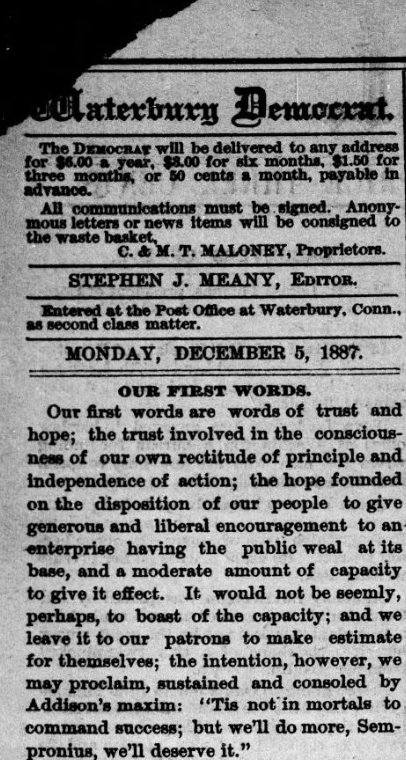
Waterbury Democrat Newspaper

The Waterbury Democrat began in July 1881 as a weekly newspaper called the Valley Democrat in Waterbury, Connecticut. The newspaper became The Sunday Democrat on January 7, 1886, and The Waterbury Evening Democrat on December 5, 1887. Founded by an Irish Catholic Democrat, Cornelius Maloney, the Democrat was known for its promotion of the Democratic Party’s principles and for its coverage of Irish and Catholic topics. The paper focused its local reporting on Waterbury news and sports, along with a column for the neighboring towns of Naugatuck, Oakville, and Watertown.

Irish Catholics made up approximately half of Waterbury’s population at this time. The city’s first Irish immigrants arrived during the early 1830s. By the 1880s, they had largely overcome discrimination from the city’s Protestant community and were establishing themselves as a formidable force in local politics.

Cornelius Maloney was joined by his brother, Michael Thomas Maloney, in 1882, establishing the publishing firm name C. & M. T. Maloney. The Maloney brothers learned the printing and newspaper business in New Britain. Cornelius apprenticed with Oviatt & Guernsey, and later worked for the New Britain Record and the New Britain Observer before moving to Waterbury. He served as a Representative in the Connecticut General Assembly in 1887 and 1888, and he was the founder and first Grand Knight of the local Knights of Columbus, Sheridan Council, No. 24.

Editorial, Waterbury Democrat, 1887
Courtesy of Library of Congress Chronicling America


Sunday, January 29, 2017

Early Muslim Immigrants in Waterbury

Waterbury was one of the first places in the United States to become home to a community of Muslim immigrants, when Albanians began arriving a few years before World War I, fleeing war and massacres.

Although Muslims have lived in the United States throughout the entirety of the country's history, it was not until the twentieth century that sizable Muslim communities were able to establish themselves and thrive. The first recorded instance of communal prayers being held by American Muslims happened in 1900 in North Dakota.

Waterbury had one of the first mosques in the United States, established by the Albanian community in 1919. Earlier mosques included ones in North Dakota and Michigan in 1912 and Biddeford, Maine in 1915. Waterbury's mosque may well have been the fourth mosque to be established in this country. I have found very little information about it. By the 1930s, it was gone, but Waterbury's Albanian Muslim community would continue to grow as new wars and political oppression forced more people to flee their homeland.

Albanian American Muslim Center on Raymond Street, built in 1969.


Sunday, January 22, 2017

Waterbury at the Women's Marches

I'm doing something a little different with this post. I wasn't able to attend the Women's March yesterday, but I noticed many of my friends did. I reached out to some Waterbury people who went and asked them to share photos of the event and their reasons for attending. I want to make sure the Waterbury experience of this national historic event is preserved (because that's what historians do).

There's still time to participate in this blog post. If you're from Waterbury, send your photo(s) and reason for participating in the Women's March to waterburygirl@gmail.com and I will add them to the post. [Latest update: Tuesday, January 24, 2017]

Women's March in Hartford. Image courtesy of Robert Goodrich.


Peace and Unity Community Gathering

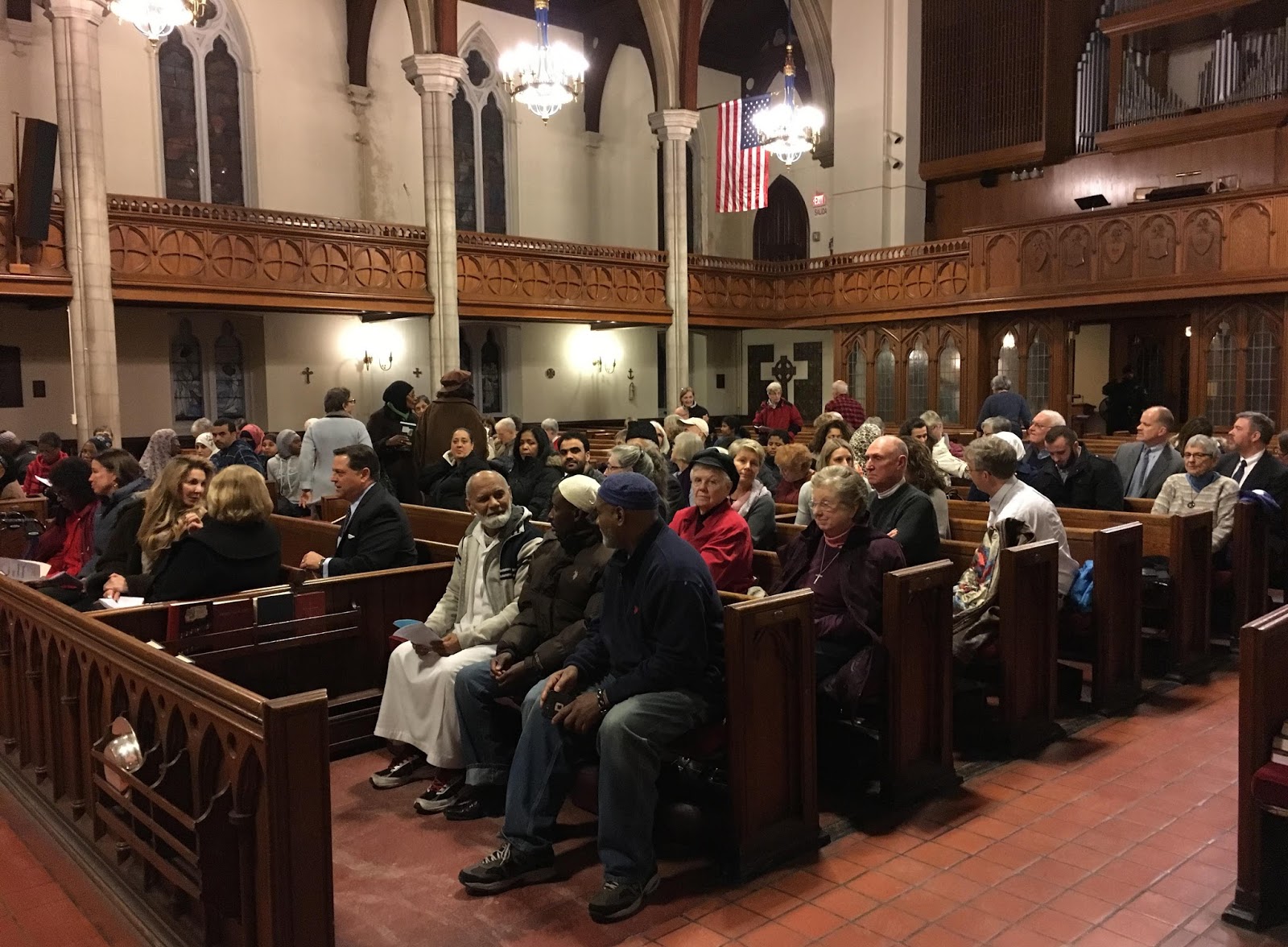
The Naugatuck Valley Project partnered with Waterbury's United Muslim Masjid and St. John's Episcopal Church to host a community gathering on Wednesday, January 18, 2017. As soon as I heard about it, I was determined to attend and show my support for my Muslim friends and neighbors who face an uncertain future with a president who gladly stoked people's irrational fear of Muslims during his campaign.

I was so pleased to see a large audience at the community gathering. When I arrived, the church was nearly half full and many more people arrived after me. The Rep-Am estimated some 200 people were in attendance. Christians, Jews, Muslims, atheists, agnostics, Democrats, Republicans, Independents, unaffiliated voters, and more came together to take a stand against bigotry, racism, xenophobia, and intolerance.

The scene when I arrived, before the church filled up.

Saturday, January 14, 2017

Grassroots Organizing and Funding

I am a member of the Grassroots Grants Committee at the Connecticut Community Foundation. In the year or so that we've been active, we have been privileged to see some of the amazing individuals and groups that are changing people's lives in Waterbury and to make funds available for their programs. It has been a profoundly heartwarming experience to see how many people truly care about others, to see how many people who have experienced difficulties and suffering in their own lives turn that into a determination to help others facing the same challenges they once faced, and to see how many people are working to lift up those around them out of the goodness of their hearts.

The Grassroots Grants program is open to any Waterbury resident who wants to make positive changes in their neighborhood or community. This can include things like starting a community garden, offering a program for homeless youth, or building relationships between community members.

Melissa Green, co-chair of the Grassroots Grants Committee, speaking at the Silas Bronson Library


Saturday, November 26, 2016

Welton Horse Fountain


The publication of Charles Monagan's novel about Carrie Welton has inspired renewed interest in the statue of a horse on the Green downtown. The novel is very good--I highly recommend reading it, especially if you have any interest at all in Waterbury's history. It blends fiction seamlessly with historical fact, making the past come alive. The Silas Bronson Library has copies of the book available to borrow. You can also buy a copy at John Bale Books on Grand Street, the Mattatuck Museum on the Green, or online at Amazon.com.

For whatever reason, I have always been very passionate about defending the horse that was the inspiration for the statue. If you're not familiar with the story, here's the gist of it: the horse was modeled after Knight, Carrie Welton's favorite horse; Knight, however, was responsible for the death of Carrie's father, Joseph Welton. The condensed version of the story, as it is often told, is "that's Carrie Welton's horse Knight, who killed her father." Very dramatic and memorable, but the full story is more nuanced.

Monday, October 31, 2016

Vampires, Ghosts, and Witches

It's Halloween, so what better time to look for stories of ghosts, goblins, and haunted houses in Waterbury? Here's what I've been able to find so far.


Baby Vampire?

The New-York Gazette reported a bizarre story on September 10, 1770: "We hear from Waterbury, that a Woman of that Town, who in the fourth or fifth Month of her Pregnancy, was taken with a most violent Longing to eat the Flesh from her husband's Arms---he indulged her in making several Attempts, but her Teeth were not sufficient for her Purpose;---and her accountable Longing continued until her Deliver, which was about three Weeks ago. The infant refusing the Breast, or any other Sustenance usually given to Infants, it was offered the raw Flesh of a Fowl, cut fine and dipt in the Fowl's Blood; on which it has fed heartily every Day since its Birth, and is the only Food the Child has taken, till a few Days since, when it eat a little Milk mixt with Blood."

Tuesday, September 20, 2016

Construction on the Green

The big public works project right now is the reconstruction of the Green downtown. The Green has been fenced off, and so far they've removed most of the sidewalks, lamp posts, benches, wood stanchions, and a few trees.

Friday, September 16, 2016

Library Matters

I've always taken it for granted that, of course, everyone has a library card. Why wouldn't you? As it turns out, however, only about a third of the residents of Waterbury have a library card, and more than half of those cards are expired.

In the past year, people have told me they don't use the library because their kids are all grown up, or because they think there's nothing for them at the library. In fact, there is something for everyone at the Silas Bronson Library. Take a look at this list, and I think you'll see something that appeals to you:

Friday, June 17, 2016

Aliens and Refugees During World War II

The war in Europe began with Germany's invasion of Poland and the subsequent declarations of war against Germany by Great Britain and France in September, 1939. On the other side of the Atlantic Ocean, the United States remained neutral until December, 1941, when Japan bombed our military base at Pearl Harbor.

Refugees

In 1940, as the war raged on, the United States began taking in refugees. Children from Great Britain were the first to be welcomed, sent away by their parents in the hopes that they would escape the bombings and the possible impending invasion. (If you're a fan of the Narnia Chronicles, this might sound familiar--the Pevensie children were sent away to the English countryside to escape the Nazi bombings of London.) The U.S. government found itself balancing citizen enthusiasm for taking in refugee children with the slow bureaucratic requirements of the immigration laws ("Mayor Spellacy Gets Assurance," Waterbury Democrat, 13 July 1940).

Waterbury Republican, 7 Aug 1940
Collection of Silas Bronson Library

Sunday, April 10, 2016

A Century of Melting Pot Frictions, Part Five

Part of a series exploring the prejudice each new immigrant group encountered when they arrived in this country.
--------------------------
 
Chinese and Japanese

Immigrants from Asia fared somewhat better in Waterbury during the late 1800s and early 1900s than did immigrants from Europe, most likely because they came here in small numbers, drawing less attention to themselves. In 1901, the Hartford Courant mentioned in passing that the only Chinese woman in Connecticut lived in Waterbury, running a store with her husband. The paper did not bother to print their names.

Hartford Courant, 2 Aug 1901


A Century of Melting Pot Frictions: Part Four

Part of a series exploring the prejudice each new immigrant group encountered when they arrived in this country.
--------------------------
 
Russians

Russian and Italian immigrants were often grouped together as anarchists, perhaps because many of them were socialists advocating for improved labor rights. Russian socialists were referred to as Bolsheviks, the Russian political party led by Lenin which seized control of the Russian government in October 1917. Within a year's time, newspapers across the United States were instilling a fear of the "red terror," Bolshevism, in the hearts of their readers.

A Century of Melting Pot Frictions, Part Three

Part of a series exploring the prejudice each new immigrant group encountered when they arrived in this country.
--------------------------
 
Italians

After a surge in immigration from Italy during the 1880s, Italians became closely associated with anarchy, socialism, and general crime from the 1890s to the 1930s. "Italian anarchists" is a phrase that was frequently repeated in the newspapers, as was "Italian radical."

A Century of Melting Pot Frictions, Part Two

Part of a series exploring the prejudice each new immigrant group encountered when they arrived in this country.
--------------------------
 
New Immigrants

Just as the Irish were reviled during the 1850s, new groups from Europe were reviled during the early 1900s. In 1904, Rev. Joel S. Ives of Hartford preached against immigration ("Connecticut's Immigrant Problem," Boston Evening Transcript, 23 March 1904), declaring that the problem wasn't the large number of immigrants arriving from Europe, but the poor character of the immigrants. He claimed "I have seen no foreign country with worse appearing settlements of foreigners" than what he saw in New Haven. Ives targeted Catholics Italians and Poles, and Russian Jews.