Sunday, September 25, 2011

Sublime Sky

Last night's sunset was spectacular, and it included a rainbow. I spotted the rainbow after I pulled into the Walmart/Stop & Shop plaza.


I was all excited about the rainbow. Then I turned around and saw an amazing cloud/light formation.


By the time I came out of the grocery store, the sky had turned a deep pinks and purples.

Saturday, September 17, 2011

Unemployment Rate

Here's another one of my updates on the Waterbury unemployment rate. Guess what? We're still number one--in the bad way, not the good way. Waterbury continues to have the highest unemployment rate in Connecticut, ten years in a row. Why? I'm not sure. Our mill rate certainly doesn't help entice employers to stay or move here. You can't really blame the loss of the brass industry--that's old news from 30+ years ago, and it's something we recovered from (in terms of unemployment figures--the psychological impact lingers on). We were doing well during the late '90s. So what happened in 2001 to drag us down, and why haven't we recovered since then?

Here are the latest figures. Did you know that job hunters are being told to not even bother looking in the Waterbury area?

Connecticut Statewide Unemployment Rate
2010 Annual: 9.1%
January 2011: 9.6%
July 2011: 9.2%

Bridgeport-Stamford-Norwalk Metro Area Unemployment Rate
2010 Annual: 8.5%
January 2011: 8.9%
July 2011: 8.5%

Danbury Metro Area Unemployment Rate
2010 Annual: 7.7%
January 2011: 8.0%
July 2011: 7.4%

Hartford-West Hartford-East Hartford Metro Area Unemployment Rate
2010 Annual: 9.2%
January 2011: 9.6%
July 2011: 9.3%

New Haven Metro Area Unemployment Rate
2010 Annual: 9.3%
January 2011: 10.0%
July 2011: 9.7%

Norwich-New London Metro Area Unemployment Rate
2010 Annual: 8.8%
January 2011: 9.4%
July 2011: 8.8%

Waterbury Metro Area Unemployment Rate
2010 Annual: 12.1%
January 2011: 12.8%
July 2011: 11.8%


Figures for July are preliminary, except for the statewide figure. All data is taken from the Bureau of Labor Statistics website.

Tuesday, September 13, 2011

The Blight Next Door: Still There

...and getting worse.

What has changed since my last post about this on August 22: instead of removing any of the litter, garbage and dead plant material piled up against my fence, they added a smooth layer of dirt on top of the junk. From the street, it looks clean. From my yard, it looks like a cut-away view of a small landfill. Also new: more garbage on the pile of dead wood, and what appears to be an abandoned car on the side of the building.


Wednesday, September 07, 2011

Fulton Park Cleanup

The Historic Overlook Community Club is sponsoring a community wide cleanup of Fulton Park on Sunday, September 18th from 11:00 a.m. to 3:00 p.m. A free lunch will be served (hotdogs, drinks and chips). They also hope to educate participants on what we as a community can do to help revitalize Fulton Park.

To keep up with the details, visit the new Fulton Park Cleanup Facebook page.

Sunday, September 04, 2011

Labor Day Weekend

Plenty to do in Waterbury this weekend! Here are some highlights taken while trailing the Democrat candidates around the town.


Diaz Family Cookout at Cooke and Moran Streets

Christie Maia-Jones lent her voice to the party.


State Senator Joan Hartley stopped by.

City Clerk Mike Dalton, City Sheriff Steve Conway, and
President of the Board of Aldermen Paul Pernerewski.

Congressman Chris Murphy also joined the party.


Albanian Festival on Columbia Boulevard


Neil O'Leary talking to the voters.


Old School Cookout at Lakewood Park

This is a great event, great party, great opportunity to catch up with people I haven't seen in ages.


I managed to shoot several photos that will make for great paintings someday.


Before it got really crowded.


The reason I was there.


Greg Hadley, candidate for Board of Aldermen, and supporters.

The food line.


Listening to the choir.


One of the things I love about Waterbury--it's a city, but there are so many trees.


Zion Church Choir performed in the pavilion. Beautiful music.


Thursday, September 01, 2011

Western Woods

This has been a difficult issue for me, since I am very much in favor of open space and I love driving through Park Road, with its gorgeous woodlands. But there are some things about the proposal that bother me.

I had trouble with the proposal two years ago. See my blog posts from August 27, 2009 and September 2, 2009 for my earlier concerns.

One of my concerns, the guarantee that the property would be preserved as open space, has been addressed. But there are other concerns, or maybe questions.

The latest development in the story, the news that Norman Drubner is no longer offering the property for sale, has yet to bring a conclusion to the tale.

Is it possible for Drubner to withdraw his offer without penalty? The city has invested time and staff power to pursuing funding for the purchase. Was this done with any written contract or guarantee between the city and Drubner? Surely Mayor Jarjura, himself a prosperous real estate developer, must have formalized the arrangement with a written contract between the city and Drubner before directing his staff to spend their resources on the project.

When I watched the promotional video about purchasing the Western Woods, there was one thing in particular that stuck out in my mind: Norman Drubner stating that he would like to see the land preserved as open space. Norman Drubner owns the land. If he really wants it preserved as open space (which apparently he does not, since he's now saying he will sell to a condo developer), he can make that happen without my tax dollars. Why do we have to pay him $1.75 million to do something he wants to do? Whatever happened to philanthropy?

The only philanthropist in this scenario is the City of Waterbury, which has not been charging Drubner taxes on the full value of the property. From what I can tell, he's been paying only a couple of thousand or less in annual property taxes for the land. The city assessor's online database indicates that there are only 114 acres of land (not 134) -- with a total appraised value of $31,100.

This does not sit well with me. The people pushing the loudest for the city to give him $1.75 million for the land insist that the current appraised value of the property is between $2.3 million and $4.2 million. So why does the city have it appraised at $31,100?  I feel swindled. Either Drubner hasn't been paying enough taxes, or his asking price for the land is grossly inflated. No matter which way I look at it, Drubner is profiting at the expense of the Waterbury taxpayers.

I also feel railroaded. Two years after the topic was first raised, and one year after the grant was awarded, the Board of Aldermen were told they needed to approve bonding for the project immediately or risk losing the grant. They were told to hurry up and push it through during campaign season, adding to the pressure. Why the last-minute rush during campaign time? Why wasn't it presented to the Board of Aldermen sooner?

Now we find out that Drubner doesn't like the politics involved and is backing out of the deal. Which in turn has become a political issue with Drubner accusing the entire Board of Aldermen, which voted unanimously to go to referendum, of making their decision in order to undermine Mayor Jarjura's re-election campaign. This accusation doesn't hold a lot of weight for me, since the two Republican aldermen also voted for the referendum.

Bonding to acquire open space is a new venture for the city, something it has never done before. It should not be done as a last-minute decision made in reaction to pressure from the property owner. It should be done as part of a long-range plan to preserve open space in a logical manner throughout the city. There are numerous other parcels of open space that are available for purchase, including some that have been sitting unsold for years. What about Holyland? The asking price is $750,000. Can the open space grant be used to purchase that instead?
 
Personally, I don't see what's wrong with a referendum. We had one for bonding on City Hall. It failed in referendum but still happened. For the past ten years, Waterbury has been heavily dependent on bonding to cover its debts and expenses, and that makes me nervous.

Waterbury is broke. Mayor Jarjura declared earlier this year that we can't afford to bond any more money. Now he wants to bond money for the Western Woods, and money for blight. We just bonded $30 million for general operating expenses. If we have to borrow money, with interest, to cover our general operating expenses, how can we possibly afford to borrow money for anything else?

Wednesday, August 31, 2011

Rising Water

I made another trip to the Freight Street bridge this morning to see what the Naugatuck River is doing. The water has risen higher and is moving very rapidly.


The river is overflowing its banks, but since it is channeled between high cement walls along this section, the flooding is contained.


I was reminded that if you visit a river early enough in the day, you get to see some of the wildlife, like the Great Blue Heron staring at me from the opposite side of the river.


I guess he didn't like my camera, because he flew away, up the river and out of sight.


Monday, August 29, 2011

Aftermath

From what I can tell, there's a real mix of situations in Waterbury post-Hurricane Irene. On my street, only a few small branches came down, but my neighborhood lost power and may not see it restored for 5 to 7 days. I've heard that there are power lines and trees blocking other streets (including Frost Road). City crews can't clean up until CL&P takes care of the power lines.

The only place I've been able to get any updates on what is happening in Waterbury is WATR 1320 AM, but I can listen to that only in my car. I wish the city would update their website with the latest news and information. I tried checking the Mayor's Facebook pages (he has two), but nothing there either.

Relatively speaking, Waterbury fared very well in the storm. The photos I've seen of the shoreline are very reminiscent of photos taken after the 1938 hurricane. But the massive power loss throughout the state is really bad. Many towns are completely without power. Waterbury has about a 30% loss of power. My employer up in Cornwall called me last night to report in that our building is fine, but no one in town has power, so don't come in to work. He also told me about a stream in Cornwall that is normally only three feet wide--yesterday it was more like 50-70 feet wide.

It was weird last night. My street was extremely dark and very quiet. Some people spent the night with family or friends who have power, the rest of us curled up next to a candle or battery-powered light and did some reading. One woman told me she spent the night staring at the dark. Now she's wondering what to do with the forty-five dollars' worth of hamburger meat she had in her freezer. Another neighbor suggested donating it to a church, which someone else down the street did yesterday.

My neighbor across the street has been regaling her granddaughters with stories about growing up in the south before electricity, when they relied on kerosene lamps, bought large blocks of ice to keep their food refrigerated, and had a radio powered by a giant battery. She remembers when they got their first telephone--a party line shared with one other household. She also remembers the flood of '55--she had moved up to Waterbury by then--watching people being rescued by helicopter.

I'm downtown on Grand Street right now, where I can access power and wifi, and fresh coffee. Last night we went to dinner at Royal Buffet on Wolcott Street, since they still have power. A few of my neighbors wound up there too. Later today I need to empty out my fridge and freezer, and try not to think about how much money I spent on all the food I have to throw away. On a happier note, my water heater is gas-powered, so I can still take hot showers (yay!).

I drove down to Freight Street earlier today to see what the Naugatuck River looks like. It's not bad, certainly higher than normal, and there's still a lot of water gushing into it.

Naugatuck River from Freight Street Pearl Harbor Memorial Bridge, the day after Irene.


The same stretch of the Naugatuck River in April 2005.


Water pouring into the Naugatuck River from underneath Route 8.


Thursday, August 25, 2011

Hurricanes Past

Hurricane Irene, currently predicted to hit us straight-on this Sunday, is expected to be the worst hurricane we've had in decades. Since I am a historian, that naturally got me thinking about past hurricanes. The two worst on record were in 1938 and 1955.

On September 21, 1938, Connecticut and Rhode Island were struck by a hurricane which caused severe flooding throughout both states and Long Island.  Called “New England’s Greatest Disaster,” the hurricane and flood caused $500 million in property damage and killed 682 people.  The bulk of the damage occurred in coastal communities and in eastern Connecticut, but it impacted people in Waterbury. Some were stranded in NYC, unable to get back to Waterbury. Others lost property on the shoreline. Charles McTernan's summer camp for boys, Crystal Beach Camp at Saybrook, was wiped out. 

Track of the 1938 Hurricane, from
NOAA's ClimateWatch Magazine.


The Connecticut State Library has a set of aerial photographs showing the damage from the 1938 hurricane available online.

In 1955, the damage came not so much from a single hurricane, but from the massive flooding which followed. In August of 1955, Connecticut was drenched with heavy rains from two hurricanes, Connie and Diane. Hurricane Connie brought 3.5 inches of rain to Waterbury on August 13.  Less than a week later, on August 18 and 19, Hurricane Diane unleashed 8.06 inches of rain on Waterbury. North of Waterbury, Torrington recorded 14.25 inches of rainfall from Diane.

The heavy rains resulted in torrential flooding throughout the Naugatuck River valley on Friday, August 19. In Waterbury, Mayor Raymond Snyder declared a state of “extreme emergency” shortly after 3 a.m. The waters reached their highest point seven hours later, cutting the city in half.

View of the 1955 flood from Waterbury Hospital.
Collection of Mattatuck Museum.


Back in 2005, I put together an exhibit about the Flood of '55 at the Mattatuck Museum, which has an amazing collection of photographs and films of the flood, as well as many powerful oral histories from city residents sharing their memories of what happened.

Twenty-nine people in Waterbury were killed by the flood. Eighty-five businesses were destroyed.  Dozens of houses and apartment buildings were swept away. Four of the city’s seven bridges crossing the Naugatuck River were washed out. A week went by before electricity was restored to Waterbury; gas and safe drinking water were restored in September. Property damage in Waterbury was estimated at $54 million. 

Downtown was completely under water, as was Brooklyn, South Main Street and Watertown Avenue.  Flooding like this should never happen again--a series of flood control dams were constructed after to prevent a repeat catastrophe. As we've seen this summer, however, localized flash flooding can and does happen. I do not recommend trying to drive anywhere in Waterbury during the hurricane this weekend!

Monday, August 22, 2011

The Blight Next Door

As a follow-up to the article about blight in yesterday's Rep-Am, I'm posting some photographs and comments about the two properties next to mine. They are both on Oak Street--one at the corner and the other next to it.

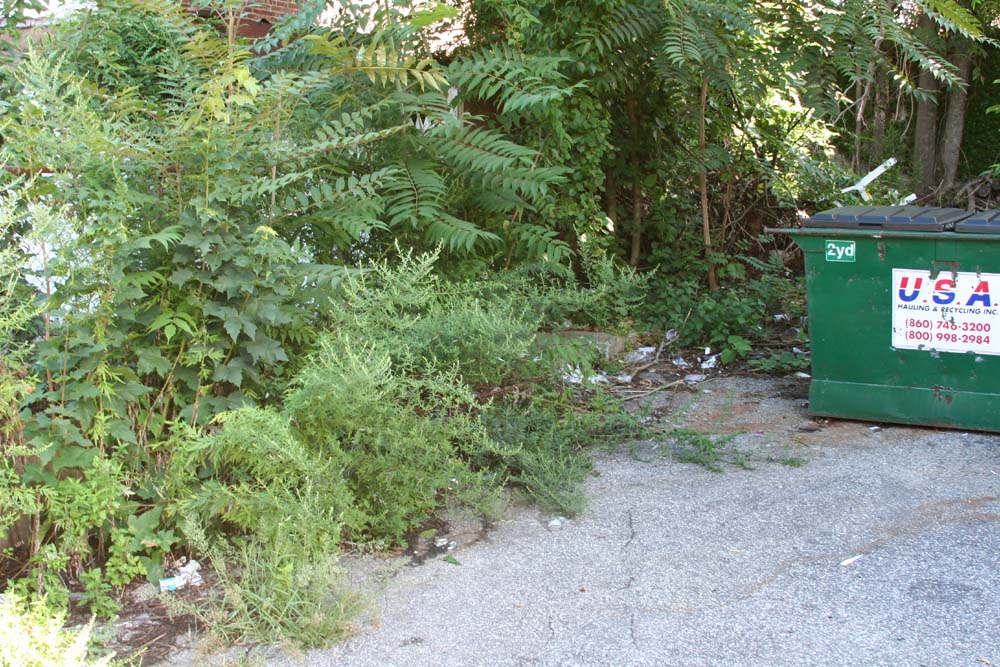
First up, the building on the corner. There is a mini-grocery store on the first floor, apartments on the upper two floors. Behind the building is a small driveway with a dumpster for cardboard only--but it is not marked as such, so people sometimes put garbage in it. The driveway runs alongside my front yard.

As you can see, the property owner and the store owner make no effort to cut back the weeds. The only time the weeds get cut back is when I or another neighbor complain to the city. Which happens several times a year.


The weeds hide the garbage that is strewn about the property, but when the weather is dry and the wind blows, the garbage moves to my yard.


Seriously, they do not clean up. They must see the weeds and garbage when they put their cardboard in the dumpster, but they never clean up around the dumpster. Every time I complain, they are given three days to clean up. They do the bare minimum cleanup, and then we wait a few months for it to get bad again. This is an extremely frustrating cycle, like beating your head against a rock wall. Why should I have to waste my time complaining again and again about exactly the same thing? Why should the city waste its resources again and again for exactly the same thing? Shouldn't there be stiffer penalties for repeat offenders? Stop giving the same people the same warning. Slap them with a fine and require that they attend some sort of class to teach them how and why to clean their property.


Here's the view beyond the dumpster into the next yard, which is an even worse problem. They did cut down the weeds between the two properties so that people can walk through. Ironically, they don't shovel the snow from the sidewalk in the winter, and right now their weeds are partially blocking the sidewalk.


Beer bottles, wood slats, plastic cups, motor oil containers, roofing material, and sometimes feces. This has been going on for years and the city is completely incapable of doing anything about it.


Moving on to the next property, here's the view from my upstairs window. The vulgar graffiti on the ground is new. There are a couple of new items on the wood pile that are also new. Everything else has been there for at least a year.


This property was fine when I bought my house four years ago. But at about the same time, this property was purchased by an absentee landlord. According to the city, she lives in New York, so they can't do anything to force her to clean up her property.

The only work I've seen done on the property in four years was the blocking off of the building's back door. I guess the landlord did that because she wants to pretend there is no backyard. Earlier this summer, I saw whoever she hired to clean out the vacant second floor apartment take a bag full of garbage, open it up out the back window, dump the contents onto the ground, then take the empty bag back inside.

I showed the filth to an official from the Health Department at the beginning of June. He agreed that it was unacceptable. The last thing I heard was that the warrant (I assume that's what it is) was in the hands of the State Marshall. That was on July 6. The only thing that has happened since then is that more garbage has piled up.


The fence dividing our properties has a four-year-deep pile of leaves and litter on their side. It also has weeds and numerous trees starting to grow, which lean over my property and threaten to destroy the fence.


It is clear to me that the city is impotent. The current "system" for dealing with blight is useless and a total waste of money and people. When faced with a property like this one, the city should be able to send its own workers in to clean it up, then place a lien on the property to cover the cost of the cleanup. Maybe there's another option that will also be effective. There has to be a better way that what we're doing now.

Thursday, August 18, 2011

Tax Credits for Historic Home Rehabilitation

Here's something more people in Waterbury should know about. For full details, visit the Connecticut Trust for Historic Preservation website.


CT Historic Homes Rehabilitation Tax Credit Program
Public Act 99-173 established a Historic Homes Rehabilitation Tax Credit for the rehabilitation of owner-occupied historic residential buildings containing 1-4 units.

What is the Incentive? A tax credit equal to 30% of the eligible rehabilitation costs up to a maximum of $30,000 per unit of housing. For example a four-family house could qualify for up to $120,000 in tax credits.

What properties are eligible? Properties that are listed on the National Register of Historic Places or State Register of Historic Places are eligible. Targeted areas in 29 towns and cities are eligible, including the entire municipality of Waterbury.

Who can utilize the credits? Any owner, including private developers and non-profit housing corporations, can apply for the credits. If applicable, the owner can claim the credits against the owner's business corporation taxes due or the owner can assign the tax credit to a business corporation that is providing funds to help finance the rehabilitation. A lender, for example, might agree to accept the tax credit as partial payment against the principal of a loan. The tax credit cannot be used against the personal income tax.

What is the minimum expenditure? The owner must incur qualified rehabilitation costs of at least $25,000. Eligible costs include interior and exterior work to the historic home but exclude site improvements or soft costs, such as architect's fees or loan-processing fees.

What is the owner-occupancy requirement? At least one unit of the building must be the personal residence of the owner for five years after the credit voucher is issued. Private developers and non-profit housing corporations are required to sell the property to a new owner who will make the historic home the new owner's personal residence during the occupancy period.


Connecticut Historic Structures Rehabilitation Tax Credit Program
Public Act 06-186 section 82 establishes a tax credit for the conversion of historic commercial and industrial buildings to residential use, including rental or condominium units. Partial tax credits are available for buildings converted to mixed residential and commercial uses.
• 25% tax credit of the total qualified rehabilitation expenditures
• buildings must be listed on the National or State Register of Historic Places, either individually or as part of an historic district
• projects under construction but not placed in service as of July 1, 2006, may qualify
• state tax credits may be combined with the 20% federal historic preservation tax credits provided the project qualifies under federal law as a substantial rehabilitation of depreciable property as defined by the Internal Revenue Service
• annual aggregate cap of $15 million in tax credit reservations
• per building cap is up to $2.7 million in tax credits
• tax credit vouchers are issued after completion of rehabilitation work or, in phased projects, completion of rehabilitation work to an identifiable portion of the building placed in residential use
• tax credits are available for the tax year in which the building or, in phased projects, an
identifiable portion of the building is placed in service
• tax credits can only be used by C corporations with tax liability under Chapters 207 through 212 of the Connecticut General Statutes
• tax credits can be assigned, transferred or conveyed in whole or in part by the owner to others


Low Income Housing Investment Tax Credit
The Tax Reform Act of 1986 (IRC Section 42) also established an investment tax credit for acquisition, construction or rehabilitation of low- income housing. The credit is approximately 9% per year for 10 years for each unit acquired, constructed, or rehabilitated without other Federal subsidies and approximately 4% for 10 years for units involving the 20% rehabilitation tax credit, Federal subsidies or tax exempt bonds. Units must meet tests for cost per unit and number of units occupied by individuals with incomes below area median income. The law sets a 15 -year compliance period. Credits are allocated by State Housing Credit Agencies.

Tuesday, August 09, 2011

Ponte Feast

If you missed out on this year's Ponte Feast, here are some photos from Friday night.

Frying up the fried dough. Yum!

Serving up the pasta.


The only way to avoid waiting in line for food is to get there very early!

Another advantage to arriving early: you might find a seat after getting your food.

A few of the Republicans in attendance, including Linda McMahon,
Carlo Palladino (candidate for Board of Aldermen) and Mayor Jarjura.


Democrats from left to right: Greg Hadley and Anne Phelan,
candidates for Board of Aldermen, Neil O'Leary, running for Mayor,
Christopher Donovan, Speaker of the Connecticut House of Representatives,
and Chris Murphy, our 5th District Congressman.


Taking a break from the kitchen to enjoy the music.

Candy!


Rides for the kids.


Governor Malloy went on a whirlwind tour of the kitchen before
sitting down to enjoy an Italian feast with Neil O'Leary.

As always, a long line of people waiting for some delicious food.


It was a beautiful night, packed full of people from all over. During the ceremony, it was announced that the Ponte Club will be doing some landscaping before next year's feast to make it even more enjoyable.