Sunday, May 27, 2012

Mayor's Inaugural Picnic

Below are some photos from yesterday's celebration at Municipal Stadium. I wasn't able to stay for the whole event. I hope they do it again next year!


5 Alarm Chili --- YUM!


Fireball Run display -- they'll be on the Green for a day in September.


Campaigning politicians Andrew Roraback, Dan Roberti, Elizabeth Esty, and Chris Murphy all made the rounds.


Monday, May 07, 2012

Deer Park

Ever wonder why Park Road is called Park Road? That’s a question I’ve had bouncing around in the back of my mind for years. I’ve also wondered for years about the location of a deer park (described in Anderson’s History of Waterbury) owned by James Nichols back in the 1740s and 1750s. It turns out the two things are connected—Park Road was once inside the Nichols deer park.

Part of the deer park is still undeveloped. One area, Western Woods, is currently being considered for acquisition as a park by the City of Waterbury. If it does become a city park, it could be considered the oldest park in the city, arguably the oldest public park in the country (although I’m sure this would be contested, since it hasn’t been maintained as a park all these centuries).

I recently walked along a stony path through the woods and was deeply impressed by its beauty. The first signs of Spring had arrived: skunk cabbage was curling upwards along small creeks, and green ferns were growing on rocky outcroppings. The area I walked is extremely rocky: small rocks, big rocks, boulders, ledges. I could imagine why it has remained undeveloped: nothing but rocks everywhere. I was surprised, however, to realize that most of the trees are new growth. Then again, if this was an old growth forest, it would be famous for its rarity, and I would have visited it long before now.

As I walked, I wondered about the land’s history. Were the trees harvested by the brass industry as fuel for their forges? Did neighboring farmers keep the land treeless for grazing cattle? I climbed up an impress rock mound and sat on top to rest. All I could hear was the wind in the trees and a nuthatch chirping loudly in a nearby tree. I was still in Waterbury, but I might as well have been in the middle of the countryside. After my walk, I went to City Hall and spent a few hours digging through old land records and assessor’s maps, tracing as much of the history of the old deer park as I could. I searched old newspapers and books for more information about James Nichols and his deer park, wishing I could find a detailed contemporary description. I didn’t have luck with that, but I did find tantalizing references to the Nichols Deer Park.


Painting by a follower of artist Adriaen van de Velde of an elegant couple
walking in a deer park in Europe, probably from the late 1600s.
Sold at Christie's on September 30, 2005.

Deer parks are typically associated with the estates of nobility in Europe and the very wealthy in America during the 1700s and 1800s. George Washington was perhaps the most famous owner of a deer park in America. Originally held within a paddock, Washington’s deer learned to jump the fence and wandered freely in the woods. The Mount Vernon deer park included both American wild deer and “English fallow deer.”

In Connecticut, wealthy colonists established private deer parks for themselves in a number of towns. In 1744, the Colony of Connecticut established an “Act for the preservation of Deer kept in Parks or other Inclosures,” noting the “sundry” people had recently established deer parks. The Act established penalties for anyone caught poaching deer within a park enclosure, with fines as high as one hundred pounds. Reference to 18th century deer parks appear in various town and family histories.

The Woosters of Oxford owned a deer park of several hundred acres, fenced in to keep the deer from wandering and to discourage hunters. According to John Warner Barber’s description of Oxford, the Wooster deer park was established during the mid-1700s. The park was located south of Quaker Farms and was known as “the Park” well into the 1800s.

In Woodbury, Gideon Treat owned a 100 acre deer park which he built around 1780. The park was surrounded by a high fence and, on one side, a steep rock. Deer could, according to a genealogical history of the Treat family, jump into the park but could not get back out.

Jobamah Gunn owned 563 acres of land in Naugatuck in 1791, a portion of which was a deer park. Gunn was wealthy, furnishing his home in the best style of the time, and aspired to be the largest landowner in the region.

James Nichols and His Park 
The Nichols family came to Waterbury around 1729. Several of the Nichols children married into prominent Waterbury families. Captain George Nichols, brother of James, became one of the wealthiest and most influential men in Waterbury. James Nichols (1712-1785) began buying land all over Waterbury in the early 1730s. During the early 1740s, Nichols began buying land in the western area of Waterbury for his deer park. Through several purchases, Nichols assembled about 300 acres of land, bordered, more or less, by what are now Park Road, Grandview Avenue, and Bunker Hill Avenue.

Park Road was surveyed in 1763, taking its name from its location at the Park. The gated entrance for the Park was on Park Road, with a pathway leading towards the Stone Path connecting Grandview and Bunker Hill Avenues. The Park included a clubhouse on the pathway to the Stone Path. A second clubhouse was believed to have been built two generations later, although its exact location was unknown to the authors of Anderson’s History.

There is no known record of the number of deer contained within the Park. Much of the land was surrounded by a fence, as was typical for deer parks. Anderson’s History, written in the 1890s, described the remaining Park land as “a wild, rugged region, almost untouched by the hand of man.” That description is just as true today. A prominent feature of the Park was called World’s End Rocks, located in the middle of the Park. Although it is not know if those particular rocks are still standing (they may have been located in an area that has since been developed), there are several impressive rock outcroppings remaining.

Sales of the Park Land 
Nichols didn’t keep his deer park for very long. In 1756, he was living in Salisbury and sold several parcels of land to his brother-in-law Ebenezer Wakelee and to his son-in-law Ezra Bronson. Wakelee immediately sold half the Park to James Wakelee of Stratford. These were the first of many subdivisions of the property. The Waterbury Land Records reference “the Park” in each transfer of land until about 1963. A deed for the purchase of land by the Westbury Homes Company on January 22, 1963 describes a parcel of land located “easterly of Clough Road and westerly of Westwood Avenue, at the “Park”, so-called.” This is the most recent mention of the Park that I was able to find in the Land Records.

Most of the Park lands remained undeveloped until the late 1800s. A map of Waterbury in 1852 shows several farms clustered along Bunker Hill Avenue and maybe two farms on Park Road. One large parcel was owned by St. John’s Episcopal Church Parish. Another parcel was owned by Scovill Manufacturing: Scovill purchased 50 acres of woodland at the Park in 1862, possibly to use the wood as fuel for their forge. Another manufacturer, Brown & Brothers, also owned a portion of the former park land.

The Park Today 
Since 1900, residential developments have been gradually eating away at the edges of the original 300 acre Park. The remaining undeveloped land is owned by less than a dozen small owners, including private individuals and organizations such as the Republican-American, which owns about 19 acres. The three largest owners of undeveloped land in the former Park are CL&P, which owns roughly 68 acres; Norman Drubner, whose 134 acres are known as the Western Woods; and the City of Waterbury, which owns more than 476 acres of the former Park and adjoining land, including the Western Hills Golf Course and several parcels that have been subdivided for residential development.

 The future of the former deer park is currently up the in air. Western Woods has been offered to the City of Waterbury in a deal that was hotly contested during last year’s mayoral election. The City is currently waiting for a new Conservation Commission to conduct a survey of all land in the city before it negotiates any open land purchases. Depending on the outcome of the survey and the recommendations of the Commission, and depending on whether or not Drubner is still interested in selling Western Woods to the city, nearly half of Waterbury’s first park could become its newest park.

Saturday, May 05, 2012

Earth Day Cleanup at WOW and Scovill Homes

Another year, another cleanup. This year we started at Carpmill, went down Wood Street to Walnut, then split into two groups and went up Ives and Irion.

Starting out on Wood Street, raking up debris blocking a storm drain.


Youths from the WOW Community Learning Center, always willing to help out.


Raking and sweeping on Wood Street with Alderman Hadley.


Two years ago, Patricia Sockwell and I tackled the area between Wood and Ives Streets
on our own for Earth Day cleanup. So nice to be working with a large team now!


Our Community Officer, Andrew Abney, helped with the clean up.


Cleaning up litter at the bus stop. Yes, that's a school bus stop as well as a public bus stop.


I'm not sure how many bags we filled. Definitely a lot!


Tackling both sides of Walnut Street, and loading up the full bags on a trailer.


The man with the broom lives on the corner of Walnut and Ives Streets. He came out to help
when he saw us. As with so many people, he does what he can to keep his area clean,
but feels frustrated because his neighbors don't do their part.


Around 10:30, our crew met up with the PAL/North End Area crew.


We already had Walnut, so they went down Locust Street.


Our youngest volunteer. I think the gloves were a little big for her.


We could have had a tag sale with some of what we found on Irion Street.


The Ives Street cleanup crew at the end of the morning's work.


Frankies! Everyone who participated in the cleanup got a free hot dog, chips, and soda.


Sharing stories, eating dogs.

Sunday, April 22, 2012

Taking a Bite Out of Blight

Educating youth is a big part of Mayor O'Leary's anti-blight plan. Following the example set by PAL, in which children began taking pride in picking up litter instead of just walking past it, the Blight Task Force held an Anti-Blight and Litter Slogan Contest in February.

The winners of the contest were announced and the new slogan and logo were unveiled last week:

Mosies Vega, Rotella Magnet School, Grade 5 - Slogan Contest Winner

Fatime Kaliki, Wallace Middle School, Grade 6 - Slogan Contest Finalist

Katherine Abreu, Crosby High School, Grade 10 - Slogan Contest Finalist

Tye Proctor, Crosby High School, Grade 12 - Logo Design Winner


Photo from Mayor O'Leary's Facebook page.

The slogan and logo will be used in school literature, on posters, t-shirts, bumper stickers, billboards, and city buses.

This is an important step in creating a culture of cleanness. Our city's children are growing up surrounded by blight and litter. Picking up litter is not instinctive. By teaching our children that it's not okay to ignore litter, that keeping things clean is a good thing, they will be less likely to litter, and our city's future will be a little brighter.

Wednesday, April 11, 2012

Best of Waterbury Nominations

It's that time again! The Waterbury Observer is taking nominations for the Best of Waterbury awards. This year, you can conveniently vote online, download the form and fill it in by hand, or go old-school and pick up a copy of the Observer and fill out the form inside.

Ballots must be received by April 30, 2012. Results will be published in the Observer in mid-June.

If you fill out 25 categories on the ballot, and fill in your personal information, you will be entered to win $400 in gift certificates to area restaurants. Very cool.

One ballot per person.

Thank you again to everyone who voted this the Best Blog in 2011. I would love to win again this year, so if you like this blog, please vote for it!

Wednesday, April 04, 2012

Stripping Down Chase

Not much left to this building now. Seeing more of it disappear every week is a powerful experience.


Monday, March 26, 2012

Trayvon Martin

I know this isn't a Waterbury topic, but it is on the minds of many people in Waterbury, and I suspect it will shape legislation and actions around the country.

There are a lot of terrible things that happen every day for no good reason. That's how life is. For me, what stands out most about the Trayvon Martin case is that his killer was not arrested, that the police believed his action was protected by law. That terrifies me.

I've listened to the available 911 tapes, and I've read the accounts of the night given by Martin's girlfriend, the boy walking his dog, and the nearby neighbors. It seems clear to me that George Zimmerman is a vigilante, that he did not trust the police to do their jobs, that he felt it was necessary to take the law into his own hands.

The story resonates deeply for me. As a woman, I am always hyper-aware of my surroundings when I am walking alone, especially after dark. Women in this country get assaulted far too frequently. When I hear footsteps behind me, I tense up. If the footsteps get closer and closer, I brace myself for an attack. This is the reality of being a woman. I've had friends who have panicked when they found out I walk by myself after dark. I've had acquaintances practically beg me to let them drive me home, because they're certain I will be assaulted if I walk by myself. This is the reality of being a woman in the United States, of having grown up in a time when men argued that a woman was "asking" to be raped because she wore a short skirt, of having attended college at a time when women needed to hold rallies to take back the night, of living in an era in which a woman who has been raped can be treated like a criminal when she seeks help.

When I hear about Trayvon Martin, I imagine myself in his place. I imagine myself walking home in the dark and realizing that a man is following me, I imagine that I start walking faster in an attempt to get home safely, only to end up being cornered by the man following me. I imagine being frightened and assuming this man following me intends to harm me. I imagine the police deciding, because I fought back against my pursuer, that he was acting in self defense when he killed me, that he did nothing wrong.

When Geraldo Rivera, and now Bill O'Reilly, claimed that Martin would still be alive if only he hadn't worn a hoodie, how is that any different than saying a woman wouldn't have been raped if only her skirt had been longer? This adds to the repulsion and fear that is being generated for me by this ongoing story. What direction is our country headed in?

As a nation, now is a critical time. Are we going to decide it's okay to hunt someone down, kill them, then get away with it because the victim fought back, or because the victim was dressed a certain way?  I certainly hope not.

The captain of a neighborhood watch should be armed with a camera, not with a gun. That's why it's called "neighborhood watch" not "neighborhood vigilantes." When the police decided to let Zimmerman go, stating that they believed he acted in self-defense, they gave him the green light to kill again. They endorsed vigilante behavior, and they endorsed murder. As a nation, we must condemn their decision, or find ourselves living in a country where we have no legal protection from vigilantes, stalkers, and even serial killers who claim self-defense when they kill.

Sunday, March 25, 2012

Freight Street Gallery: That's Women's Work Too!

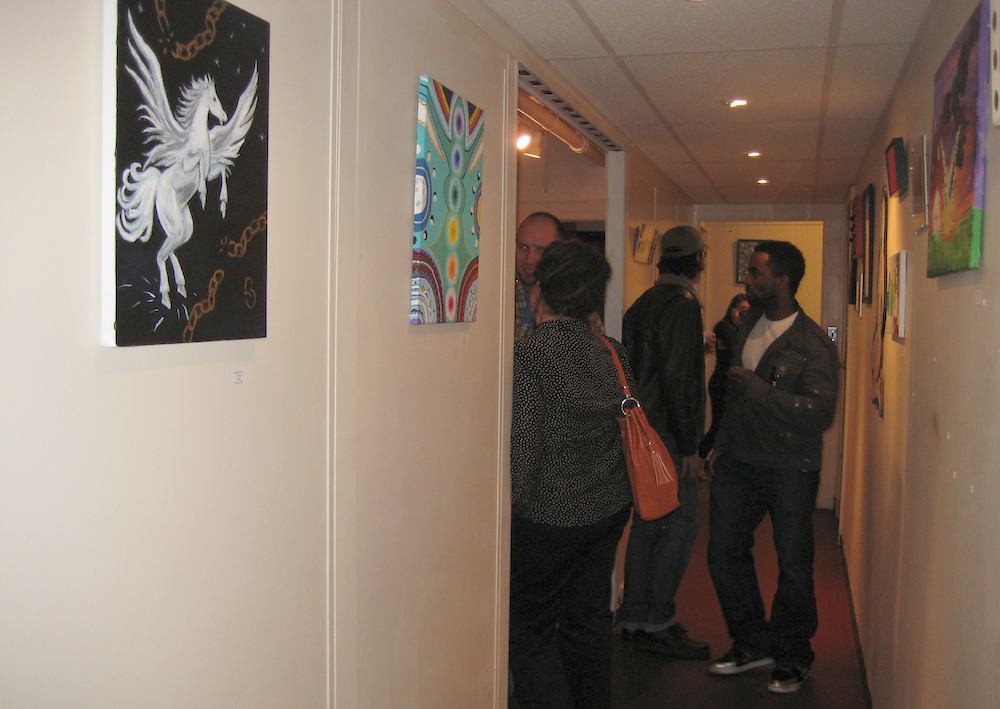
Here are some shots of last night's reception for That's Women's Work Too! at the Freight Street Gallery. I took the photos early on, before it got crowded.


The Freight Street Gallery is currently the only art gallery in Waterbury. I'm hoping that will change very soon (stay tuned!).


Tuesday, March 20, 2012

Freight Street Gallery Art Show

This Saturday night!  I'll be there, and so will one of my paintings, along with approximately 50 other women artists who are participating in the show, and a bevy of musicians. For the latest info on the event, visit the Freight Street Gallery page on Facebook or visit their regular website.

Sunday, March 11, 2012

Flea Market Find


Apothecaries Hall Co., Oil Citronella. Five bucks at the flea market. The cork is saturated with citronella, so I can tell it's still good!

The label has the name of Clark H. W. Newton as the manager, which means it dates from no earlier than July 1903, when Newton became the manager of Apothecaries Hall.

The company name changed to The Hubbard-Hall Chemical Co. in 1959 and Hubbard-Hall Inc. in 1986. The Hubbard-Hall headquarters is located on South Leonard Street in Waterbury. Their former downtown building, constructed in 1894 and bearing the name Apothecaries Hall, is currently being renovated for market-rate apartments.

Wednesday, March 07, 2012

The Never-Ending Blight Next Door

The saga of blight at 76 Oak Street continues...

Two weeks ago, we saw a man walk to the back of the property next door. He looked at the mess with dismay. The property owner has hired him to be the property manager. In addition to cleaning up the yard, he has to evict the third floor tenant.

While I'm glad that the owner has hired someone to manage the property, I'm impatient in waiting for results. So far, the only change is that the mess has gotten worse. Most noticeable was the addition of a dozen or so oranges to the pile a few days after the property manager stopped by, as well as less visible garbage.


Meanwhile, the Connecticut Legislature is considering toughening the laws on blight, raising the fines from "not less than ten or more than one hundred dollars for each day" to
"(I) For the period from the first day to the thirtieth day during which such violation exists, one hundred dollars for each day that such violation continues; (II) for the period from the thirty-first day to the sixtieth day during which such violation exists, two hundred fifty dollars for each day that such violation continues; and (III) for the period from the sixty-first day to the day the violation is corrected, five hundred dollars for each day that such violation continues..."

The proposed bill is online at www.cga.ct.gov/2012/TOB/H/2012HB-05319-R00-HB.htm

Tuesday, March 06, 2012

Mile Long No More

Driving down Thomaston Avenue yesterday, I had to stop and take photos. The old Chase Metal Works is disappearing rapidly.


The Metal Works factory complex was built starting in 1910 (expansion was constant for years, partly because the company's production increased during World War I). The entire Chase complex of buildings sprawled over 211 acres in two towns. The bed of the Naugatuck River was re-routed to make room for the factory. By the 1940s, the plant was nearly a mile long, rivaling Scovill’s mile-long mill (now the Brass Mill Mall).

A portion of Chase Metal Works in the 1930s.
The section currently being torn down is in the upper center and right of center in this photo.
(Collection of Mattatuck Museum)


Roger Freeman, MIT graduate, was the construction engineer for the Chase Companies. He put together a construction team of about a dozen assistant engineers and four hundred laborers. The engineers included another six graduates of MIT; the others were from Dartmouth, Rensselaer and Yale. In a report to his alumni newsletter, Freeman reported that they designed and built reinforced concrete and structural steel factory buildings for the Metal Works and for Chase Rolling Mills and Waterbury Manufacturing  over two years’ time during WWI. The last concrete building was a six-story flat slab structure, 200 feet by 60 feet, constructed at a pace of six days per floor.  


The factory building with the sawtooth roof was constructed in 1916 and was considered very modern at the time. It was a challenge for the Metal Works’ Chief Engineer, John E. Williams, to heat the building. He wrote in 1928 that “the amount of glass used in its roof of modern saw-tooth construction and its huge rooms, make the heating a serious question for consideration by the modern engineer.” He solved the problem by installing a then-unique heating system connecting over 78 miles of hot water pipe directly onto the condensers in the power house.


In October 1915, Chase Metal Works reported that they had begun work on several additions to its facilities: a one-story brick and steel factory building, 140 x 180 feet; three two-story additions, 60 x 260 feet, 60 x 320 feet, and 60 x 120 feet; two two-story brick additions, 60 x 160 feet and 60 x 200 feet; and two other additions, 60 x 80 feet and 60 x 120 feet.


Seeing it being torn down, I felt like it was the end of an era. But what era? Chase shut down the Metal Works factory in 1976. The only thing ending now is the era of abandoned factory buildings. However, without those visual relics, the past will seem more distant and unrelated to our present.