Showing posts with label Architecture. Show all posts

Saturday, January 17, 2026

The Goss House

I've been seeing a lot of buzz about this house on Facebook, with people wanting to know more about it. So here is some of its history. 

The Goss House, 70 Hillside Avenue, Photo from Realtor.com, 2025


The house was built as a wedding present for Ella Young and John H. Goss, who were married in 1901. Construction started in 1901 and was finished in 1903. Construction was paid for by Ella's father, Alden M. Young, while John Goss's father, C.P. Goss, contributed the land.

Thursday, April 24, 2025

Waterbury's Oldest Houses

I've been meaning to put together a catalog of Waterbury's oldest houses for some time now. I still haven't finished researching the buildings, but I figured I might as well get what I have posted, since there is interest in this. 

In some cases, the date of the house comes from the City Assessor's Office. In other cases, the date is based on historical records. The Assessor records aren't always accurate for houses built before construction records were kept. For some of the houses, I have done in-depth research. For others, the research remains to be done.

Please note this is a work in progress and I will add more information when possible. 
 
Some photos are new, others are from years ago.


Gaylord-Welton House
3029 North Main Street
c. 1704

This house was built for Joseph Gaylord, Jr. and later became the home of generations of the Welton family; it is quite possibly the oldest house in Waterbury, built sometime in 1703 or 1704.


3029 North Main Street, c. 1704


Sunday, March 09, 2025

Union Station

 The most iconic building in Waterbury is about to enter a new era in its history. The Republican-American newspaper has been sold, and now the building is being sold as well (asking price is just under $5 million). Before the sale was announced, it looked like the building was going to be converted into apartments with restaurants or other types of businesses on the first floor. Whether or not that still happens will depend on the new owner. 

The future of the building is unknown, but I can tell you a bit about its past. Although best known now as the Rep-Am building, it was originally Union Station, constructed as a station on the New York, New Haven & Hartford Railroad line. Construction was completed in 1909.

Postcard View of Union Station

When Union Station was built, it was the main entrance to Waterbury. Nearly everyone traveled by train, which meant that the train station was one of the most important and busiest buildings in town.

Sunday, October 20, 2024

A History of the Miller & Peck Buildings

Two of the oldest buildings in downtown Waterbury are about to be demolished. Previous owners allowed the buildings to decay so badly that they can't be saved and are no longer safe to enter. The buildings have long been called Miller & Peck, since they were home to the Miller & Peck store for decades. I was recently asked about the history of the buildings and found far more than I expected.


The Miller & Peck buildings in 2023: north on the left, south on the right


The Miller & Peck buildings stand side-by-side on South Main Street. The building to the north (on the left when facing them) is white, with ornate Greek Revival columns flanking two-story windows. The building to the south (on the right when facing them) is blue and resembles a typical New England Greek Revival house, only bigger, with three floors under the pediment. (For ease of reference, I will call them "north" and "south" in the rest of this article.)

Both buildings were constructed out of wood almost two hundred years ago, with several additions built behind them over the course of a century. The National Historic Register nomination form for the Downtown Historic District lists the two buildings as having been constructed sometime around 1830.

I've spent the past few weeks poring through the Waterbury Land Records and various other sources tracing the history of the two buildings. A precise date of construction for either building has proven to be elusive, but what I have found is fascinating. There is undoubtedly more to find: this is merely a starting point.

My research here is focused on the history of the buildings. The history of Miller & Peck as a business is a story for another day.

Sunday, October 15, 2023

Old Houses at Bucks Hill, Part Two

Here are a few of the great houses in the Bucks Hill neighborhood. To see more, visit Old Houses at Bucks Hill, Part One.


Feodore Liebreich House
2658 North Main Street


Feodore Liebreich was a German immigrant who lived in Waterbury at Bucks Hill from about 1873 until his death in 1897. Liebreich was a successful farmer who slowly acquired several parcels of land to expand his farm.

Built in 1900 on the site of an early 1700s house, this house may retain some of the original colonial-era structure. It is now a two-family house with vinyl siding and fake shutters hiding the original wood siding.

2658 North Main Street


Saturday, January 07, 2023

Pritchard Family Farm Houses

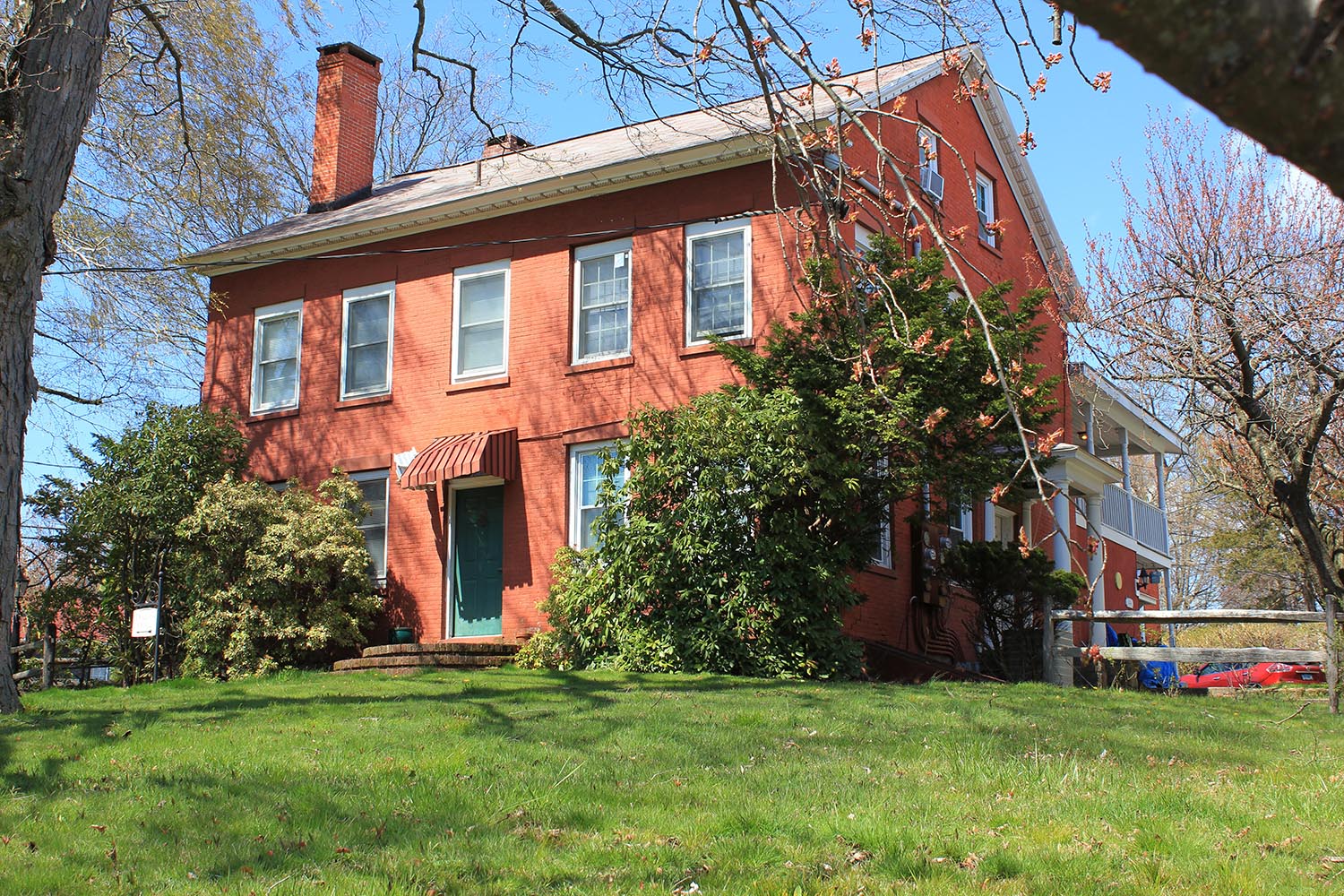
A few years ago, I noticed a gorgeous house for sale in Waterbury's Hopeville neighborhood and wondered about its age and history. I have finally gotten around to researching its history and discovered that it was part of the Pritchard family's farm two hundred years ago. A second old house, about a block away, was built for the same family.

Pritchard Family house on Piedmont Street, built in 1815
Photograph from Realtor.com in 2019


The houses were built for Isaiah Pritchard (1755-1833), a Revolutionary War veteran. Pritchard was married twice. His first wife, Olive Upson, died sometime after 1792. Pritchard then married Sylvia Scovill (1773-1838). Isaiah Pritchard had a total of six children.

The original Isaiah Pritchard homestead is on Piedmont Street, where Pritchard owned farmland that included Pritchard's Pond. The family's total real estate holdings included close to two hundred acres of land near Smug Brook (now Hopeville Pond Brook) and on East Mountain.

The Pritchard House on Piedmont Street is actually two houses. The original house is in the back and was built during the 1700s in what we now call the Cape Cod style. The house in front, which you see from the street, was built in 1815.

Sunday, April 10, 2022

Historic Building to be Demolished

Four years ago, the City of Waterbury adopted a Demolition Delay Ordinance designed to help prevent the destruction of historic buildings in the city. The first test of the ordinance arrived last month, when the owner of 30 Central Avenue, Building 2 (formerly 38-40 Central Avenue) filed paperwork to demolish the building. The owner's only stated goal is to make space for the church next door.

The house is a contributing building to the Hillside Historic District, which is on the National Register of Historic Places.  

A petition to save the building has been started on Change.org.

30 Central Ave, Building 2 (38-40 Central Avenue)

Sunday, September 05, 2021

The Weston House

Tucked away in the middle of a large block on West Side Hill is a house built in the middle of the 19th century for Catharine Weston and her family. The early history of the house's ownership is one of female empowerment and of Black entrepreneurship.

1048 West Main Street (1050 West Main can be seen behind to the left)


Architectural Style

The house was built using wood frame construction in a simplified version of the Greek Revival style. It is a common house style that can be seen throughout western Connecticut. The house is relatively small and modest, designed as a cozy private home rather than a showy display of wealth. The siding would originally have been wood clapboards (it now has asphalt siding).

Saturday, August 22, 2020

Early Jewelers

From the 1670s through the 1830s, Waterbury was primarily a farming community. During the 1840s, Waterbury's industrial entrepreneurs and financial speculators helped transform the rural farm town into a bustling center of commercial activity. A growing middle class and increasing wealth of the upper class helped support the expansion of retail, personal services, and luxury goods.

Completion of the Naugatuck Rail Road in 1849 was essential to Waterbury's transformation. Having an affordable, efficient, and safe way to travel to New York City made Waterbury's economic growth possible. The town's population hovered around 3,000 people during the early 1800s. By the time the train arrived, the population was growing rapidly. By 1850, the town's population was just over 5,000 people and by 1860, it reached 10,000 people.


M. Richardson

M. Richardson may have been Waterbury's first jeweler, operating a store in the center of town during the mid-1840s. I have not yet been able to find any further information about him.

M. Richardson advertisement,
Waterbury American
, 6 September 1845

Silas Bronson Library microfilm


Friday, August 07, 2020

The Fight Against Housing Discrimination, 1900-1970

Like other cities in the U.S., Waterbury has suffered from the impact of racism on housing. Throughout the twentieth century, there have been numerous efforts to combat housing discrimination in Waterbury. There is still a lot of research to be done on the topic, but here are some highlights of what I've found so far.


James Kefford and the Waterbury Negro Business League

James Kefford (1871-1940) came to Waterbury from Virginia during the 1890s. He started a real estate business in 1904, successfully competing with white realtors in Waterbury. Kefford bought and sold houses and served as a manager for various rental properties including the building with his office at 95 Bank Street.

In 1905, Kefford began constructing apartment buildings to rent to Black people. Housing discrimination was unchecked at this time: there were no laws preventing property owners from refusing to rent to non-white people, and as a result it was very difficult for non-white people to find quality housing in Waterbury. (James E. Kefford, speech given at the Sixteenth Annual Convention of the National Negro Business League, Boston, MA, 1915)


James E. Kefford

Waterbury Republican, 15 September 1912
Silas Bronson Library microfilm


Saturday, June 27, 2020

Waterbury Clock Company Complex

As announced in the Rep-Am on June 26, the former Waterbury Clock office building will soon be demolished, along with portions of the factory complex. The buildings have been crumbling apart for decades. The factory complex is listed on the National Register of Historic Properties.

The former Waterbury Clock Company office building in 2007


Aerial View of the former Waterbury Clock Company factory complex, 2020


The Waterbury Clock Company was formed in 1857, a spin-off of the Benedict & Burnham Manufacturing Company. It became a highly successful company, selling its products all over the world.

Although the name of the company specified clocks, they also produced watches, most notably the "dollar watch" starting in the 1890s. The watch was an oversize pocket watch with a mechanism based on alarm clocks. The company teamed up with Robert H. Ingersoll, a retailer in New York City, to improve and market the watch under the Ingersoll name. By 1910, Waterbury Clock was producing 3,500,000 dollar watches each year for Ingersoll. The watches were so ubiquitous, Ingersoll declared the product to be "the watch that made the dollar famous."

Despite the popularity of the dollar watch, Ingersoll went into bankruptcy in 1922. Waterbury Clock bought out their holdings, continuing the use of the Ingersoll name for a line of cheap watches. They later added a line of Disney character watches, including a highly collectible Mickey Mouse watch.

Waterbury Clock is also known for the devastating effects of radium on its employees. Radium was used in the early 1900s by several companies to highlight the dials on clocks and watches, making them visible in the dark. The radiation that made the dials glow in the dark also sickened and killed many of the young women hired to paint the radium onto the dials. All of the buildings in the North Elm Street complex have been tested for radiation hazards.

Waterbury Clock Company was purchased by Norwegian investors in 1942 and was renamed United States Time Corporation in 1944. The name was changed again in 1969, to Timex.


Monday, May 25, 2020

Hall Memorial Chapel

Located next to Route 8, at the entrance to Riverside Cemetery, is a small Victorian chapel in need of repair. Built during the 1880s, the Hall Memorial Chapel was actively used for funeral services until 1971. The Friends of Riverside Cemetery is currently trying to raise money for the building's restoration, saving it from destruction and allowing it to be put back into use as a community resource.

Photograph by Lisa Hendricks, Wikimedia Commons, 2013


Waterbury's first burial ground was located on Grand Street, where the Silas Bronson Library is today. By the 1840s, as Waterbury was transforming itself from a small farming community to a growing industrial city, it became clear that a new cemetery was needed. In 1850, the Riverside Cemetery Association was formed.


Thursday, April 30, 2020

The Porter House

One of Waterbury's most underappreciated buildings is the Porter house on East Main Street, across from Hamilton Park. The history of the house, from its construction to its role as a station on the Underground Railroad, make it worthy of recognition and preservation as an important historic property.

The Porter House, April 2020

Friday, February 14, 2020

Old Houses at Bucks Hill, Part One

Bucks Hill (also spelled Buck's Hill) was far enough removed from the center of Waterbury to be considered a satellite settlement during the early 1700s. The origin of the name is unknown.
Bucks Hill District, 1874


Sunday, July 07, 2019

Rowhome Rehab

We've been trying to remodel our Scovill Row Home for over a year now, hitting endless obstacles from contractors who want nothing to do with us. The worst was Giordano Cabinets. The rep who came to our house took one look at the neighborhood (which is predominantly African American and Hispanic) and asked if his crew would be safe here, then gave us an estimate of $62,000 for cabinets and countertops for a 19 square foot kitchen. I can only assume that the estimate was excessively high because they don't want the job.

Sunday, May 05, 2019

The Spires of St. Anne's

As reported in the Republican-American on May 2, the iconic spires of St. Anne's Church will be removed by All Saints Parish this summer. The job will cost the parish an estimated $881,255. The plan is to remove the Vermont blue marble blocks carefully, so that they can be used to someday restore the spires if enough money can be raised. The dome of the church is also in need of repairs; parishioners have told me there is water coming in through the dome windows.

The twin spires of St. Anne in 2006


This is not the first time that stonework has fallen from the building. Major repairs were done in the 1980s and the 2000s, but the problems have continued.

I have, frankly, had trouble tracing all of the repairs done to the towers, as very little information is available, and what I can find seems contradictory in places. A newspaper article in 2004 stated that $329,000 had just been spent to repair the towers and dome, but in 2006 there was a chunk of stonework missing from the west tower. Another newspaper article, from 2006, stated that the parish had raised nearly $2 million for repairs to the building. When I curated an exhibit about Waterbury architecture in 2009, repairs to the spires and dome had just wrapped up the previous year, but in 2011, the parish was once again talking about raising money to repair the spires.


Saturday, November 24, 2018

Farewell to Trinity

The Trinity Episcopal Parish was formed in 1877 as an off-shoot of St. John's Episcopal Parish, in part because St. John's had grown very large. Additionally, the new Trinity parish adhered to precepts of a Catholic movement within the Episcopal/Anglican faith.

For the first six years, Trinity's parishioners worshiped in a former Universalist chapel on Grand Street. Construction of the beautiful granite Trinity Episcopal Church was completed in 1884, with the first service held there on May 18, 1884.

Trinity Episcopal Church in 1884; photo by Adt & Brothers, published in Waterbury and Her Industries

In a centennial history of Trinity Episcopal Church, it was noted that Trinity "can boast of having some of the most influential people in Waterbury's history as her parishioners. She can also claim the allegiance of three Connecticut governors, Templeton, Stearns and Lilley."

The book's preface was written by John J. McMahon, who wrote the following about the interior of Trinity:
As an outsider to the church I was deeply impressed by the interior. It is a building that, regardless of one's religious beliefs, should be seen. The architectural lines and handcrafted fixtures have a charm and majesty of their own not often seen in more modern ecclesiastical buildings. In Trinity one can feast his eyes upon a composition of unusual beauty and strength. Here, one can forget all about the hurried noises of downtown Waterbury. There is only the hushed air of a church that can match any other around in terms of elegance and character. 


Saturday, September 22, 2018

Trinity Episcopal Church

Last weekend, a friend drew my attention to a distressing post on the Facebook group, You Know You're From Waterbury When.... The post has since been taken down, but it showed photos of the former Trinity Episcopal Church on Prospect Street and stated that the Immaculate Conception parish was about to demolish the building. The post was followed by a flurry of responses from people who were horrified by the news. Several of the Immaculate's parishioners responded with some conflicting information. The church is owned by Immaculate Conception, which ran it as the Father McGivney Center for many years.

The former Trinity Episcopal Church, 2018


Since there were so many rumors and conflicting details, I reached out to Immaculate Conception asking for the correct information. No one has responded. Father Ford, who is in charge of the plans, has been out of the country in Portugal. Perhaps when he returns, I'll find out more details. In the meantime, here's what I know.

Saturday, August 04, 2018

The Life and Death of a Factory

Waterbury has lost another historic factory building to catastrophic fire. The building most recently known as Ansonia Copper and Brass caught fire on July 30, 2018. The dramatic fire was covered by all of the area news media.

WTNH Channel 8 coverage of the factory fire, July 31, 2018

Amazingly, the fire was contained to just one building. Sadly, it was the oldest and most beautiful building in a sprawling complex of historic factory buildings, with a rich history that made it worth preserving.


Monday, March 26, 2018

Hillside's Palliser Homes

The Hillside neighborhood has some of the most ornate homes in the city. Developed during the late 1800s and early 1900s, Hillside was home to Waterbury's wealthiest residents: factory owners and upper management, bankers and financiers, attorneys and judges, real estate developers, and business owners.

Although most of the houses were built for families, some were built for the unmarried daughters of industrialists. One such house, on Hillside Avenue, was built for Mary L. Mitchell, a widow whose brother, Charles Benedict, built a mansion for himself right next door.

The architect for both houses was Palliser, Palliser & Co., a Bridgeport-based firm that specialized in "cottages." During the late 1800s, the term cottage was used to describe the Queen Anne or stick style, no matter how large or grand the house might be.

House and floorplans from advertising brochure
for Palliser's New Cottage Homes, c. 1888.
This house was built in Peekskill, NY.