I love political debates (and wish we would have one during this election season!). Last Friday's Democratic Forum at the River Baldwin center had a brief moment when Vance and Jarjura slid into a debate, but the moderator quickly got them back on format. While the two hours were relatively calm, it certainly was informative.
I was astonished by some of the things Jarjura said, especially considering that the first round of Q&A was prepared in advance. Most notably (if that's the right word for it), he proposed several scenarios in which he will raise taxes and one scenario in which he will be cutting funding to some city programs.
Most infuriatingly, at one point Jarjura claimed, in effect, that things are great in all of Waterbury's neighborhoods. I was so outraged by his claims that I almost started shouting at him. The question to which he was responding (I wrote notes, but not verbatim) asked what his plan was for improving the city's suffering neighborhoods. Jarjura answered with a sort of anecdote about how terrible things were when he first became mayor eight years ago, that back then city residents were so fed up and frustrated that they were ready to leave Waterbury, but now (after 8 years of Jarjura as Mayor), everything is fine, we have plenty of grant writers, there is money available for homeowners to upgrade their houses, and we have no extra money to fix up neighborhoods.
Now, granted, I'm writing this 48 hours later, working from notes I typed quickly into my phone, so these are not direct quotes, just the gist of what he said. Tearing it apart one piece at a time:
~Most everyone in my neighborhood is frustrated and fed up and ready to leave Waterbury; in the past 8 years, they have seen their property taxes more than double without seeing any improvements to city services, and in most cases they don't feel like they have seen any city services worth mentioning;
~If we have "plenty" of grant writers, why don't we have any extra money to fix up neighborhoods? if we can spend $2 million buying Drubner's land, why can't we spend $2 million fixing up blighted neighborhoods? If we have neighborhoods that NEED fixing up, then how is it possible that everything is fine?
It was clear from what Jarjura said that he has never been to my neighborhood, or any other neighborhood that has been suffering for years. He is completely oblivious.
Other memorable highlights from the forum: in response to the lack of diversity in city hiring (for example, every member of the Mayor's office staff are white, in a city where 25% of the population is Hispanic), Jarjura said "the problem is primaries", that Cicero Booker has failed to recommend minorities for assorted positions, and that the Board of Aldermen, which according to Jarjura has nothing to do all year except approve his budget, hasn't done anything and "hopefully the next Board of Aldermen will do their jobs." I wondered what the incumbents on his ticket thought of that. I spoke to Alderman Nogueira after the forum--he was furious.
After a mid-forum break, members of the public had the opportunity to have their questions asked. One woman from the South End wanted to know what each candidate was going to do about the poor conditions of some of the school buildings and school supplies. Jarjura was flummoxed, and insisted that everything was fine with schools, implying that the woman didn't know what she was talking about.
The forum started out with a general question about problems Waterbury faces. Jarjura responded by citing the national financial crisis and, for the next question concerning future policy decisions, warned that he will have to stop funding some programs in order to avoid raising taxes. Later on, he described a plan to increase the sales tax for anything sold in Waterbury so that the city will gain extra revenue. This is apparently a plan concocted by the mayors of several cities, but it seems fundamentally flawed. It increases taxes for the poorest city residents who are unable to go to a town with lower taxes to do their shopping.
The overall message from Jarjura was "everything is fine, there's no need to make any changes or improvements," except when he was blaming problems on anyone other than himself (in addition to the above examples, he also blamed the school problems on single-parent families, teen pregnancy and abusive households).
In contrast, Vance proposed numerous ways to improve city services, lower taxes and improve quality of life in Waterbury. His plans include ways to make the city friendlier to businesses, establishing the Mayor's office as a hub for economic development, reducing the city's expenditures for legal fees by putting legal services out to bid, hiring a grant writer (which was in the city budget for last year, but instead a new aide was hired for the Mayor's office), establishing monthly community meetings for the Mayor's office and making the Board of Aldermen more accessible to the public by holding some meetings in community centers, give neighborhood associations grant funds to help improve the neighborhoods, create tax incentives to help fight foreclosures, and reduce pollution (whereas Jarjura spoke about bringing in more industry to the heavily-polluted South End).
By the end of the 2-hour forum, Vance had earned several new supporters.
Monday, September 07, 2009
Wednesday, September 02, 2009
$1.75 million
I'm trying to avoid having this blog dwell too much on campaign issues, but this one is really bothering me, and I think there are a couple of reasons for it. Mayor Jarjura's proposal to purchase the 130+ acre Park Road parcel of woodlands from Norman Drubner is a proposal I would support if there was a plan to preserve it as open space (instead the plan seems to be to sell it to the next eager developer--who will that be? Jarjura?) and if the price were more realistic. Spending $1.7 million to buy land that has been assessed at less than $40,000 just doesn't sit right with me.
Jarjura says the expenditure is an investment for the city. I have a better investment proposal. For $1.75 million, the city (or designated organization, for example, WDC) could purchase every abandoned, blighted house in my neighborhood (and there are a lot of them!), rehabilitate them, and then sell them to people who would live in them and maintain them. The city would possibly make an immediate financial profit, followed by an increase in tax collection from the newly owned buildings, and the improvement to this neighborhood would be phenomenal. In one year, my neighborhood could go from being blighted to being one of the nicer neighborhoods in the city.
Or we could just stick with Jarjura's plan and funnel the money into Drubner's bank account without making any improvements to the city in the short or long run. That's Jarjura's plan, isn't it? Use the property exactly the same way as Drubner would, but first give him a big chunk of taxpayer money.
Now that it's been re-appraised for $4.3 million, wouldn't it be more profitable to let Drubner keep it and pay the appropriate taxes on it?
Jarjura says the expenditure is an investment for the city. I have a better investment proposal. For $1.75 million, the city (or designated organization, for example, WDC) could purchase every abandoned, blighted house in my neighborhood (and there are a lot of them!), rehabilitate them, and then sell them to people who would live in them and maintain them. The city would possibly make an immediate financial profit, followed by an increase in tax collection from the newly owned buildings, and the improvement to this neighborhood would be phenomenal. In one year, my neighborhood could go from being blighted to being one of the nicer neighborhoods in the city.
Or we could just stick with Jarjura's plan and funnel the money into Drubner's bank account without making any improvements to the city in the short or long run. That's Jarjura's plan, isn't it? Use the property exactly the same way as Drubner would, but first give him a big chunk of taxpayer money.
Now that it's been re-appraised for $4.3 million, wouldn't it be more profitable to let Drubner keep it and pay the appropriate taxes on it?
Tuesday, September 01, 2009
Comment Apologies
Thanks to a new web marketing strategy in which hired spammers in Sri Lanka and India post fake blog comments with links to commercial sites, I have changed the options for leaving comments on this blog. Going forward, no comments will post until I have reviewed them. Hopefully this will take less of my time than going back through old blog posts to individually delete the spam comments.
Sunday, August 30, 2009
Campaign Events

The Democratic Primary is only a few weeks away (on September 15) and things are really heating up (especially, for some reason, on Facebook).
The Grand Opening of the Vance HQ is Monday, August 31 at 5 p.m., complete with free Frankie's hot dogs, courtesy of our Board of Aldermen candidate Frank Caiazzo.
Join us again at The Turf on Grand Street for a fundraiser on Wednesday, September 2, 7 p.m. - 10 p.m. ($20 per person).
You can check out votevance.com to keep up-to-date with the latest events.
My lawn signs are finally here, so if you want one, send me an email or give me a call (I'm in the phone book as R Guest).
Thursday, August 27, 2009
Park Road "Gift"?
The need for more open space in Waterbury has been a concern of mine for many years. In the past two weeks, there has been a lot of news concerning the 134 acres of forest owned by developer Norman Drubner on Park Road. It’s a beautiful stretch of land, one of the most park-like roads in the city, and one of the most endangered open spaces in Waterbury.
Drubner had planned on building 431 condominiums on the property, which provoked a public outcry from residents who feel that the city has more than enough high-density housing and not enough open space. The issue of open space in Waterbury has been a hot topic for many years: sometime around 2005, when the city was considering selling a portion of the East Mountain Golf Course for condo development, Mayor Jarjura was quoted as saying that Waterbury has enough open space, including cemeteries in his count.
Jarjura, a real estate developer, has now offered to have the city purchase Drubner’s land for $1.75 million. The property is assessed at less than $40,000. The difference between those two values has raised some instant red flags for a lot of people. Either the city has offered to pay far too much for the property, or Drubner has not been paying anywhere near enough taxes for it.
There also seems to be some confusion regarding the future of the property: Drubner was quoted in the paper on August 20 as stating that “this property is going to be preserved.” Preserving land usually means that policies, laws or zoning changes are enacted to guarantee that the land will never be developed as anything other than open space. The same article notes that Drubner envisions the land being converted for baseball fields and hiking trails, which would be a fantastic use of the property. Unfortunately, Drubner has yet to announce that this would be a condition of the sale.
More unfortunately, in the August 19 article announcing the deal, Mayor Jarjura was quoted saying “I don’t want to call it open space… I would like it to be undisturbed property. If for whatever reason the city finds itself in trouble, this would be an asset the city could sell, develop or whatever.”
It sounds an awful lot like Jarjura has no intention of using the space as Drubner now envisions, with baseball fields and hiking trails. Instead, it sounds like Jarjura intends to use the property exactly as Drubner has previously intended for himself: a multi-family development cash cow.
Further in the August 19 article, Jarjura says that he would like to see Drubner and “even himself” (in the reporter’s words) “concentrate on redeveloping the housing stock in the city’s inner core rather than bulldozing virgin sites like the Drubner property.” The hypocrisy of this makes me laugh. While I absolutely agree with the sentiment, I have never seen any evidence of Jarjura doing anything except the exact opposite. During his tenure as Mayor, Jarjura and his business partners have bulldozed virgin sites in the East End and just over the town line in Middlebury to construct new building developments. I have never once heard of them rehabbing existing buildings.
While the newspaper article printed yesterday (Wednesday August 26) suggests that the purchase of the land would end the fight to prevent unwelcome developments on the property, it also notes that the residents opposed to the development still want the area rezoned from multi-family to single-family. The reality, as described by Jarjura, is that the city’s purchase of the land will not prevent the property from being converted into condominiums or any other high-density housing. It sounds more like the city will wait until the furor dies down, then sell it to a condo developer.
The issue of whether or not the transaction constitutes a gift hinges on the appraised value of the property. Drubner, quite naturally, wants the land appraised at the maximum value he believes he would gain from developing it for multi-family housing, which would be two or three times the amount of money he proposes selling it for. The difference is what he calls his “gift”, which would perhaps be tax deductible. But, again, if that’s the true value of the property, shouldn’t he have been paying taxes for that value?
I question the ethics of waiting until after the sale to change the zoning on the property. There is clear pressure from the community to change the zoning now. The only reason for waiting is to maximize Drubner’s tax deduction. I assume that is not illegal, but it certainly does not seem ethical.
In times past, the people who donated land to the city for parks also donated endowment funds for the maintenance of the property, and in some cases also paid for the conversion of the land into public parks—Fulton Park is an excellent example of this. Why can’t that happen now?
Drubner had planned on building 431 condominiums on the property, which provoked a public outcry from residents who feel that the city has more than enough high-density housing and not enough open space. The issue of open space in Waterbury has been a hot topic for many years: sometime around 2005, when the city was considering selling a portion of the East Mountain Golf Course for condo development, Mayor Jarjura was quoted as saying that Waterbury has enough open space, including cemeteries in his count.
Jarjura, a real estate developer, has now offered to have the city purchase Drubner’s land for $1.75 million. The property is assessed at less than $40,000. The difference between those two values has raised some instant red flags for a lot of people. Either the city has offered to pay far too much for the property, or Drubner has not been paying anywhere near enough taxes for it.
There also seems to be some confusion regarding the future of the property: Drubner was quoted in the paper on August 20 as stating that “this property is going to be preserved.” Preserving land usually means that policies, laws or zoning changes are enacted to guarantee that the land will never be developed as anything other than open space. The same article notes that Drubner envisions the land being converted for baseball fields and hiking trails, which would be a fantastic use of the property. Unfortunately, Drubner has yet to announce that this would be a condition of the sale.
More unfortunately, in the August 19 article announcing the deal, Mayor Jarjura was quoted saying “I don’t want to call it open space… I would like it to be undisturbed property. If for whatever reason the city finds itself in trouble, this would be an asset the city could sell, develop or whatever.”
It sounds an awful lot like Jarjura has no intention of using the space as Drubner now envisions, with baseball fields and hiking trails. Instead, it sounds like Jarjura intends to use the property exactly as Drubner has previously intended for himself: a multi-family development cash cow.
Further in the August 19 article, Jarjura says that he would like to see Drubner and “even himself” (in the reporter’s words) “concentrate on redeveloping the housing stock in the city’s inner core rather than bulldozing virgin sites like the Drubner property.” The hypocrisy of this makes me laugh. While I absolutely agree with the sentiment, I have never seen any evidence of Jarjura doing anything except the exact opposite. During his tenure as Mayor, Jarjura and his business partners have bulldozed virgin sites in the East End and just over the town line in Middlebury to construct new building developments. I have never once heard of them rehabbing existing buildings.
While the newspaper article printed yesterday (Wednesday August 26) suggests that the purchase of the land would end the fight to prevent unwelcome developments on the property, it also notes that the residents opposed to the development still want the area rezoned from multi-family to single-family. The reality, as described by Jarjura, is that the city’s purchase of the land will not prevent the property from being converted into condominiums or any other high-density housing. It sounds more like the city will wait until the furor dies down, then sell it to a condo developer.
The issue of whether or not the transaction constitutes a gift hinges on the appraised value of the property. Drubner, quite naturally, wants the land appraised at the maximum value he believes he would gain from developing it for multi-family housing, which would be two or three times the amount of money he proposes selling it for. The difference is what he calls his “gift”, which would perhaps be tax deductible. But, again, if that’s the true value of the property, shouldn’t he have been paying taxes for that value?
I question the ethics of waiting until after the sale to change the zoning on the property. There is clear pressure from the community to change the zoning now. The only reason for waiting is to maximize Drubner’s tax deduction. I assume that is not illegal, but it certainly does not seem ethical.
In times past, the people who donated land to the city for parks also donated endowment funds for the maintenance of the property, and in some cases also paid for the conversion of the land into public parks—Fulton Park is an excellent example of this. Why can’t that happen now?
Sunday, August 23, 2009
What a Summer!
I can't believe I'm writing this, but here goes: I have not had to use the garden hose even once this summer. My front lawn is still green and grew nearly a foot in the past week.
It's late August. My front lawn, which gets full sun all day long, should be brown right now. I shouldn't have to mow it, because normally this time of year it's stopped growing. At the start of last week, I actually started to think that we might not get much rain the rest of this month.
It's a good thing that this was the year I finally made an effort to reduce the amount of damp in my basement. One section of basement wall is afflicted with mold every summer, a white, fluffy, disturbing mold. Earlier this year, I purchased some plastic sheeting and spent an hour digging a trench along the side of the house corresponding to where the mold grows in the basement. I laid down the plastic in a couple layers, at an angle directed away from the house, then buried it back under the dirt.
I wasn't sure if I had spread out enough plastic to divert the rain properly, but now, months and several feet of rain later, I believe my labor has paid off--although the basement wall is a little damp, it's not fluffy.
Next summer I'll figure out how to get rid of the basement damp completely.
It's late August. My front lawn, which gets full sun all day long, should be brown right now. I shouldn't have to mow it, because normally this time of year it's stopped growing. At the start of last week, I actually started to think that we might not get much rain the rest of this month.
It's a good thing that this was the year I finally made an effort to reduce the amount of damp in my basement. One section of basement wall is afflicted with mold every summer, a white, fluffy, disturbing mold. Earlier this year, I purchased some plastic sheeting and spent an hour digging a trench along the side of the house corresponding to where the mold grows in the basement. I laid down the plastic in a couple layers, at an angle directed away from the house, then buried it back under the dirt.
I wasn't sure if I had spread out enough plastic to divert the rain properly, but now, months and several feet of rain later, I believe my labor has paid off--although the basement wall is a little damp, it's not fluffy.
Next summer I'll figure out how to get rid of the basement damp completely.
Sunday, August 16, 2009
Train Time!
I think I must blog about the train more than anything else these days. I guess when you're dependent upon public transportation, it become very important to you!
For the past month, the train running between Waterbury and Bridgeport has been replaced by buses to allow MetroNorth time to do some basic service work to the tracks (nothing that will increase the number of trains, just basic maintenance to keep the existing trains running). The morning bus has usually been a Peter Pan with free wifi, which was nice to have, but for some reason the a/c was always set to about 60 degrees. The morning bus was an express, which meant we got to Bridgeport in about 35 minutes. The downside was that the bus left 15 minutes earlier than the train--the upside was that I was sometimes able to catch the 7:02 from Bridgeport, getting into the office before anyone else, and the total travel time was reduced to two hours instead of two and a half.
The evening bus was always a CT Transit bus, no wifi, no express (although the only other stop was Naugatuck). It took just as long to get to Waterbury as the train did, even though the train made a lot more stops. That fact says a lot about the merits of train transportation.
I'm not the only one who prefers the train: I overheard several people talking on their cell phones, explaining where they were to whoever was on the other end of the line, and speaking very disparagingly about being on a bus instead of on the train. A few people even sounded like it was insulting to be forced to take the bus rather than the train.
Happiness should return tomorrow morning, when I and my fellow commuters finally get our train back!
For the past month, the train running between Waterbury and Bridgeport has been replaced by buses to allow MetroNorth time to do some basic service work to the tracks (nothing that will increase the number of trains, just basic maintenance to keep the existing trains running). The morning bus has usually been a Peter Pan with free wifi, which was nice to have, but for some reason the a/c was always set to about 60 degrees. The morning bus was an express, which meant we got to Bridgeport in about 35 minutes. The downside was that the bus left 15 minutes earlier than the train--the upside was that I was sometimes able to catch the 7:02 from Bridgeport, getting into the office before anyone else, and the total travel time was reduced to two hours instead of two and a half.
The evening bus was always a CT Transit bus, no wifi, no express (although the only other stop was Naugatuck). It took just as long to get to Waterbury as the train did, even though the train made a lot more stops. That fact says a lot about the merits of train transportation.
I'm not the only one who prefers the train: I overheard several people talking on their cell phones, explaining where they were to whoever was on the other end of the line, and speaking very disparagingly about being on a bus instead of on the train. A few people even sounded like it was insulting to be forced to take the bus rather than the train.
Happiness should return tomorrow morning, when I and my fellow commuters finally get our train back!
Tuesday, August 11, 2009
Turning Them In
I took a break from work at lunchtime today to join some of my fellow candidates and Vance supporters at the office of the Registrar of Voters. We turned in 180 signed petitions, close to 3000 signatures, with more petitions to follow before tomorrow's deadline. So far it's been a very interesting experience.

I feel like a politics geek when I say this, but I am really enjoying participating in democracy, and I am really kind of glad that my first go-round as a candidate is with the petitioning challenger. I think I am learning more about the democratic process this way. It's also been an amazing experience to talk to so many people about their concerns, complaints and viewpoints.

I feel like a politics geek when I say this, but I am really enjoying participating in democracy, and I am really kind of glad that my first go-round as a candidate is with the petitioning challenger. I think I am learning more about the democratic process this way. It's also been an amazing experience to talk to so many people about their concerns, complaints and viewpoints.
Monday, August 10, 2009
Freight Street Gallery
I've been hoping for years that someone would put an art space in one of the many old factory buildings in Waterbury. It's been done in other cities with great success--The Nest in Bridgeport, for example.
One of the great things about using old factories for art spaces is that the roughness of the space allows artists and musicians to be relaxed. You don't have to worry about being too loud or messing up the woodwork.
Waterbury now has the Freight Street Gallery, on Freight Street which is shaping up to be a real hot spot for the city, thanks to Sin City across the street.
I checked out the gallery at the closing of the Steve Soklin/Larry Livolsi exhibit. I'd been seeing flyers and other mentions of the space for months, starting way back when it was being called Brass Monkey. Tracey O'Shaughnessy's article in the Republican-American got me finally motivated enough to actually visit the gallery.
There were more events at the gallery this weekend--the Fighting Cocks played there on Friday night, and a new exhibit opened on Saturday. My apologies for not having more info on either of those events; I wasn't able to go either night for a variety of reasons. However, here are some photos from closing of the Soklin/Livolsi exhibit:


One of the great things about using old factories for art spaces is that the roughness of the space allows artists and musicians to be relaxed. You don't have to worry about being too loud or messing up the woodwork.
Waterbury now has the Freight Street Gallery, on Freight Street which is shaping up to be a real hot spot for the city, thanks to Sin City across the street.
I checked out the gallery at the closing of the Steve Soklin/Larry Livolsi exhibit. I'd been seeing flyers and other mentions of the space for months, starting way back when it was being called Brass Monkey. Tracey O'Shaughnessy's article in the Republican-American got me finally motivated enough to actually visit the gallery.
There were more events at the gallery this weekend--the Fighting Cocks played there on Friday night, and a new exhibit opened on Saturday. My apologies for not having more info on either of those events; I wasn't able to go either night for a variety of reasons. However, here are some photos from closing of the Soklin/Livolsi exhibit:


Friday, July 31, 2009
Online Tax Payments
I've been waiting eagerly to use the city's new online payment option for property taxes, launched this summer. Today was payday and my car tax is due August 3rd, so today was the day to do it.
I'd been reading the letters to the editor in the Rep-Am written by taxpayers who were angry at having to pay a 3% convenience fee for paying by credit card. I didn't think this was a real problem, since they have always done that. The credit card companies charge the city that fee, so the city passes it on to the credit card user so that they don't lose any tax revenue. Nothing new there.
A letter to the editor from Steve Gambini, the Mayor's aide, seemed to clarify everything. Yes, there's a 3% fee for using a credit card, but that's normal. If you pay online by check, the fee is only fifty cents. Given that a stamp costs nearly that much and snail mail requires an earlier payment, I was content.
I went online this morning and eventually manoeuvred through the bill pay site (I had to do it twice--after I got through maybe five or six screens, I got a message telling me that I was using the wrong browser and needed to switch to Firefox). I finally got to the section where you actually pay the bill and was shocked by what I saw.

For a payment of $155.89, there is a mystery convenience fee of $4.68 which appears to be completely separate from the "convenience" fees related to the form of payment. That's a 3% fee, completely unexplained. I started getting very upset, but in the interest of properly testing the system for myself, I continued with the payment (also, I really didn't want to go wait in line for an hour at the Tax Collector's office).
Lo and behold! When you enter your direct debit information and move on to the next screen, the 3% fee magically transforms into the 50¢ fee!

I'll keep using the site to pay my taxes, but whoever designed the tax payment site needs to take a remedial course in User-Friendly Design.
I'd been reading the letters to the editor in the Rep-Am written by taxpayers who were angry at having to pay a 3% convenience fee for paying by credit card. I didn't think this was a real problem, since they have always done that. The credit card companies charge the city that fee, so the city passes it on to the credit card user so that they don't lose any tax revenue. Nothing new there.
A letter to the editor from Steve Gambini, the Mayor's aide, seemed to clarify everything. Yes, there's a 3% fee for using a credit card, but that's normal. If you pay online by check, the fee is only fifty cents. Given that a stamp costs nearly that much and snail mail requires an earlier payment, I was content.
I went online this morning and eventually manoeuvred through the bill pay site (I had to do it twice--after I got through maybe five or six screens, I got a message telling me that I was using the wrong browser and needed to switch to Firefox). I finally got to the section where you actually pay the bill and was shocked by what I saw.

For a payment of $155.89, there is a mystery convenience fee of $4.68 which appears to be completely separate from the "convenience" fees related to the form of payment. That's a 3% fee, completely unexplained. I started getting very upset, but in the interest of properly testing the system for myself, I continued with the payment (also, I really didn't want to go wait in line for an hour at the Tax Collector's office).
Lo and behold! When you enter your direct debit information and move on to the next screen, the 3% fee magically transforms into the 50¢ fee!

I'll keep using the site to pay my taxes, but whoever designed the tax payment site needs to take a remedial course in User-Friendly Design.
Thursday, July 30, 2009
Petitions!
If you are registered as a Democrat in Waterbury and would like to be able to vote in a primary in September, we need your signature! We're going all over the city, but we simply don't have time to go to every single door.
If you would like to sign the petition, simply stop by Vance HQ in the little plaza at 451 Meriden Road or call the HQ at 510-3175.
The Vance slate is as follows:
Mayor
J. Paul Vance, Jr.
Board of Aldermen
Bernard Bailey, Jr.
Francis J. Caiazzo, Jr.
George F. Flaherty, Jr.
Raechel E. Guest
Martin J. Misset
Paul M. Nogueira
William J. Phelan
Ruben A. Rodriguez
Richard J. Scappini
Board of Education
Lisa A. Cheney
Robert C. Lyons
Melissa Mancini Torrance
If you would like to sign the petition, simply stop by Vance HQ in the little plaza at 451 Meriden Road or call the HQ at 510-3175.
The Vance slate is as follows:
Mayor
J. Paul Vance, Jr.
Board of Aldermen
Bernard Bailey, Jr.
Francis J. Caiazzo, Jr.
George F. Flaherty, Jr.
Raechel E. Guest
Martin J. Misset
Paul M. Nogueira
William J. Phelan
Ruben A. Rodriguez
Richard J. Scappini
Board of Education
Lisa A. Cheney
Robert C. Lyons
Melissa Mancini Torrance
Wednesday, July 29, 2009
Farmer's Market on the Green
Tuesday, July 28, 2009
Fun with Quotes
I was very disappointed by the Republican-American's coverage of last night's Democratic Convention, which seemed strongly biased in favor of Mayor Jarjura. Last week the newspaper wrote, in an overly opinionated way, that Vance would have to scramble at the last minute to put together his slate of candidates. Today they failed to mention that he had his slate in place at the convention, just as they failed to mention the names of anyone running with him (which includes incumbent Alderman Martin Misset, who was at the convention).
I think this quote in the article stood out most for me: “What does it say about the Vance campaign that even the rival party thinks I’ve done a good job? I mean, when even your rival party won’t run against you, how can a real, true and loyal Democrat find fault?” Jarjura asked after the convention ended. “It’s petty.”
First of all, define "good job". When Jarjura first became mayor, the state Oversight Board (remember them?) was making the hard decisions and required actions to pull us out of an economic morass. Jarjura didn't fix the city's budget all by his lonesome. He has stayed the course and done the basic things that a mayor should do. Nothing more, nothing less. Unfortunately, after so many years of corrupt government, people in Waterbury think this is something outstanding. It's not. It's the bare minimum.
Here in Waterbury, we think it's highly commendable if the Mayor isn't corrupt and on his way to jail. It's not. It's the bare minimum.
So if by "good job" Jarjura means "hey, great, we've got a balance budget and the mayor hasn't been arrested", then yes, he's doing a good job.
Second, the reason the Republican party isn't running against Jarjura has more to do with their party being dead in the water. Waterbury voters still equate their party with Giordano. There was absolutely no point in their running a Republican candidate against Jarjura. It's going to be a long time before the voters will trust a Republican mayor again. The Republicans have endorsed Jarjura in order to save their own party and to oust the Independents.
Third, considering that Jarjura has set himself up as the Republican candidate, I don't think he has any right to talk about being "a real, true and loyal Democrat". Cutting a back-room deal with a rival party is about as far as you can get from being loyal to your own party.
Fourth, saying that it's petty for a fellow Democrat to find fault with the sitting Mayor sends chills down my spine. The last time I checked, this was a free and democratic nation. The Office of Mayor is not a dictatorship. It is not petty to find fault with one's government--it is our patriotic duty to speak up when we don't agree.
Neil O'Leary came very close to joining Vance in challenging Jarjura in a primary, does that mean he is petty as well?
If there was as strong possibility that the Republicans or Independents could win the mayoral election, I could almost agree that this is not a good year for the Democrats to be divided. But that possibility doesn't exist. The voters deserve choices.
I think this quote in the article stood out most for me: “What does it say about the Vance campaign that even the rival party thinks I’ve done a good job? I mean, when even your rival party won’t run against you, how can a real, true and loyal Democrat find fault?” Jarjura asked after the convention ended. “It’s petty.”
First of all, define "good job". When Jarjura first became mayor, the state Oversight Board (remember them?) was making the hard decisions and required actions to pull us out of an economic morass. Jarjura didn't fix the city's budget all by his lonesome. He has stayed the course and done the basic things that a mayor should do. Nothing more, nothing less. Unfortunately, after so many years of corrupt government, people in Waterbury think this is something outstanding. It's not. It's the bare minimum.
Here in Waterbury, we think it's highly commendable if the Mayor isn't corrupt and on his way to jail. It's not. It's the bare minimum.
So if by "good job" Jarjura means "hey, great, we've got a balance budget and the mayor hasn't been arrested", then yes, he's doing a good job.
Second, the reason the Republican party isn't running against Jarjura has more to do with their party being dead in the water. Waterbury voters still equate their party with Giordano. There was absolutely no point in their running a Republican candidate against Jarjura. It's going to be a long time before the voters will trust a Republican mayor again. The Republicans have endorsed Jarjura in order to save their own party and to oust the Independents.
Third, considering that Jarjura has set himself up as the Republican candidate, I don't think he has any right to talk about being "a real, true and loyal Democrat". Cutting a back-room deal with a rival party is about as far as you can get from being loyal to your own party.
Fourth, saying that it's petty for a fellow Democrat to find fault with the sitting Mayor sends chills down my spine. The last time I checked, this was a free and democratic nation. The Office of Mayor is not a dictatorship. It is not petty to find fault with one's government--it is our patriotic duty to speak up when we don't agree.
Neil O'Leary came very close to joining Vance in challenging Jarjura in a primary, does that mean he is petty as well?
If there was as strong possibility that the Republicans or Independents could win the mayoral election, I could almost agree that this is not a good year for the Democrats to be divided. But that possibility doesn't exist. The voters deserve choices.
Monday, July 27, 2009
Welcome to the Campaign!
When I started this blog in 2005, I was very dissatisfied with how the city was being run. Yes, things had improved since Giordano was removed from office, but the only noticeable differences were a balanced budget and a mayor who wasn't a sleaze bag. Waterbury has suffered for so long under political corruption that this seems like a great thing, but a balanced budget and a mayor who isn't on his way to jail should be the bare minimum expectation. It is time to demand more than the bare minimum.
In the past four years, I have become increasingly involved with making a difference. As a volunteer with Main Street Waterbury's Design Committee, I have had the opportunity to see first-hand how the city works and how it doesn't work. I have also had the opportunity to help bring about positive change.
I am honored to say that I have been offered a new opportunity to do what I can to help Waterbury achieve its potential to be one of the best cities in the country. At tonight's Democratic Convention, it was announced that I am running as a candidate for the Board of Aldermen. I am delighted to say that I am running with Mayoral Candidate J. Paul Vance, Jr. I firmly believe that it is long past time for a new Mayor in Waterbury and that Vance is eminently qualified for the job.
Tonight's Democratic Convention was my first political convention (talk about diving in head-first!), and I don't think I have ever been as nervous as I was right before my name was announced as a candidate for the Board of Aldermen. At the beginning of the convention, the majority of the Town Committee refused to allow Vance the opportunity to speak. At the end of the convention, when Jarjura and his slate naturally received the endorsement (apparently a large number of Committee members are either city employees or Jarjura's family), he was permitted a long speech. At least a third, maybe half, of the room got up and left when Jarjura started speaking. I stayed to hear what he had to say. When he was nominated by Ned Cullinan, there was a moment when I was so outraged (see below) that I almost shouted out loud, so of course I had to hear more.

In the past four years, I have become increasingly involved with making a difference. As a volunteer with Main Street Waterbury's Design Committee, I have had the opportunity to see first-hand how the city works and how it doesn't work. I have also had the opportunity to help bring about positive change.
I am honored to say that I have been offered a new opportunity to do what I can to help Waterbury achieve its potential to be one of the best cities in the country. At tonight's Democratic Convention, it was announced that I am running as a candidate for the Board of Aldermen. I am delighted to say that I am running with Mayoral Candidate J. Paul Vance, Jr. I firmly believe that it is long past time for a new Mayor in Waterbury and that Vance is eminently qualified for the job.
Tonight's Democratic Convention was my first political convention (talk about diving in head-first!), and I don't think I have ever been as nervous as I was right before my name was announced as a candidate for the Board of Aldermen. At the beginning of the convention, the majority of the Town Committee refused to allow Vance the opportunity to speak. At the end of the convention, when Jarjura and his slate naturally received the endorsement (apparently a large number of Committee members are either city employees or Jarjura's family), he was permitted a long speech. At least a third, maybe half, of the room got up and left when Jarjura started speaking. I stayed to hear what he had to say. When he was nominated by Ned Cullinan, there was a moment when I was so outraged (see below) that I almost shouted out loud, so of course I had to hear more.

Settling into our seats at the Convention.
In his speech, Jarjura claimed that Waterbury is in excellent economic condition, that we are somehow better off than any other city in Connecticut. The facts tell a very different story. In 2007, 19.4% of Waterbury residents had income below the poverty level, while the state as a whole was at 7.9%. As of May 2009, Waterbury's unemployment rate was at 13%, the second-worst in the state. Last year there was a big effort to shut down tent cities, a symptom of severe economic distress, along the Naugatuck River. The Republican-American ran articles and photos deservedly lauding the city for its efforts to help the homeless. Last week I was informed by a reliable source that there are currently 23 tent cities down by the river. None of this sounds like a good economic condition.
As a follow-up, Jarjura implied that Mayor Vance would somehow bring economic ruin to Waterbury. This is ridiculous rhetoric. Vance has been President of the Board of Alderman since 2001. He served as Chairman of the Budget Subcommittee from 2002 to 2008. He has a Master's Degree from Columbia University in Public Administration. He is a smart man, and an honest man. We can trust him with the city's economics.
I was disturbed by Jarjura's attempt to strike fear in the hearts of the voters present. He seemed to be saying "if you vote for Vance, bad things will happen." I have never had any respect for any politician who attempts to sway voters by appealing to their fear of the unknown.
I was even more disturbed when Jarjura demanded that everyone, including those of us running with Vance, abandon any interest in a primary and just go with the endorsed ticket. Seriously, he wants those of us who are dedicated to collecting enough signatures for a primary, those of us who believe that Waterbury will be better off with a new administration, to suddenly jump ship and do what we're told. I thought this was a democracy, not a dictatorship.
Perhaps Mayor Jarjura is afraid that he will lose the primary. After all, he lost a primary to Karen Mulcahy, and Paul Vance is a vastly more qualified Mayoral candidate. But there's good news for Jarjura! If he loses the Democratic primary, he can still run as the Republican candidate! That's right, the man who insisted in his speech tonight, over and over again, that he is a Democrat, has agreed to be the Republican party's candidate for Mayor.
Jarjura also spoke about being "pro-family". This one made me laugh. The same man who was quoted in the newspaper blasting Vance for being with his wife and their first baby, only hours old, instead of a public function, is claiming to be pro-family. How can you claim to be pro-family and also say that Vance will make a terrible mayor because he chose to be involved with the birth of his child?
As mentioned above, I was outraged during Cullinan's speech about how wonderful Jarjura is. Amongst the many things that Jarjura is supposedly responsible for was the Facade Improvement Program. Believe me when I tell you that Jarjura has had no involvement in that program other than, perhaps, to have been persuaded that it is a good program. All of the work of the Facade Program has been done by Main Street Waterbury's Design Committee and by the Waterbury Development Corporation. I wrote the guidelines for the program. The Design Committee sub-committee, many years ago, approved the plan. The program languished for years under bureaucratic folderol. Carl Rosa and I continued to press for the program to move forward. Kathy McNamara and Geoff Green at WDC cut through the red tape to make the program viable. The new sub-committee, made up of member of Design Committee and WDC staff, have selected 7 buildings for the program. The last update I had on the project is that it is languishing at the city's Corporation Counsel (as of July 13). There is absolutely no way that the Facade Program can be credited to Jarjura.
I have a tendency to avoid bragging about my accomplishments, but when I hear other people taking the credit for my work, it makes me angry. There was, however, a delightful and long moment in Jarjura's speech when he all but endorsed me (and Republican Aldermanic candidate Bryan Baker). Jarjura gave a poetic description of how tired and worn down and dilapidated the City Hall building was when he first became Mayor. He spoke of staring out the windows of the Chase Building at the poor, forlorn City Hall, a relic of Waterbury's better days. He spoke of the pleasure he now has, able to look across the street at the construction project that is steadily restoring City Hall to its past glory. If only he had given credit where it was due: when the fate of the building was being hotly debated, when it looked like the historic and important City Hall building was going to be either torn down or boarded up and abandoned, I spoke up at Design Committee meeting and said "shouldn't we be fighting to save the building?" The rest of the Committee agreed, and we began a campaign involving impassioned pleas to the Board of Aldermen and letters to anyone and everyone who might be interested. We joined forces with the Mattatuck Museum and the Waterbury Foundation to coordinate the Cass Gilbert Symposium, during which I led one of the tour groups. I was dismayed when Jarjura caved in to pressure from Larry DePillo and refused to allow the full renovation/restoration project to move forward, but I was relieved that he was willing to allow the bare minimum to happen. So thank you, Mayor Jarjura, for praising an improvement project I fought for. Next time don't forget to mention who was involved.
In his speech, Jarjura claimed that Waterbury is in excellent economic condition, that we are somehow better off than any other city in Connecticut. The facts tell a very different story. In 2007, 19.4% of Waterbury residents had income below the poverty level, while the state as a whole was at 7.9%. As of May 2009, Waterbury's unemployment rate was at 13%, the second-worst in the state. Last year there was a big effort to shut down tent cities, a symptom of severe economic distress, along the Naugatuck River. The Republican-American ran articles and photos deservedly lauding the city for its efforts to help the homeless. Last week I was informed by a reliable source that there are currently 23 tent cities down by the river. None of this sounds like a good economic condition.
As a follow-up, Jarjura implied that Mayor Vance would somehow bring economic ruin to Waterbury. This is ridiculous rhetoric. Vance has been President of the Board of Alderman since 2001. He served as Chairman of the Budget Subcommittee from 2002 to 2008. He has a Master's Degree from Columbia University in Public Administration. He is a smart man, and an honest man. We can trust him with the city's economics.
I was disturbed by Jarjura's attempt to strike fear in the hearts of the voters present. He seemed to be saying "if you vote for Vance, bad things will happen." I have never had any respect for any politician who attempts to sway voters by appealing to their fear of the unknown.
I was even more disturbed when Jarjura demanded that everyone, including those of us running with Vance, abandon any interest in a primary and just go with the endorsed ticket. Seriously, he wants those of us who are dedicated to collecting enough signatures for a primary, those of us who believe that Waterbury will be better off with a new administration, to suddenly jump ship and do what we're told. I thought this was a democracy, not a dictatorship.
Perhaps Mayor Jarjura is afraid that he will lose the primary. After all, he lost a primary to Karen Mulcahy, and Paul Vance is a vastly more qualified Mayoral candidate. But there's good news for Jarjura! If he loses the Democratic primary, he can still run as the Republican candidate! That's right, the man who insisted in his speech tonight, over and over again, that he is a Democrat, has agreed to be the Republican party's candidate for Mayor.
Jarjura also spoke about being "pro-family". This one made me laugh. The same man who was quoted in the newspaper blasting Vance for being with his wife and their first baby, only hours old, instead of a public function, is claiming to be pro-family. How can you claim to be pro-family and also say that Vance will make a terrible mayor because he chose to be involved with the birth of his child?
As mentioned above, I was outraged during Cullinan's speech about how wonderful Jarjura is. Amongst the many things that Jarjura is supposedly responsible for was the Facade Improvement Program. Believe me when I tell you that Jarjura has had no involvement in that program other than, perhaps, to have been persuaded that it is a good program. All of the work of the Facade Program has been done by Main Street Waterbury's Design Committee and by the Waterbury Development Corporation. I wrote the guidelines for the program. The Design Committee sub-committee, many years ago, approved the plan. The program languished for years under bureaucratic folderol. Carl Rosa and I continued to press for the program to move forward. Kathy McNamara and Geoff Green at WDC cut through the red tape to make the program viable. The new sub-committee, made up of member of Design Committee and WDC staff, have selected 7 buildings for the program. The last update I had on the project is that it is languishing at the city's Corporation Counsel (as of July 13). There is absolutely no way that the Facade Program can be credited to Jarjura.
I have a tendency to avoid bragging about my accomplishments, but when I hear other people taking the credit for my work, it makes me angry. There was, however, a delightful and long moment in Jarjura's speech when he all but endorsed me (and Republican Aldermanic candidate Bryan Baker). Jarjura gave a poetic description of how tired and worn down and dilapidated the City Hall building was when he first became Mayor. He spoke of staring out the windows of the Chase Building at the poor, forlorn City Hall, a relic of Waterbury's better days. He spoke of the pleasure he now has, able to look across the street at the construction project that is steadily restoring City Hall to its past glory. If only he had given credit where it was due: when the fate of the building was being hotly debated, when it looked like the historic and important City Hall building was going to be either torn down or boarded up and abandoned, I spoke up at Design Committee meeting and said "shouldn't we be fighting to save the building?" The rest of the Committee agreed, and we began a campaign involving impassioned pleas to the Board of Aldermen and letters to anyone and everyone who might be interested. We joined forces with the Mattatuck Museum and the Waterbury Foundation to coordinate the Cass Gilbert Symposium, during which I led one of the tour groups. I was dismayed when Jarjura caved in to pressure from Larry DePillo and refused to allow the full renovation/restoration project to move forward, but I was relieved that he was willing to allow the bare minimum to happen. So thank you, Mayor Jarjura, for praising an improvement project I fought for. Next time don't forget to mention who was involved.
Sunday, July 26, 2009
State of Absurdity
Some days it seems like I can't read the newspaper without getting annoyed. This time it was the article about the state Department of Public Health requiring barbers and hairdressers to "pass a state licensing exam in English or, if an applicant has earned a license in a state that gives exams in languages other than English, they must pass an English proficiency test."
Waterbury will begin inspecting salons later this year and will inform the state DPH of any barbers or hairdressers who are unlicensed. On the surface, that sounds perfectly reasonable. The problem is that Waterbury is an immigrant city, full of Dominicans, Mexicans, Albanians and others who do not speak or read English. Granted, they will in theory have had several months to prepare and pass the licensing exam, but imagine trying to pass an exam in a language you don't speak. That can't be easy.
First level of absurdity: since when has proficiency in English had any bearing on someone's ability to be a good hairdresser?
Second level of absurdity, as printed in the Republican-American: "But the state Department of Public Health said it is too expensive to offer the state exam in other languages, at least right now while the state is grappling with its huge budget deficit, Gonzalez said. It won’t allow translators out of fear of cheating, she said."
Actually, I think that's the second and third levels. Too expensive? If this is a written exam, how expensive can it possibly be to hire translators for the most common languages? At most, probably fifty grand. Balance that against the number of barbers and hairdressers who will become unemployed because the test is available only in English. Add to the mix the number of empty storefronts and the loss of revenue from those businesses.
Connecticut will lose tax revenue if they shut down businesses because the state refuses to spend the money to translate the test.
As for fear of cheating, if the test is a written exam, I don't see how cheating is a problem. Hire reputable college professors to do the translation. If the test is an oral exam, well, there's just as much a risk of cheating in English as there is in any other language.
When my great-grandparents came to this country one hundred years ago, they spoke no English but were able to support themselves and their family by starting their own business. I wonder if they would have had a harder time doing that today, or if the difficulties and challenges, while not the same, are equivalent?
Waterbury will begin inspecting salons later this year and will inform the state DPH of any barbers or hairdressers who are unlicensed. On the surface, that sounds perfectly reasonable. The problem is that Waterbury is an immigrant city, full of Dominicans, Mexicans, Albanians and others who do not speak or read English. Granted, they will in theory have had several months to prepare and pass the licensing exam, but imagine trying to pass an exam in a language you don't speak. That can't be easy.
First level of absurdity: since when has proficiency in English had any bearing on someone's ability to be a good hairdresser?
Second level of absurdity, as printed in the Republican-American: "But the state Department of Public Health said it is too expensive to offer the state exam in other languages, at least right now while the state is grappling with its huge budget deficit, Gonzalez said. It won’t allow translators out of fear of cheating, she said."
Actually, I think that's the second and third levels. Too expensive? If this is a written exam, how expensive can it possibly be to hire translators for the most common languages? At most, probably fifty grand. Balance that against the number of barbers and hairdressers who will become unemployed because the test is available only in English. Add to the mix the number of empty storefronts and the loss of revenue from those businesses.
Connecticut will lose tax revenue if they shut down businesses because the state refuses to spend the money to translate the test.
As for fear of cheating, if the test is a written exam, I don't see how cheating is a problem. Hire reputable college professors to do the translation. If the test is an oral exam, well, there's just as much a risk of cheating in English as there is in any other language.
When my great-grandparents came to this country one hundred years ago, they spoke no English but were able to support themselves and their family by starting their own business. I wonder if they would have had a harder time doing that today, or if the difficulties and challenges, while not the same, are equivalent?
Friday, July 24, 2009
Flood?
After the flooding we had on July 2, I started thinking about the Flood of 1955 and went back through my notes for the exhibit I curated at the Mattatuck Museum in 2005 to remind myself of the sequence of events that led to the 1955 flood. Circumstances are certainly different today--numerous flood control dams were constructed after 1955--but I still wonder just how bad things could get.
The immediate cause of the 1955 flood was a double-whammy of hurricanes. Hurricane Connie dumped 3.5 inches of rain on Waterbury on August 13, while Diane brought 8.06 inches on Waterbury and 14.25 inches on Torrington a week later, on the night of August 18-19.

Flooding on the Green, August 19, 1955 (Collection of the Mattatuck Museum Arts & History Center)
There have been other major floods in Waterbury's history: in 1896, heavy rainstorms on February 6, February 29 and March 19 turned the streets downtown into rivers five feet deep; a flood on November 19, 1853 took out nearly all of the bridges on the Naugatuck River; while the first recorded flood, in February of 1691, wiped out farmland and drowned the Green.
On July 2 this year, an estimated 4 to 5 inches of rain fell in three hours, manhole covers popped off and many streets were under several feet of water. As we all know, we've had a tremendous amount of rain this year. The river is higher than normal (I've been told four feet higher, but I haven't fact-checked). The flooding we had this month is presumably linked to the city's sewer and drainage system being unable to handle that volume of water, but I've also been told that the elevated height of the river relative to the drains is part of the problem.

There have been other major floods in Waterbury's history: in 1896, heavy rainstorms on February 6, February 29 and March 19 turned the streets downtown into rivers five feet deep; a flood on November 19, 1853 took out nearly all of the bridges on the Naugatuck River; while the first recorded flood, in February of 1691, wiped out farmland and drowned the Green.
On July 2 this year, an estimated 4 to 5 inches of rain fell in three hours, manhole covers popped off and many streets were under several feet of water. As we all know, we've had a tremendous amount of rain this year. The river is higher than normal (I've been told four feet higher, but I haven't fact-checked). The flooding we had this month is presumably linked to the city's sewer and drainage system being unable to handle that volume of water, but I've also been told that the elevated height of the river relative to the drains is part of the problem.

View of the flood on August 19, 1955 from Waterbury Hospital (Collection of the Mattatuck Museum Arts & History Center)
Considering how much rain we've had this summer, and considering just how saturated the ground and rivers are, I'm a little concerned about hurricane season. Yes, we have flood control dams now, so the overall devastation surely wouldn't be as bad, but what we saw on July 2 suggests that we could be in for a lot more localized flooding and wash-outs.
Tuesday, July 21, 2009
Hoppy
Last year I wrote about the sole grasshopper living in my front yard. This year there are more--at least two, possibly three. Okay, I have no idea how many, so far I've seen two at one time. The first time I saw one was at least a month ago, when it was just a tiny little speck of pastel green. They're bigger now, with a little more variation in their coloring.

I know absolutely nothing about grasshoppers. I am going to have to assume the one in my yard last year was a female, and I'm wondering if there was more than one and I just never noticed the second, or was she already pregnant when she arrived with the plants I bought, even though she was just a tiny little thing?
Also, how do they survive the winter? According to the only information I've ever read about grasshoppers, they spend the summers singing and partying and then end up starving to death in the cold, cold winter while the industrious ants it living it up by the fireside.

I know absolutely nothing about grasshoppers. I am going to have to assume the one in my yard last year was a female, and I'm wondering if there was more than one and I just never noticed the second, or was she already pregnant when she arrived with the plants I bought, even though she was just a tiny little thing?
Also, how do they survive the winter? According to the only information I've ever read about grasshoppers, they spend the summers singing and partying and then end up starving to death in the cold, cold winter while the industrious ants it living it up by the fireside.
Sunday, July 19, 2009
Lady Godiva
I had a great time painting at Goldsmith's on Friday. It was a productive painting session, and some great visitors stopped by to say hello (and I got a copy of American Brass--great stuff, check it out!). The highlight of the afternoon, however, was Lady Godiva.
About mid-afternoon, a woman came into the store and was in the back talking to Todd for a while. As she was leaving the store, she stopped to talk to me and shared the fantastic story of her 40th birthday and the horse fountain.
When she was a little girl, she declared that she wanted to climb up the fountain and sit on the horse just like Lady Godiva, completely naked. Her mother, not surprisingly, refused to let her do that. Decades later, on her 40th birthday, she was drinking at a bar downtown and decided that it was time to make her life-long dream come true. She stripped down in the bathroom, ran out of the bar wearing nothing but a coat, and climbed up onto the horse with a little help from a milk crate. She was a little dismayed to find the horse's back was covered in bird droppings (and was worried about getting ringworm, so she washed herself off back at the bar afterwards), but she had a great time, whooping and hollering, sitting on the statue of Knight just like Lady Godiva. She had only two regrets: her mother wasn't alive to see this finally happen, and it didn't make the newspaper.
I wondered what Carrie Welton would think, but somehow I suspect she might approve.
About mid-afternoon, a woman came into the store and was in the back talking to Todd for a while. As she was leaving the store, she stopped to talk to me and shared the fantastic story of her 40th birthday and the horse fountain.
When she was a little girl, she declared that she wanted to climb up the fountain and sit on the horse just like Lady Godiva, completely naked. Her mother, not surprisingly, refused to let her do that. Decades later, on her 40th birthday, she was drinking at a bar downtown and decided that it was time to make her life-long dream come true. She stripped down in the bathroom, ran out of the bar wearing nothing but a coat, and climbed up onto the horse with a little help from a milk crate. She was a little dismayed to find the horse's back was covered in bird droppings (and was worried about getting ringworm, so she washed herself off back at the bar afterwards), but she had a great time, whooping and hollering, sitting on the statue of Knight just like Lady Godiva. She had only two regrets: her mother wasn't alive to see this finally happen, and it didn't make the newspaper.
I wondered what Carrie Welton would think, but somehow I suspect she might approve.
Wednesday, July 15, 2009
Juvenile Delinquents
Remember those teen gang movies from the 1950s and '60s? Waterbury is beginning to look like them. The big news in the paper this week (so far) involves 20-30 kids fighting outside the Arts Magnet School downtown, and 70 kids fighting in Washington Park.
I don't know how long this trouble has been brewing, but I saw it start to manifest in my neighborhood this spring. For a couple of weeks, there were numerous teen fights involving large groups of kids, some with weapons. The girls seemed to be the ones most eager to fight and to use weapons. On the worst day, the police had to break up fights five or six times.
I don't know all the details, but one thing I heard from a neighbor was that a girl in the 8th grade was feuding with another girl and was coming to our street to start the fights. For at least one fight, her mother came to help her fight. Craziness.
The paper also recently reported on a fight between two young women that resulted in one of them getting stabbed. They were allegedly fighting over a man who had been dating both of them. More craziness--never attack each other, go after the jerk who was two-timing the both of you.!
Seriously though, why is there so much fighting going on? We could blame video games or television (I once read an article blaming the tv show "Buffy the Vampire Slayer" for inspiring teen girls to fight one another), but I think that's pointless. Violence existed long before modern technology.
We seem to have a city-wide problem with teens fighting. Punishing the ones caught fighting (if you can figure out which ones were doing the fighting) isn't going to solve the problem. Maybe there is an established program for teaching kids that fighting isn't the solution to their problems. I'm sure there must be. The schools must be able to identify the kids most likely to be involved. There's probably even funding somewhere for this sort of thing.
I think another part of the equation, as much as I hate to say it, is that Waterbury is now a party city for teens and young adults. There's been a growth in the number of popular nightclubs and in nightclubs with 18+ events. (Not to mention the illegal rave in the former Odd Fellows Building on the Green--now we know what it takes to get 500 people to attend an event downtown! -- just kidding).
Waterbury has been described as a "kindergarten town" for many years. Until now, there's been nothing for teens and young adults in Waterbury (other than hanging out at the mall). Now we have nightclubs, raves and fights. Rather than seeing this as just a problem, hopefully we can see the opportunity as well. We finally have young people coming to Waterbury for their entertainment--surely there is something a little more classy and upscale that we can offer them.
I don't know how long this trouble has been brewing, but I saw it start to manifest in my neighborhood this spring. For a couple of weeks, there were numerous teen fights involving large groups of kids, some with weapons. The girls seemed to be the ones most eager to fight and to use weapons. On the worst day, the police had to break up fights five or six times.
I don't know all the details, but one thing I heard from a neighbor was that a girl in the 8th grade was feuding with another girl and was coming to our street to start the fights. For at least one fight, her mother came to help her fight. Craziness.
The paper also recently reported on a fight between two young women that resulted in one of them getting stabbed. They were allegedly fighting over a man who had been dating both of them. More craziness--never attack each other, go after the jerk who was two-timing the both of you.!
Seriously though, why is there so much fighting going on? We could blame video games or television (I once read an article blaming the tv show "Buffy the Vampire Slayer" for inspiring teen girls to fight one another), but I think that's pointless. Violence existed long before modern technology.
We seem to have a city-wide problem with teens fighting. Punishing the ones caught fighting (if you can figure out which ones were doing the fighting) isn't going to solve the problem. Maybe there is an established program for teaching kids that fighting isn't the solution to their problems. I'm sure there must be. The schools must be able to identify the kids most likely to be involved. There's probably even funding somewhere for this sort of thing.
I think another part of the equation, as much as I hate to say it, is that Waterbury is now a party city for teens and young adults. There's been a growth in the number of popular nightclubs and in nightclubs with 18+ events. (Not to mention the illegal rave in the former Odd Fellows Building on the Green--now we know what it takes to get 500 people to attend an event downtown! -- just kidding).
Waterbury has been described as a "kindergarten town" for many years. Until now, there's been nothing for teens and young adults in Waterbury (other than hanging out at the mall). Now we have nightclubs, raves and fights. Rather than seeing this as just a problem, hopefully we can see the opportunity as well. We finally have young people coming to Waterbury for their entertainment--surely there is something a little more classy and upscale that we can offer them.
Monday, July 13, 2009
Metro-North
[Disclaimer: I'm in a bad mood about this. Maybe it won't be as bad as I think. Or maybe it will be worse.]
I think the administrators at Metro-North need a good, swift kick in the pants. They need to make extensive repairs along the Waterbury branch line. Instead of doing the work at night, when the trains aren't running, they've chosen to simply not run the passenger trains for a full month, starting today until August 14. Instead, they're running buses.
The newspaper has run a couple of stories about this which included the suggestion that there might be an express bus between Waterbury and Bridgeport. I don't know if this is true or not. I'll find out tomorrow morning.
What has me very unhappy right now is the posted bus schedule. My normal train for commuting to NYC leaves Waterbury at 6:40. The replacement bus leaves at 6:25 a.m. and, according to the schedule, makes every stop along the way. No express. The same story applies to the return train at the end of the day.

They're doing the same thing to the Danbury line, but only during Off-Peak hours. I'm going to lose half an hour of my day because Metro-North loves to screw over Waterbury.
I can't wait to see what kind of bus they stick us on.
[Update, the next day:]
I take it all back. I'm still not happy about getting up a little earlier, but Metro-North has definitely put a lot of effort into making this as painless as possible. They had ten or twelve representatives on hand this morning to help out, and there were four coach buses, two of which were Peter Pan buses. In addition to which, they did run an express to Bridgeport. I'm willing to concede the earlier departure time is designed to guarantee we avoid getting stuck in traffic (not a problem when we're on the train!).
I had a little bit of motion sickness from the bus, and my toes turned blue because the a/c on the bus was set to an extremely low temperature, but I did get into NYC half an hour earlier than normal.
I think the administrators at Metro-North need a good, swift kick in the pants. They need to make extensive repairs along the Waterbury branch line. Instead of doing the work at night, when the trains aren't running, they've chosen to simply not run the passenger trains for a full month, starting today until August 14. Instead, they're running buses.
The newspaper has run a couple of stories about this which included the suggestion that there might be an express bus between Waterbury and Bridgeport. I don't know if this is true or not. I'll find out tomorrow morning.
What has me very unhappy right now is the posted bus schedule. My normal train for commuting to NYC leaves Waterbury at 6:40. The replacement bus leaves at 6:25 a.m. and, according to the schedule, makes every stop along the way. No express. The same story applies to the return train at the end of the day.

They're doing the same thing to the Danbury line, but only during Off-Peak hours. I'm going to lose half an hour of my day because Metro-North loves to screw over Waterbury.
I can't wait to see what kind of bus they stick us on.
[Update, the next day:]
I take it all back. I'm still not happy about getting up a little earlier, but Metro-North has definitely put a lot of effort into making this as painless as possible. They had ten or twelve representatives on hand this morning to help out, and there were four coach buses, two of which were Peter Pan buses. In addition to which, they did run an express to Bridgeport. I'm willing to concede the earlier departure time is designed to guarantee we avoid getting stuck in traffic (not a problem when we're on the train!).
I had a little bit of motion sickness from the bus, and my toes turned blue because the a/c on the bus was set to an extremely low temperature, but I did get into NYC half an hour earlier than normal.
Wednesday, July 08, 2009
South End
I've been planning on writing this blog post for a few weeks now. The theme was going to be "why South Main Street is a terrible location for the biofuel plant." Earlier this week, I had decided that today was the day I finally would have time to get this done. Lo and behold! this morning's newspaper announced that Chestnut Hill had decided to give up on moving into Waterbury.
I was sorry to see how much animosity was involved in the announcement. I can understand their sentiment, however, since they probably assume that Larry DePillo represented all of the opposition. DePillo devotes a tremendous amount of time to protesting just about everything (okay, I'm exaggerating, it just seems like that sometimes) and he typically cites information that is either completely wrong or is correct but misinterpreted. More than once I have seen outsiders to Waterbury become exceedingly frustrated and flat-out baffled by DePillo's speeches at public hearings. While I appreciate the energy he puts into his causes, I wish he would take the time to get his facts right. He makes all of us look bad.
The Republican-American has run a few stories suggesting that those of us opposing Chestnut Hill never bothered to research the facts before arriving at our decisions to oppose the plant. I certainly was more than willing to consider their proposal in full fairness, and from what I can tell, many other opposition voices also did the research first. For more on the topic, see Bryan Baker's blog post, "Good Riddance".
Unfortunately for Chestnut Hill, the facts were damning. Their poor track record is unsettling. Their venture in New Jersey was a colossal environmental and health disaster. Their lack of respect towards the Waterbury community compounded the problem. Factor in the unsuitability of the location relative to several plans to revitalize that neighborhood, and factor in pollution concerns, and the proposal falls flat.
One question that I was going to raise before reading the news this morning, but that I think is a valid concern going forward, is the issue of pollution levels. Maybe I wasn't paying close enough attention, but it seems like the amount of pollutants legally allowed for each site creating pollution (like FirstLight and Phoenix Soil) is based solely on the output of that single business. [If someone knows the answer to this, please share!] While the amount of pollutants being produced by a single business might fall within legal safety limits, the combined total pollutants being produced by all the businesses in Waterbury's flood plain area is, logically, higher. If a company wants to add a plant that creates even a miniscule amount of pollution, shouldn't the acceptability be based on the total existing pollution level?
Speaking of which, what is the current total existing pollution level in downtown and the South End?
Now that Chestnut Hill has decided to forget about Waterbury, we're left with the question of what to do with that factory site. A few people have expressed bitterness over the loss of Chestnut Hill (which I don't think is that great a loss). The great thing about this whole situation is that people are demanding to know how the city will bring that site back to life. This is fantastic. One year ago, this neighborhood barely registered on anyone's radar. The Loyola group has struggled for support. The residents of this neighborhood have struggled to have even their most basic needs met. Our success in preventing Chestnut Hill from starting their biofuel factory on South Main Street is only one small step in revitalizing an important part of our city.
The question remains, what is the future of that property? It's a large tract of land with a rich history and loads of contaminants. I decided that I should stick to my original plan of visiting the site before tossing out any suggestions.
I drove down to the South End this afternoon and parked in the side lot at PetSmart. I wound up spending almost two hours walking the perimeter of the Anamet facility (a good chunk of that time was spent talking with security guards at Ansonia Copper & Brass / FirstLight -- I was accidentally trespassing, but after I explained myself we had a really good conversation about the brass industry and what's going on now with old factory sites). I took a lot of photos and came to a few conclusions.
Basically, I have to say that the property is not well-suited for industry. Times have changed, as have logistics and expectations. The only practical way that large trucks can reach the site is from the Meadow Street exits of I-84, but even then it's a little tricky with some of the turns.
In times past, the Naugatuck and Mad Rivers were seen as power sources and convenient sewage systems. Today they have the potential to be fantastic recreational facilities and therefore a reason for people to choose to move to Waterbury. We should be working to convert the rivers to parks, rather than encouraging the restoration of industrial facilities on these magnificent resources.
Also in times past, it was considered perfectly acceptable to locate people's homes directly across the street from factories. This can't possibly be seen as acceptable today. It's just plain uncivilized.
There are factory buildings running along South Main Street from Jewelry Street to Washington Avenue. They are bleak, bland and crowd the street. They have no architectural value. Tear them down and widen South Main Street, turning it into a tree-lined boulevard with bicycle lanes and ample sidewalks. Find money from somewhere to clean up the brownfield pollution (yeah, I know, it's not that easy a task, but let's not be stopped--if we continue to complain and protest and fight like we've done the past few months, just imagine what we could accomplish!).
I don't have any answers as to what should replace the factory buildings. It needs to be something that works well within a residential neighborhood and can function as a buffer against the FirstLight facility on the other side of the river. Imagine a greenway running along the river. That could be enough of a buffer. The Anamet property could become a mixture of condos and retail.
I took too many photos to post here, so I've got them loaded onto Picasa. You can watch them as a slideshow or you can click on this link to the page and see them individually with captions/commentary and some map locations.
I was sorry to see how much animosity was involved in the announcement. I can understand their sentiment, however, since they probably assume that Larry DePillo represented all of the opposition. DePillo devotes a tremendous amount of time to protesting just about everything (okay, I'm exaggerating, it just seems like that sometimes) and he typically cites information that is either completely wrong or is correct but misinterpreted. More than once I have seen outsiders to Waterbury become exceedingly frustrated and flat-out baffled by DePillo's speeches at public hearings. While I appreciate the energy he puts into his causes, I wish he would take the time to get his facts right. He makes all of us look bad.
The Republican-American has run a few stories suggesting that those of us opposing Chestnut Hill never bothered to research the facts before arriving at our decisions to oppose the plant. I certainly was more than willing to consider their proposal in full fairness, and from what I can tell, many other opposition voices also did the research first. For more on the topic, see Bryan Baker's blog post, "Good Riddance".
Unfortunately for Chestnut Hill, the facts were damning. Their poor track record is unsettling. Their venture in New Jersey was a colossal environmental and health disaster. Their lack of respect towards the Waterbury community compounded the problem. Factor in the unsuitability of the location relative to several plans to revitalize that neighborhood, and factor in pollution concerns, and the proposal falls flat.
One question that I was going to raise before reading the news this morning, but that I think is a valid concern going forward, is the issue of pollution levels. Maybe I wasn't paying close enough attention, but it seems like the amount of pollutants legally allowed for each site creating pollution (like FirstLight and Phoenix Soil) is based solely on the output of that single business. [If someone knows the answer to this, please share!] While the amount of pollutants being produced by a single business might fall within legal safety limits, the combined total pollutants being produced by all the businesses in Waterbury's flood plain area is, logically, higher. If a company wants to add a plant that creates even a miniscule amount of pollution, shouldn't the acceptability be based on the total existing pollution level?
Speaking of which, what is the current total existing pollution level in downtown and the South End?
Now that Chestnut Hill has decided to forget about Waterbury, we're left with the question of what to do with that factory site. A few people have expressed bitterness over the loss of Chestnut Hill (which I don't think is that great a loss). The great thing about this whole situation is that people are demanding to know how the city will bring that site back to life. This is fantastic. One year ago, this neighborhood barely registered on anyone's radar. The Loyola group has struggled for support. The residents of this neighborhood have struggled to have even their most basic needs met. Our success in preventing Chestnut Hill from starting their biofuel factory on South Main Street is only one small step in revitalizing an important part of our city.
The question remains, what is the future of that property? It's a large tract of land with a rich history and loads of contaminants. I decided that I should stick to my original plan of visiting the site before tossing out any suggestions.
I drove down to the South End this afternoon and parked in the side lot at PetSmart. I wound up spending almost two hours walking the perimeter of the Anamet facility (a good chunk of that time was spent talking with security guards at Ansonia Copper & Brass / FirstLight -- I was accidentally trespassing, but after I explained myself we had a really good conversation about the brass industry and what's going on now with old factory sites). I took a lot of photos and came to a few conclusions.
Basically, I have to say that the property is not well-suited for industry. Times have changed, as have logistics and expectations. The only practical way that large trucks can reach the site is from the Meadow Street exits of I-84, but even then it's a little tricky with some of the turns.
In times past, the Naugatuck and Mad Rivers were seen as power sources and convenient sewage systems. Today they have the potential to be fantastic recreational facilities and therefore a reason for people to choose to move to Waterbury. We should be working to convert the rivers to parks, rather than encouraging the restoration of industrial facilities on these magnificent resources.
Also in times past, it was considered perfectly acceptable to locate people's homes directly across the street from factories. This can't possibly be seen as acceptable today. It's just plain uncivilized.
There are factory buildings running along South Main Street from Jewelry Street to Washington Avenue. They are bleak, bland and crowd the street. They have no architectural value. Tear them down and widen South Main Street, turning it into a tree-lined boulevard with bicycle lanes and ample sidewalks. Find money from somewhere to clean up the brownfield pollution (yeah, I know, it's not that easy a task, but let's not be stopped--if we continue to complain and protest and fight like we've done the past few months, just imagine what we could accomplish!).
I don't have any answers as to what should replace the factory buildings. It needs to be something that works well within a residential neighborhood and can function as a buffer against the FirstLight facility on the other side of the river. Imagine a greenway running along the river. That could be enough of a buffer. The Anamet property could become a mixture of condos and retail.
I took too many photos to post here, so I've got them loaded onto Picasa. You can watch them as a slideshow or you can click on this link to the page and see them individually with captions/commentary and some map locations.
Tuesday, July 07, 2009
North Walnut
I'm back to thinking I can stick to an exercise regime, so I went for a long walk before dinner tonight. There are some areas of the city that are very rural, even if they are looking out over very urban neighborhoods. It's all due to the trees.

I was startled when I realized what a great view there was on North Walnut Street. I think the gorgeous woods are part of Lakewood Park.

The one thing I don't like about my house is that it doesn't have views like this. Oh well.

I was startled when I realized what a great view there was on North Walnut Street. I think the gorgeous woods are part of Lakewood Park.

The one thing I don't like about my house is that it doesn't have views like this. Oh well.
Tuesday, June 23, 2009
Super Cool!
The kids on my street have started a new thing this summer (or it's a new group of kids, lots of renters here). Usually late in the day, they'll get together in a group, more-or-less a circle, and start clapping and chanting the beat, taking turns to bust their moves in the center of the group. Maybe I'm just old, but it's great to see kids doing something positive. It's cool enough to make me want to take out my sketchpad and start drawing them (but I don't want to make them self-conscious).
They were at it for a pretty long time, off and on, this Sunday. At the end of the evening, while some of them were waiting for their ride home, a few of the kids sat on the porch and sang the Star Spangled Banner.
While there certainly are times when all I want is total quiet, I love living in a neighborhood where people really live, instead of just going there to sleep and watch tv. I've lived on streets where you never see your neighbors, and that's kind of sad.
They were at it for a pretty long time, off and on, this Sunday. At the end of the evening, while some of them were waiting for their ride home, a few of the kids sat on the porch and sang the Star Spangled Banner.
While there certainly are times when all I want is total quiet, I love living in a neighborhood where people really live, instead of just going there to sleep and watch tv. I've lived on streets where you never see your neighbors, and that's kind of sad.
Sunday, June 21, 2009
Tyranny of the Few??
Today's hot topic, on everyone's mind and keyboards, is the latest coverage of the Chestnut Hill Biofuel proposed plant. I came into this backwards today, reading the responses on Facebook before reading the article in today's Republican American, so I'm entering the discussion a little late in the game.
For me, what stood out most is the quote by Michael Maynard of Chestnut Hill, “I feel this was the tyranny of the few, a small handful of people decided to do whatever they needed to do to make sure this wouldn’t see light of day.”
Up until this point, I had been willing to consider that a better-suited location in Waterbury would be appropriate for Chestnut Hill, a location not in the densely-populated center of town (seriously, why would you put a garbage plant in the middle of town?). After reading that quote, however, I feel very strongly that I do not want to see Chestnut Hill in Waterbury. They clearly have no respect for the concerns of the community they would be moving into, already demonstrating an arrogance that will almost certainly cause trouble down the road, especially considering what happened in New Jersey.
Waterbury's residents have every right to be concerned about Chestnut Hill. Their facility in New Jersey was shut down by the DEP following complaints about the stench and citations for polluting the air and the water. We're trying to get rid of pollution in Waterbury, not increase it.
I wonder what exactly Maynard thinks is the "tyranny of the few" that has, presumably unfairly in his mind, derailed the proposed biofuel plant. Chestnut Hill has been given ample opportunity to present their side of the story. While there certainly may have been one or two people who were automatically opposed to the plan without having examined the facts, I think that the vast majority have carefully weighed the situation before coming out in opposition.
The former Anamet factory on South Main Street is a terrible location for anything that has the potential to produce air and water pollution, and it is a terrible location for added truck traffic. To my knowledge, Chestnut Hill has not yet given us any reason to believe that the problems in New Jersey won't be repeated here. How, then, can they dare to be offended when the city's residents and political leaders choose to oppose them? That's not the tyranny of the few, that's the voice of the people.
For me, what stood out most is the quote by Michael Maynard of Chestnut Hill, “I feel this was the tyranny of the few, a small handful of people decided to do whatever they needed to do to make sure this wouldn’t see light of day.”
Up until this point, I had been willing to consider that a better-suited location in Waterbury would be appropriate for Chestnut Hill, a location not in the densely-populated center of town (seriously, why would you put a garbage plant in the middle of town?). After reading that quote, however, I feel very strongly that I do not want to see Chestnut Hill in Waterbury. They clearly have no respect for the concerns of the community they would be moving into, already demonstrating an arrogance that will almost certainly cause trouble down the road, especially considering what happened in New Jersey.
Waterbury's residents have every right to be concerned about Chestnut Hill. Their facility in New Jersey was shut down by the DEP following complaints about the stench and citations for polluting the air and the water. We're trying to get rid of pollution in Waterbury, not increase it.
I wonder what exactly Maynard thinks is the "tyranny of the few" that has, presumably unfairly in his mind, derailed the proposed biofuel plant. Chestnut Hill has been given ample opportunity to present their side of the story. While there certainly may have been one or two people who were automatically opposed to the plan without having examined the facts, I think that the vast majority have carefully weighed the situation before coming out in opposition.
The former Anamet factory on South Main Street is a terrible location for anything that has the potential to produce air and water pollution, and it is a terrible location for added truck traffic. To my knowledge, Chestnut Hill has not yet given us any reason to believe that the problems in New Jersey won't be repeated here. How, then, can they dare to be offended when the city's residents and political leaders choose to oppose them? That's not the tyranny of the few, that's the voice of the people.
Wednesday, June 17, 2009
Waterbury Branch Line Feasibility Study
Last night I attended the public information meeting held by the Connecticut Department of Transportation concerning the Waterbury train line. Within five minutes, I was outraged and spent the next half hour forcing myself to calm down enough to ask civilized, intelligent questions, rather than launching into a tirade. I wonder if the DOT and their consultants had any idea what to expect from this meeting. I suspect they didn't, since they surely would have been better prepared to deal with the issues that were making all of us so angry. I was particularly pleased with the eloquent expressions of anger and frustration from State Senator Joan Hartley and Reginald Beamon.
For those of you who weren't able to attend the meeting, the Feasibility Study information and documents are available online at www.waterbury-newcanaanrail.org. They are accepting comments from the public if they are mailed before July 20 to:
Waterbury and New Canaan Branch Lines Needs and Feasibility Study
Andrew H. Davis, Transportation Planner II
Connecticut Department of Transportation
2800 Berlin Turnpike
Newington, CT 06131-7456
You can also email your comments, presumably to Mr. Davis (there's a comment form on the website, but also his email address) at andrew.h.davis@po.state.ct.us.
Okay, time for my comments.
I use the train to commute to NYC, but not on a daily basis. Much of the time I work from home. When I do commute, it's intense, every day for several weeks at a time and frequently very long days. In order to arrive at the office at 9:30, I need to take the 6:40 a.m. train from Waterbury. At the end of the day, if I can get out of the office quickly enough and then race to the station, I can catch the 6:42 p.m. train and get home at 9:30 p.m. If I miss the 6:42, which often is the case, I have to wait for the 9:07 and don't get home until 11:30 p.m. Sometimes the train to Waterbury isn't running (which will happen for at least a month this summer), so at the end of a very long day, when I would like to be napping, I'm packed in like a sardine onto a city bus with no room to move, no toilets, not enough seats for everyone, and no ability to relax or rest.
When the Waterbury train is taken offline this summer, I might very well drive to Bridgeport, rather than take that awful bus. The downside is that I'll have to drive home late at night when I am tired, which I am not happy about, but I'll have more flexibility for getting home early.
The Meeting Last Night
First of all, I think part of the anger and frustration last night stemmed from the information being poorly presented. At some point later in the meeting, it was implied that the long list of options was created to satisfy funding requirements--if the DOT requests funds to expand the train line, they need to prove that they have examined all of the alternatives, even if some of those alternatives are absolutely terrible. On the other hand, if they are seriously considering building a roadway alongside the train tracks to be used by buses, they are insane.
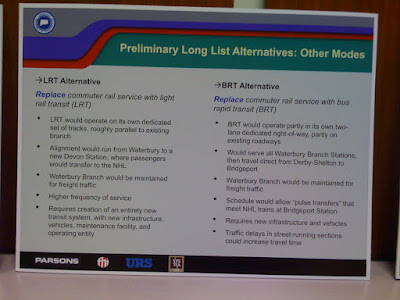
The rest of the anger and frustration stems from the way Waterbury has been shafted by the DOT for decades. The tiny little bit of barely-acceptable service we have has come from the persistent efforts of individual representatives (Beamon) who demanded that we have things like a platform, and individual train riders (I didn't catch her name) who call repeatedly to complain about cars being broken into, the train toilets being broken or lacking toilet paper, and so on. As Sen. Hartley pointed out, we have been trying to get the train line improved for decades, and so far all we've gotten are more studies and no action.
At the meeting, I was a little concerned by the fact that the consultants suggesting improvements to the train line are not working in conjunction with the consultants planning the improvements to the station, just as those consultants don't know for certain what will be happening with the rebuilding of the mixmaster, and none of those consultants seems to be aware of plans to construct a greenway along much of the train and highway routes, just as whoever is responsible for the selection of South Main Street as a likely location for the Chestnut Hill Bioenergy clearly has no clue about development plans for improving that neighborhood which would be derailed by sticking a garbage facility there. This level of chaos is a terrible way to go about planning anything.
Back to my comments on the Feasibility Study:
Do It Now!
This latest study has identified things that can and should be done right now. The primary improvement, in my mind, is the installation of signals along the line. The Waterbury line is used by passenger and freight trains without a signal system, which is why the passenger train schedule is so terrible--there is only one track and it is not safe to have more than one train on the track at the same time, even if they are going in the same direction. Without signals, there would be a collision. My understanding from last night's meeting is that if we install the signals, we can add more trains to the passenger schedule.
If we had a decent freight yard in Waterbury (in other words, if all those rusting tracks to the west of the track that gets used were reactivated), they could store passenger trains in Waterbury and thereby run more trains every day. This is how they were able to add the early-morning commuter train. When the 5:57 from Waterbury arrives at Bridgeport, the 6:40 from Waterbury is ready to depart.
I'd also like to see some upgrades to the trains themselves. Some are in good condition, but all of the toilets are terrifying, to be used only in desperation. I've noticed recently that some of the passenger seats are being randomly recovered in fabric--bad idea! The NJ Transit trains have fabric seats, which absorb all of the sweat and grime from people sitting in them. It's disgusting.
Safety at the Waterbury station could be improved right now. Tear down the abandoned building blocking the view from the street, reducing the likelihood of car being broken into. Patrol the lot regularly, not just when we complain. Keep the lot clean! The broken glass gets swept up once or twice a year. Why not contract with the city to have the street sweeper come through on a regular basis?
Improve signage for the parking lot. First time train riders can never figure out how to get to the parking lot, even if someone has explained it to them. The entrance is hidden between the little white bank building and the non-usable mini-lot.
Spend some money marketing the train. Make the quick and easy improvements to the trains and parking lot, then promote the trains. Make sure people know they exist. Make sure people know how much cheaper it is to take the train. Make sure people realize that time spent on the train is time you can spend reading, working, watching a DVD and relaxing (as opposed to driving, which is time spent driving and getting stressed out by traffic).
Do It SOON!
Electrify the Waterbury line. It boggles the mind that we have to rely on a diesel engine to go back and forth on those 27 miles of track.
Add a second track. The presenters last night seemed to think this was impossible, as there are too many bridges involved, but they also think they can build a two-lane bus road alongside the tracks for the full length, so maybe it's not that impossible after all. At the very least, add a second track along enough of the line for trains to pass one another. We need more trains.
Don't Do These At All
My outrage last night stemmed largely from the proposals to replace the train with buses. This is a terrible idea for several reasons.
Buses that use the regular highway system offer no improvements for riders. We'd still get stuck in traffic during rush hour, thereby missing our connecting train in Bridgeport, making us late for work or, worse, late for our flight at JFK or LaGuardia. (I've taken the train from Waterbury when I have a flight leaving from JFK. It's the best way to get there. You take the train to Grand Central, then hop on either a shuttle bus or the subway to the airport. No stress, no parking fees, and it can take less time than driving.)
Constructing a special roadway just for the buses seems incredibly wasteful. It will take up more space than adding a second track to the train line and adds more cost, both financial and environmental, in the long run. How many bus tires will be added to dumps when they wear out? Will the buses be electric or diesel? What type of buses will they be? (I asked this question and was told that they hadn't gotten that far yet). You can't beat the train for passenger comfort, even with a coach bus. Buses are always cramped and claustrophobic. I have a tendency to get motion sickness on buses, but never have that problem with trains.
Come to think of it, if I enjoyed taking the bus, I'd already be doing that. In fact, replacing the train with an express bus is pointless for anyone going to NYC. We already have buses (and nice ones at that) which go there from Waterbury.
Public Feedback
Try a little harder to get public feedback. At the meeting last night, we were told that the consultants surveyed passengers between 6 and 8 a.m. on one day last fall. I guess that must have been one of the days when I wasn't commuting, because I was not surveyed (or did they miss me because I was on the 5:57 and they didn't start until after that?). Ridership to/from Waterbury is highest on weekends (when there are fewer trains), and the survey missed all of those people.
They also did a phone survey, trying to find people who don't take the train. Again, I think they missed a few demographics. I know a lot of people in the Waterbury area who drive to White Plains and take the train from there because it is a nicer train experience. I know a lot of other people who don't take the train from Waterbury because the last train home is at 9:07 p.m., which means you can't take the train if you want to go to NYC for the evening. I'm not sure those concerns were reflected in their phone survey results.
Why not do a survey that is published in the newspaper and on the train and buses for a month? Then you'd really get a good result.
Final Thoughts
We need improved train service. Trains, not buses.
The DOT needs to treat Waterbury with more respect. Every time Waterbury residents demand improved public transportation, we hear the same basic illogical response. The city buses don't run past 6 p.m. because no one takes the bus after 6 p.m. (even though we keep requesting that the buses run past 6 p.m.). Not enough people take the train to justify spending money on making the train worth taking. Completely illogical. Make the train worth taking, promote the train, then a ton more people will take the train.
Don't keep us waiting. As someone said at the meeting last night, we needed these improvements yesterday.
For those of you who weren't able to attend the meeting, the Feasibility Study information and documents are available online at www.waterbury-newcanaanrail.org. They are accepting comments from the public if they are mailed before July 20 to:
Waterbury and New Canaan Branch Lines Needs and Feasibility Study
Andrew H. Davis, Transportation Planner II
Connecticut Department of Transportation
2800 Berlin Turnpike
Newington, CT 06131-7456
You can also email your comments, presumably to Mr. Davis (there's a comment form on the website, but also his email address) at andrew.h.davis@po.state.ct.us.
Okay, time for my comments.
I use the train to commute to NYC, but not on a daily basis. Much of the time I work from home. When I do commute, it's intense, every day for several weeks at a time and frequently very long days. In order to arrive at the office at 9:30, I need to take the 6:40 a.m. train from Waterbury. At the end of the day, if I can get out of the office quickly enough and then race to the station, I can catch the 6:42 p.m. train and get home at 9:30 p.m. If I miss the 6:42, which often is the case, I have to wait for the 9:07 and don't get home until 11:30 p.m. Sometimes the train to Waterbury isn't running (which will happen for at least a month this summer), so at the end of a very long day, when I would like to be napping, I'm packed in like a sardine onto a city bus with no room to move, no toilets, not enough seats for everyone, and no ability to relax or rest.
When the Waterbury train is taken offline this summer, I might very well drive to Bridgeport, rather than take that awful bus. The downside is that I'll have to drive home late at night when I am tired, which I am not happy about, but I'll have more flexibility for getting home early.
The Meeting Last Night
First of all, I think part of the anger and frustration last night stemmed from the information being poorly presented. At some point later in the meeting, it was implied that the long list of options was created to satisfy funding requirements--if the DOT requests funds to expand the train line, they need to prove that they have examined all of the alternatives, even if some of those alternatives are absolutely terrible. On the other hand, if they are seriously considering building a roadway alongside the train tracks to be used by buses, they are insane.

The rest of the anger and frustration stems from the way Waterbury has been shafted by the DOT for decades. The tiny little bit of barely-acceptable service we have has come from the persistent efforts of individual representatives (Beamon) who demanded that we have things like a platform, and individual train riders (I didn't catch her name) who call repeatedly to complain about cars being broken into, the train toilets being broken or lacking toilet paper, and so on. As Sen. Hartley pointed out, we have been trying to get the train line improved for decades, and so far all we've gotten are more studies and no action.
At the meeting, I was a little concerned by the fact that the consultants suggesting improvements to the train line are not working in conjunction with the consultants planning the improvements to the station, just as those consultants don't know for certain what will be happening with the rebuilding of the mixmaster, and none of those consultants seems to be aware of plans to construct a greenway along much of the train and highway routes, just as whoever is responsible for the selection of South Main Street as a likely location for the Chestnut Hill Bioenergy clearly has no clue about development plans for improving that neighborhood which would be derailed by sticking a garbage facility there. This level of chaos is a terrible way to go about planning anything.
Back to my comments on the Feasibility Study:
Do It Now!
This latest study has identified things that can and should be done right now. The primary improvement, in my mind, is the installation of signals along the line. The Waterbury line is used by passenger and freight trains without a signal system, which is why the passenger train schedule is so terrible--there is only one track and it is not safe to have more than one train on the track at the same time, even if they are going in the same direction. Without signals, there would be a collision. My understanding from last night's meeting is that if we install the signals, we can add more trains to the passenger schedule.
If we had a decent freight yard in Waterbury (in other words, if all those rusting tracks to the west of the track that gets used were reactivated), they could store passenger trains in Waterbury and thereby run more trains every day. This is how they were able to add the early-morning commuter train. When the 5:57 from Waterbury arrives at Bridgeport, the 6:40 from Waterbury is ready to depart.
I'd also like to see some upgrades to the trains themselves. Some are in good condition, but all of the toilets are terrifying, to be used only in desperation. I've noticed recently that some of the passenger seats are being randomly recovered in fabric--bad idea! The NJ Transit trains have fabric seats, which absorb all of the sweat and grime from people sitting in them. It's disgusting.
Safety at the Waterbury station could be improved right now. Tear down the abandoned building blocking the view from the street, reducing the likelihood of car being broken into. Patrol the lot regularly, not just when we complain. Keep the lot clean! The broken glass gets swept up once or twice a year. Why not contract with the city to have the street sweeper come through on a regular basis?
Improve signage for the parking lot. First time train riders can never figure out how to get to the parking lot, even if someone has explained it to them. The entrance is hidden between the little white bank building and the non-usable mini-lot.
Spend some money marketing the train. Make the quick and easy improvements to the trains and parking lot, then promote the trains. Make sure people know they exist. Make sure people know how much cheaper it is to take the train. Make sure people realize that time spent on the train is time you can spend reading, working, watching a DVD and relaxing (as opposed to driving, which is time spent driving and getting stressed out by traffic).
Do It SOON!
Electrify the Waterbury line. It boggles the mind that we have to rely on a diesel engine to go back and forth on those 27 miles of track.
Add a second track. The presenters last night seemed to think this was impossible, as there are too many bridges involved, but they also think they can build a two-lane bus road alongside the tracks for the full length, so maybe it's not that impossible after all. At the very least, add a second track along enough of the line for trains to pass one another. We need more trains.
Don't Do These At All
My outrage last night stemmed largely from the proposals to replace the train with buses. This is a terrible idea for several reasons.
Buses that use the regular highway system offer no improvements for riders. We'd still get stuck in traffic during rush hour, thereby missing our connecting train in Bridgeport, making us late for work or, worse, late for our flight at JFK or LaGuardia. (I've taken the train from Waterbury when I have a flight leaving from JFK. It's the best way to get there. You take the train to Grand Central, then hop on either a shuttle bus or the subway to the airport. No stress, no parking fees, and it can take less time than driving.)
Constructing a special roadway just for the buses seems incredibly wasteful. It will take up more space than adding a second track to the train line and adds more cost, both financial and environmental, in the long run. How many bus tires will be added to dumps when they wear out? Will the buses be electric or diesel? What type of buses will they be? (I asked this question and was told that they hadn't gotten that far yet). You can't beat the train for passenger comfort, even with a coach bus. Buses are always cramped and claustrophobic. I have a tendency to get motion sickness on buses, but never have that problem with trains.
Come to think of it, if I enjoyed taking the bus, I'd already be doing that. In fact, replacing the train with an express bus is pointless for anyone going to NYC. We already have buses (and nice ones at that) which go there from Waterbury.
Public Feedback
Try a little harder to get public feedback. At the meeting last night, we were told that the consultants surveyed passengers between 6 and 8 a.m. on one day last fall. I guess that must have been one of the days when I wasn't commuting, because I was not surveyed (or did they miss me because I was on the 5:57 and they didn't start until after that?). Ridership to/from Waterbury is highest on weekends (when there are fewer trains), and the survey missed all of those people.
They also did a phone survey, trying to find people who don't take the train. Again, I think they missed a few demographics. I know a lot of people in the Waterbury area who drive to White Plains and take the train from there because it is a nicer train experience. I know a lot of other people who don't take the train from Waterbury because the last train home is at 9:07 p.m., which means you can't take the train if you want to go to NYC for the evening. I'm not sure those concerns were reflected in their phone survey results.
Why not do a survey that is published in the newspaper and on the train and buses for a month? Then you'd really get a good result.
Final Thoughts
We need improved train service. Trains, not buses.
The DOT needs to treat Waterbury with more respect. Every time Waterbury residents demand improved public transportation, we hear the same basic illogical response. The city buses don't run past 6 p.m. because no one takes the bus after 6 p.m. (even though we keep requesting that the buses run past 6 p.m.). Not enough people take the train to justify spending money on making the train worth taking. Completely illogical. Make the train worth taking, promote the train, then a ton more people will take the train.
Don't keep us waiting. As someone said at the meeting last night, we needed these improvements yesterday.
Thursday, June 11, 2009
Twelfth Night

It's that time again! The Fifth Annual Shakespeare in Library Park performances will be held on six nights, Thursday through Saturday, June 18-20 and June 25-27. Performances begin at 7 p.m., picnicking starts at 6:30. It's always a great event, so don't miss out!
Tuesday, June 09, 2009
Death Row
Some disturbing statistics: Connecticut is tied with Texas(!) for the highest percentage (70%) of death row inmates who are minorities, and half of Connecticut's death row inmates come from Waterbury, even though we have only 3% of the state's population (see http://www.allamericanpatriots.com/48753351-naacp-decries-connecticut-governor-jodi-rell-for-veto-of-anti-death-penalty-legi# for that stats and story).
Considering that a good portion of the rest of the state loves to hate Waterbury, is someone from Waterbury more likely to receive a death sentence because he or she is from Waterbury?
Monday, June 08, 2009
Garden Days
The weather this weekend was beautiful, and I've been too busy to keep up with my yard work until now, so I brought the weed whacker, rake, clippers and gloves up from the basement and did what I could to bring some order to my yard. I am not a gardening expert by any stretch of the imagination, but for the most part I can tell the difference between weeds and things I planted last year.
Weeds are amazing. They sprout up everywhere and grow SO fast! Does anyone know what this yellow flower is? It "bleeds" orange dye.

The downside to pulling up the weeds: the trash that blows into my side yard from the neighboring corner store becomes very visible.

Rogozhin carefully supervised all my activities by lying down wherever I was working. When I took a break and put my gloves on the ground, he stretched himself out on top of them almost immediately.

Here's the post-weeding, pre-litter pick up view alongside the garage. Fortunately, this part of the yard is hidden by a privacy fence--it would have been very funny if the blight patrol had cited me for overgrown weeds potentially harboring rats, considering that the weeds were mostly harboring cats (my cats, the neighbors' cats, stray cats....).

The fern growing wild in the side yard is still going strong. It was one of several pleasant surprises when I bought the house two years ago. After I cleared out the weeds back then, and picked up all the garbage, I found that I had a fern, some trillium, and wisteria vines snaking everywhere. This is one of the things I like about Waterbury--it's a city, but it's still full of Nature.

A bonus for this year: one of the carrots I planted last year is growing this year! Amazing! (Honestly, if anything I put in the ground fails to shrivel up and die, I'm amazed.)

Next weekend, assuming the weather is nice, I need to dig up the side yard and put down some sort of drainage system to cut back on the amount of fungus growing on the basement wall. I might even get really ambitious and try planting a vegetable garden again.
Weeds are amazing. They sprout up everywhere and grow SO fast! Does anyone know what this yellow flower is? It "bleeds" orange dye.

The downside to pulling up the weeds: the trash that blows into my side yard from the neighboring corner store becomes very visible.

Rogozhin carefully supervised all my activities by lying down wherever I was working. When I took a break and put my gloves on the ground, he stretched himself out on top of them almost immediately.

Here's the post-weeding, pre-litter pick up view alongside the garage. Fortunately, this part of the yard is hidden by a privacy fence--it would have been very funny if the blight patrol had cited me for overgrown weeds potentially harboring rats, considering that the weeds were mostly harboring cats (my cats, the neighbors' cats, stray cats....).

The fern growing wild in the side yard is still going strong. It was one of several pleasant surprises when I bought the house two years ago. After I cleared out the weeds back then, and picked up all the garbage, I found that I had a fern, some trillium, and wisteria vines snaking everywhere. This is one of the things I like about Waterbury--it's a city, but it's still full of Nature.

A bonus for this year: one of the carrots I planted last year is growing this year! Amazing! (Honestly, if anything I put in the ground fails to shrivel up and die, I'm amazed.)

Next weekend, assuming the weather is nice, I need to dig up the side yard and put down some sort of drainage system to cut back on the amount of fungus growing on the basement wall. I might even get really ambitious and try planting a vegetable garden again.
Wednesday, May 27, 2009
Waterbury, the new Wild West
After much consideration, I think I know what I think about the recent incidents in my neighborhood involving guns, fights and insufficient police presence (at the time--loads of police presence since then; my complaints brought an immediate strong and good response from the Mayor's office and from the Police Department). I had a lot of responses from the police, city officials, and private citizens in Waterbury and outside Waterbury, and I have had ample time to calm down and think things through rationally.
A response from J. Paul Vance, Jr. sums things up very well: "There are some areas of Waterbury that sometimes I wonder if we have just ceded to lawlessness and it is not acceptable." I think Vance is on to something with this idea.
Several people responded to my story with the insistence that police in suburban towns would have responded to the report of gunshots and to the report of groups of people fighting in the street with extreme presence: immediate convergence of five or six police cars, lights flashing and sirens wailing, followed by the police not leaving the neighborhood until they had figured out who to arrest or until everyone had gone inside for the night and order was firmly restored.
I'm still not sure what I think about that, since it sounds a little too much like a police state. But there's no denying the pervasive lawlessness that exists in Waterbury. There is an expectation that the Waterbury police won't do anything unless someone gets killed. There is an attitude, which seems to be widely-held, that there is no real law enforcement here. If you want the law enforced, you have to demand it.
For example, there is no enforcement of road laws and everyone knows it, which contributes to a Wild West feel in Waterbury. There have been fatal collisions caused by excessive speeding and by running of red lights. Speed limits and stop signs are in place for good reasons, and should not be ignored. But in Waterbury, there is no law, it's the Wild West, and if you have the audacity (for example) to obey the 25 mph speed limit while driving past Fulton Park on Cooke Street, which is typically narrow, lined with cars, and prone to small children running across the road, the chances are good that you'll end up with an infuriated driver behind you. If you're lucky, all that driver will do is pass you on the other side of the road (despite the fact that it's not a passing zone) while shouting insults at you. Imagine that: being punished for obeying the law.
There was a snippet article in today's Republican-American noting that the Board of Aldermen have voted to amend the city's noise control ordinance allowing police officers to use their discretion to determine if a noise is too loud, rather than relying on a decibel meter. While this sounds like a lovely thing, I wonder if it will have any effect. There is no neighborhood in Waterbury that isn't plagued by car stereos with the bass jacked up so much that your house's wall vibrate when they go by, but I have never seen any sign of the police doing anything about it. The snippet article (in the "Daily Digest") also noted that the updated ordinance gives residents a new way to complain to the police. Wild West again--the law is sitting back waiting to be told to do their jobs by outraged townfolk.
One person told me a story about a friend of his who phoned the police to report an incident on Congress Ave. (I think I'm remembering the street correctly) involving a violent fight between a couple. According to the story, it took the police 20 minutes to arrive. I can't vouch for any of the details of this story (let alone my memory of how it was related to me!), but the conclusion was that this never would have happened in a "nice" neighborhood or town.
This led me down another avenue of thought. What defines a "nice" neighborhood? Generally speaking, the "nice" neighborhoods have well-kept houses with no boards over windows, sidewalks that are in good condition and wide enough to use (WHY do so many sidewalks in Waterbury have telephone poles in the middle, making them unusable?), streets that are free from potholes, streets with fresh, easy-to-see, painted markings, and well-maintained landscaping.
In my neighborhood, there is a large number of boarded up, abandoned, decaying buildings. The sidewalks are mostly unusable, with sink holes in a number of places. The owner-occupied homes have decent landscaping, as do some of the tenant-occupied homes (although other tenant-occupied homes are in a terrible condition).
Last summer, the small children in my neighborhood (which, I should add, has no park; there is a very small playground at the WOW Center, but it is locked behind a gate) found most of their entertainment in destructive behavior. On one of the occasions when I scolded them, I asked them why they would try to tear down their own street. Their answer? "It's already trashed."
I can see their point. Eight years old, all they see is the decay and neglect. If the city doesn't care enough to take care of the neighborhood, why should they?
Litter is a huge problem in Waterbury, more than in other cities. As I understand it, the psychology is that people are more likely to litter if trash is already present. Like the eight-year-olds, are other people littering in Waterbury because they figure the city is already in such a state of decay, a little more trash won't hurt any?
My attitude is that I love this city, I love my neighborhood, I love my street, I love my home. I feel that I have a responsibility to make my house and yard look good because other people have to look at it. I do what I can to improve the city, because I think it's the right thing to do. I draw inspiration from the civic leaders of the past who made the city a better place. And I recognize that not everyone shares my viewpoint.
I think that Waterbury's future will be bright if we demand it. One of the many components of this is to get rid of the Wild West lawlessness. We need to demand a higher standard of behavior, and we need to expect that the laws will be enforced throughout the city, even in neighborhoods where the residents are afraid to complain.
Most of all, we need a public awareness campaign. We need to change the public sentiment in this city from "who cares?" to "I care, and I know I can make a difference." The city needs to do everything it can to get rid of the blight, but until a large majority of the residents understand the power of civic pride, progress will continue to move at a snail's pace.
A response from J. Paul Vance, Jr. sums things up very well: "There are some areas of Waterbury that sometimes I wonder if we have just ceded to lawlessness and it is not acceptable." I think Vance is on to something with this idea.
Several people responded to my story with the insistence that police in suburban towns would have responded to the report of gunshots and to the report of groups of people fighting in the street with extreme presence: immediate convergence of five or six police cars, lights flashing and sirens wailing, followed by the police not leaving the neighborhood until they had figured out who to arrest or until everyone had gone inside for the night and order was firmly restored.
I'm still not sure what I think about that, since it sounds a little too much like a police state. But there's no denying the pervasive lawlessness that exists in Waterbury. There is an expectation that the Waterbury police won't do anything unless someone gets killed. There is an attitude, which seems to be widely-held, that there is no real law enforcement here. If you want the law enforced, you have to demand it.
For example, there is no enforcement of road laws and everyone knows it, which contributes to a Wild West feel in Waterbury. There have been fatal collisions caused by excessive speeding and by running of red lights. Speed limits and stop signs are in place for good reasons, and should not be ignored. But in Waterbury, there is no law, it's the Wild West, and if you have the audacity (for example) to obey the 25 mph speed limit while driving past Fulton Park on Cooke Street, which is typically narrow, lined with cars, and prone to small children running across the road, the chances are good that you'll end up with an infuriated driver behind you. If you're lucky, all that driver will do is pass you on the other side of the road (despite the fact that it's not a passing zone) while shouting insults at you. Imagine that: being punished for obeying the law.
There was a snippet article in today's Republican-American noting that the Board of Aldermen have voted to amend the city's noise control ordinance allowing police officers to use their discretion to determine if a noise is too loud, rather than relying on a decibel meter. While this sounds like a lovely thing, I wonder if it will have any effect. There is no neighborhood in Waterbury that isn't plagued by car stereos with the bass jacked up so much that your house's wall vibrate when they go by, but I have never seen any sign of the police doing anything about it. The snippet article (in the "Daily Digest") also noted that the updated ordinance gives residents a new way to complain to the police. Wild West again--the law is sitting back waiting to be told to do their jobs by outraged townfolk.
One person told me a story about a friend of his who phoned the police to report an incident on Congress Ave. (I think I'm remembering the street correctly) involving a violent fight between a couple. According to the story, it took the police 20 minutes to arrive. I can't vouch for any of the details of this story (let alone my memory of how it was related to me!), but the conclusion was that this never would have happened in a "nice" neighborhood or town.
This led me down another avenue of thought. What defines a "nice" neighborhood? Generally speaking, the "nice" neighborhoods have well-kept houses with no boards over windows, sidewalks that are in good condition and wide enough to use (WHY do so many sidewalks in Waterbury have telephone poles in the middle, making them unusable?), streets that are free from potholes, streets with fresh, easy-to-see, painted markings, and well-maintained landscaping.
In my neighborhood, there is a large number of boarded up, abandoned, decaying buildings. The sidewalks are mostly unusable, with sink holes in a number of places. The owner-occupied homes have decent landscaping, as do some of the tenant-occupied homes (although other tenant-occupied homes are in a terrible condition).
Last summer, the small children in my neighborhood (which, I should add, has no park; there is a very small playground at the WOW Center, but it is locked behind a gate) found most of their entertainment in destructive behavior. On one of the occasions when I scolded them, I asked them why they would try to tear down their own street. Their answer? "It's already trashed."
I can see their point. Eight years old, all they see is the decay and neglect. If the city doesn't care enough to take care of the neighborhood, why should they?
Litter is a huge problem in Waterbury, more than in other cities. As I understand it, the psychology is that people are more likely to litter if trash is already present. Like the eight-year-olds, are other people littering in Waterbury because they figure the city is already in such a state of decay, a little more trash won't hurt any?
My attitude is that I love this city, I love my neighborhood, I love my street, I love my home. I feel that I have a responsibility to make my house and yard look good because other people have to look at it. I do what I can to improve the city, because I think it's the right thing to do. I draw inspiration from the civic leaders of the past who made the city a better place. And I recognize that not everyone shares my viewpoint.
I think that Waterbury's future will be bright if we demand it. One of the many components of this is to get rid of the Wild West lawlessness. We need to demand a higher standard of behavior, and we need to expect that the laws will be enforced throughout the city, even in neighborhoods where the residents are afraid to complain.
Most of all, we need a public awareness campaign. We need to change the public sentiment in this city from "who cares?" to "I care, and I know I can make a difference." The city needs to do everything it can to get rid of the blight, but until a large majority of the residents understand the power of civic pride, progress will continue to move at a snail's pace.
Tuesday, May 26, 2009
More on Chestnut Hill
The more I learn about the proposed biofuel plant, the less I like about it. Turns out the company, Chestnut Hill, has a long, long list of environmental violations, not just the smell problem that was publicized.
One of the comments added to my blog post on the topic made a very good point: "If the local waste water treatment facility is not involved in the discussions, this plant could bring the existing WWTP to its knees. Smell is obviously a big issue, as is the compost on the back end. Folks love to call it organic but typically the compost is full of material that wouldn't digest, like plastics, glass, etc."
After all the things I've learned about Chestnut Hill and the logistics of the intended location on South Main Street, I have to say that I am firmly against the plan as it currently stands.
For more (and more informed) reading on the topic, visit the Waterbury Observer blog for an article from May 14 by John Murray. Also visit the blog of Bryan P. Baker, who is a member of Waterbury's Environmental Commission, has been following the topic very closely and has posted several times regarding his thoughts on the matter.
One of the comments added to my blog post on the topic made a very good point: "If the local waste water treatment facility is not involved in the discussions, this plant could bring the existing WWTP to its knees. Smell is obviously a big issue, as is the compost on the back end. Folks love to call it organic but typically the compost is full of material that wouldn't digest, like plastics, glass, etc."
After all the things I've learned about Chestnut Hill and the logistics of the intended location on South Main Street, I have to say that I am firmly against the plan as it currently stands.
For more (and more informed) reading on the topic, visit the Waterbury Observer blog for an article from May 14 by John Murray. Also visit the blog of Bryan P. Baker, who is a member of Waterbury's Environmental Commission, has been following the topic very closely and has posted several times regarding his thoughts on the matter.
Saturday, May 23, 2009
Buckingham Ramparage
The next time you're downtown, be sure to check out the new mural installed on the side of the Buckingham parking garage last week. The mural was painted recently as part of an after-school arts program in collaboration with Main Street Waterbury, which targeted improvements to downtown parking for their Ultimate Workplan last year.


Also installed recently as part of the improvement project is a public toilet in the garage; and recently launched is the website Downtown Waterbury Parking.


Also installed recently as part of the improvement project is a public toilet in the garage; and recently launched is the website Downtown Waterbury Parking.
Thursday, May 21, 2009
Bank Street Open House
Merchants on Bank and Grand Streets will be hosting an Open House on Thursday, May 28, 5-8 p.m. There will be a lot of great things to do and see. Bank Street will be closed to vehicle traffic for the event.
Friday, May 15, 2009
WTF?!?!
Tonight I'm sitting on the couch watching television with my dad who is visiting from Texas. An extremely loud gunshot goes off, shaking the house and making us duck for cover. My dad, who knows what he's talking about, verifies that it was in fact a gunshot. I call 911 and give them the location, that someone fired a gun on Wood Street near the corner of Oak Street. Five minutes later, a cop car drives down the street without stopping, without sirens, nothing. The street "party" is continuing as it did before the gunshot and before the cop.
My dad, needless to say, is very unhappy that I live in Waterbury. In any of the places he's lived, the police would have swarmed on the scene instantly. In Waterbury, where people are killed by guns, the police stroll by and effectively ignore what's going on.
I've heard a lot of people say they will support the chief of police, Neil O'Leary, if he runs for mayor. Yes, the PAL program is good. Everything else I've seen is absolutely inadequate.
My dad, needless to say, is very unhappy that I live in Waterbury. In any of the places he's lived, the police would have swarmed on the scene instantly. In Waterbury, where people are killed by guns, the police stroll by and effectively ignore what's going on.
I've heard a lot of people say they will support the chief of police, Neil O'Leary, if he runs for mayor. Yes, the PAL program is good. Everything else I've seen is absolutely inadequate.
Wednesday, May 13, 2009
So Where Are They?
There was a big ruckus on my street tonight. Maybe half a dozen people shouting and yelling, trying to get a fight going, right in the middle of the road, blocking traffic. I called the police, but they don't seem to have shown up. Half an hour after I called, the noise finally settled down by itself (although it sounds like it still might start back up). If the police did come by, I don't think they got out of the vehicle.
What bothers me the most is that there is some very obvious drug dealing that's been going on for the past six months or more. Where are the police? At least one of my neighbors has numerous visitors every day who pull up to the curb, get out of the car, go inside, come back out five minutes later and leave. (There's some shady stuff going on in one of the houses further down the street as well.) If that many people are coming here to buy drugs, shouldn't the police have figured it out by now and done something about it?
The Waterbury police department certainly deserves praise for the big city-wide busts they do a couple times a year, but where are they the rest of the time?
What bothers me the most is that there is some very obvious drug dealing that's been going on for the past six months or more. Where are the police? At least one of my neighbors has numerous visitors every day who pull up to the curb, get out of the car, go inside, come back out five minutes later and leave. (There's some shady stuff going on in one of the houses further down the street as well.) If that many people are coming here to buy drugs, shouldn't the police have figured it out by now and done something about it?
The Waterbury police department certainly deserves praise for the big city-wide busts they do a couple times a year, but where are they the rest of the time?
Subscribe to:
Posts (Atom)


